Nimes
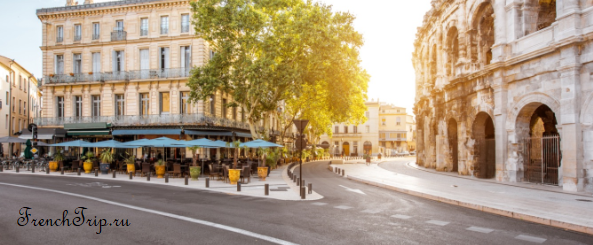
Nîmes has more standing Roman architecture than any other city in France. It was the capital of a Gaulish tribe until the Roman conquest in 121 BC; Augustus then founded a new city on the site, and its position in wine country plus imperial privileges made it one of the largest towns in southern Gaul within a century.
The prosperity did not last — Visigoths and Vandals sacked it in the fifth century, and the Arabs after them — but the buildings did. The historic ensemble is UNESCO-listed.
Nîmes sits on the boundary between Occitanie and Provence, which is why it feels like both.
Denim was invented here
The blue cotton twill made in the city was known as serge de Nîmes — shortened, in America, to denim. The cloth was shipped through Genoa, whose sailors gave the trousers their other name: gênes, jeans. Both words come from this part of the Mediterranean, and one of them from this city directly.
What to see
Les Arènes
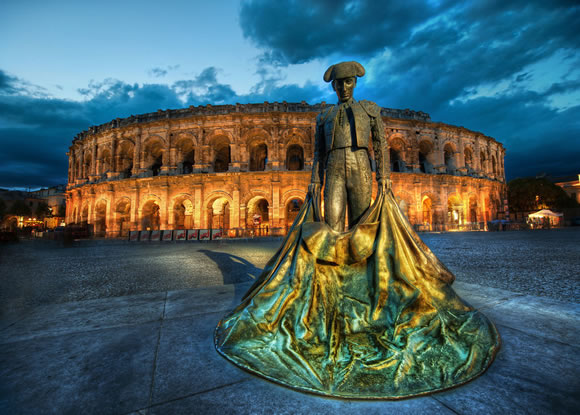
The amphitheatre is the best-preserved Roman arena anywhere. Built around 70 AD, two tiers of sixty arches, and it still holds 16,000 people — which is the unusual part: it is not a ruin but a working venue. Concerts happen here; Metallica, Rammstein and Depeche Mode have all played inside it, and the bullfights during the férias fill it twice a year.
Maison Carrée
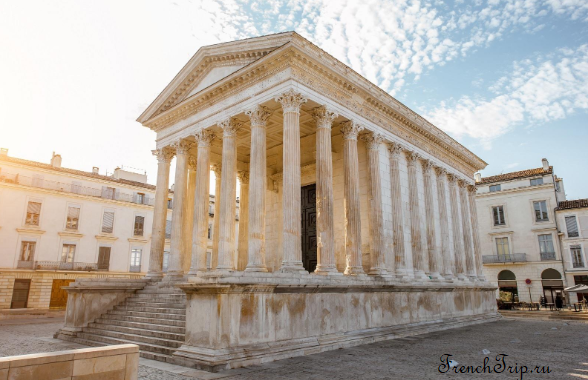
A Roman temple from the first century BC, and one of the most completely preserved anywhere in the former empire — it survived because it was continuously in use, as a church, a stable, a town hall and an archive. Thomas Jefferson admired it enough to model the Virginia State Capitol on it.
Tour Magne and the Jardins de la Fontaine
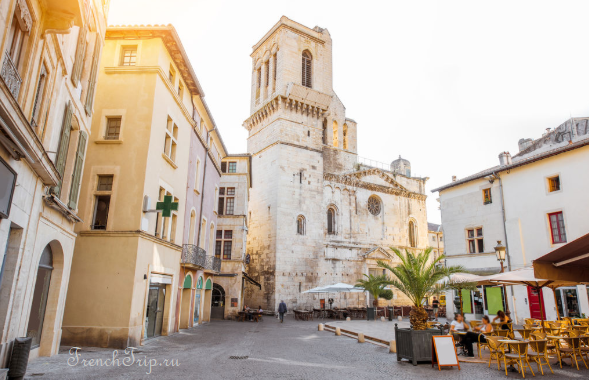
The gardens were laid out in the eighteenth century around the spring the Romans built their sanctuary on — one of the first public parks in Europe. The path climbs from them to the Tour Magne, a tower from the Augustan walls, with the view over the city and the countryside towards the Cévennes.
Temple de Diane and Porte d’Auguste
The so-called Temple of Diana stands in the corner of the gardens — nobody is certain what it was, probably a library attached to the sanctuary. The Porte d’Auguste is one of the original city gates, from 15 BC.
Musée de la Romanité
The modern museum facing the arena, opened in 2018, holds the mosaics and everyday objects that explain what all the monuments were for. The rooftop terrace looks straight across at the amphitheatre.
Pont du Gard
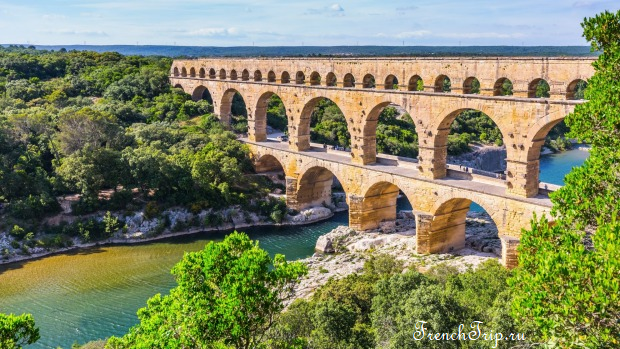
Half an hour north-east stands the reason Nîmes had water: the Pont du Gard, the highest Roman aqueduct bridge ever built at 49 metres, and part of a 50 km channel that fell just 12 metres over its whole length to bring water into the city. UNESCO-listed, and the most impressive single Roman structure in France.
Buses run from Nîmes in season; a car is easier. It is also an easy trip from Avignon on the other side.
The férias
Twice a year — at Pentecost and in September — Nîmes holds its férias: several days of bullfighting in the arena, bodegas in the streets, and a city that does not sleep. It is the largest event of its kind in France and the town’s population multiplies.
Worth knowing whichever way you feel about it: if you want to see it, book months ahead; if you would rather not, avoid those weeks entirely.
Getting to Nîmes
- By train — Nîmes Centre is a short walk from the arena, with TGV services from Paris in about 3 hours and regional trains to Montpellier (30 min), Avignon (30 min) and Marseille (1 h 15). The separate Nîmes Pont-du-Gard TGV station is 10 km out — check which one your ticket says.
- By air — Nîmes-Alès airport has limited services; Montpellier and Marseille are the practical airports.
- By car — the A9 passes the city. The centre is compact and largely pedestrian; use the car parks on the ring. See parking in France.
The centre is small enough that everything above is within twenty minutes’ walk of everything else.
What to eat
Nîmes cooking sits between Provence and Languedoc. The local specialities are brandade de morue — salt cod whipped with olive oil and milk, invented here in the eighteenth century — and the gardiane de taureau, a stew of bull meat from the Camargue with red wine and olives.
The Camargue also supplies rice and salt, and the surrounding hills the Costières de Nîmes wines. See the cooking of Occitanie and wine routes in France.
Around Nîmes
- Pont du Gard — half an hour, and unmissable
- Avignon — 30 minutes by train; see the Avignon guide
- Arles — 30 minutes, with its own Roman arena and the Van Gogh sites
- The Camargue — the delta south of the city, with flamingos, white horses and Saintes-Maries-de-la-Mer
- Uzès — a ducal town 25 km north, with one of the best markets in the south
When to go
Spring and autumn. Nîmes is one of the hottest cities in France in summer — well over 35 °C in July and August, with little shade in the stone centre. May, June, September and October are far more comfortable, with the caveat about the féria weeks.
See Occitanie for the wider region.
Where to park in Nimes
| Car park | Spaces | Fee | From centre |
|---|---|---|---|
| Parking des Halles multi-storey | — | paid | 240 m |
| Parking des Arènes underground | — | paid | 280 m |
| Parking de la Coupole multi-storey | — | paid | 290 m |
| Place de l'Écluse | — | — | 400 m |
| Place de la Révolution | — | paid | 520 m |
| Place du Guesclin | — | — | 590 m |
| Place du 8 Mai 1945 | — | — | 650 m |
| Parking de la Sernam | 50 | — | 1.1 km |
Nearby
Other places on this site within easy reach, as the crow flies:
- Fontvieille — 31 km
- Aigues-Mortes — 33 km
- Les Baux-de-Provence — 36 km
- Villeneuve-lès-Avignon — 38 km
- Saint-Rémy-de-Provence — 38 km
- Châteauneuf-du-Pape — 45 km
Weather in Nimes
| Month | Day | Night | Rainfall |
|---|---|---|---|
| January | +11° | +3° | 64 mm |
| February | +13° | +3° | 40 mm |
| March | +17° | +6° | 45 mm |
| April | +20° | +9° | 67 mm |
| May | +24° | +12° | 55 mm |
| June | +28° | +16° | 43 mm |
| July | +32° | +19° | 30 mm |
| August | +31° | +19° | 44 mm |
| September | +26° | +15° | 100 mm |
| October | +21° | +12° | 95 mm |
| November | +15° | +7° | 97 mm |
| December | +12° | +4° | 53 mm |
This page in Russian: Nîmes (Ним)
Updated: