Les Baux-de-Provence
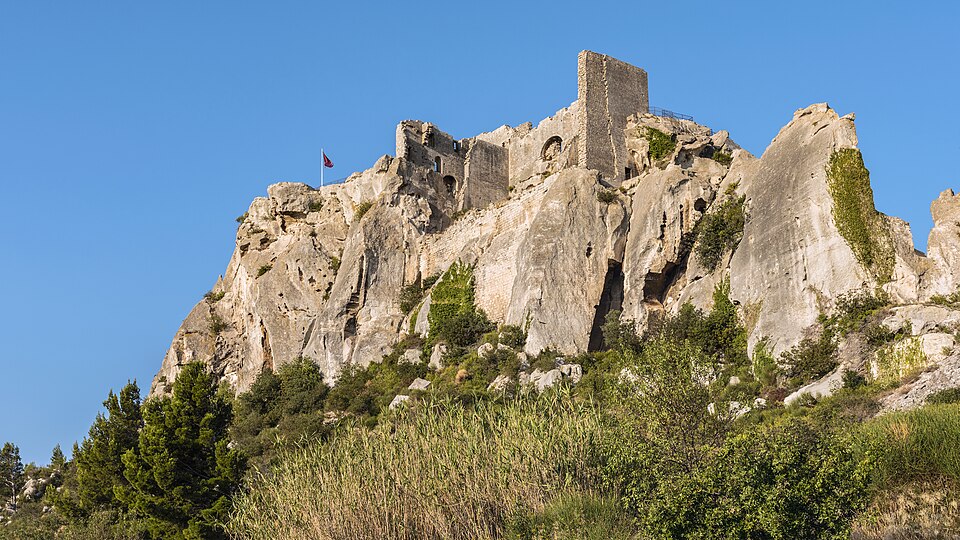
Les Baux-de-Provence is a village of about 300 people on a bare limestone crag in the middle of the Alpilles, with a ruined citadel occupying the whole southern half of the rock. It is one of the Most Beautiful Villages of France and one of the most visited places in Provence.
The name gave the world a word: bauxite, the ore of aluminium, was identified here in 1821 and named after the village.
History
The name itself is older: it comes from the Provençal word baou, a sheer rock, and refers to the spur the village and castle sit on, at around 245 m in the middle of the Alpilles ridge. On a clear day the top looks out over Arles, the Camargue and the whole of the Alpilles — one of the reasons the site was fortified in the first place.
The lords of Les Baux
The medieval lords of Les Baux claimed descent from Balthazar, one of the Magi, and put the star of Bethlehem on their arms. They were among the most powerful families in Provence, held some seventy fiefs, and were sufficiently troublesome that in 1631 Louis XIII ordered the castle and the walls demolished.
What is left is a shell — but an enormous one, cut half into the rock, with towers, a keep, a chapel, a dovecote and siege engines rebuilt full size on the plateau.
Before the demolition, Les Baux had been a seat of feudal and then royal justice: the Maison du Roy, in what is now the village, was built in 1499 as the seat of the lord’s court. The village once had a population of over 4,000; the old court building later became, among other things, a guardhouse and a school before ending up as the present-day tourist office.
The citadel
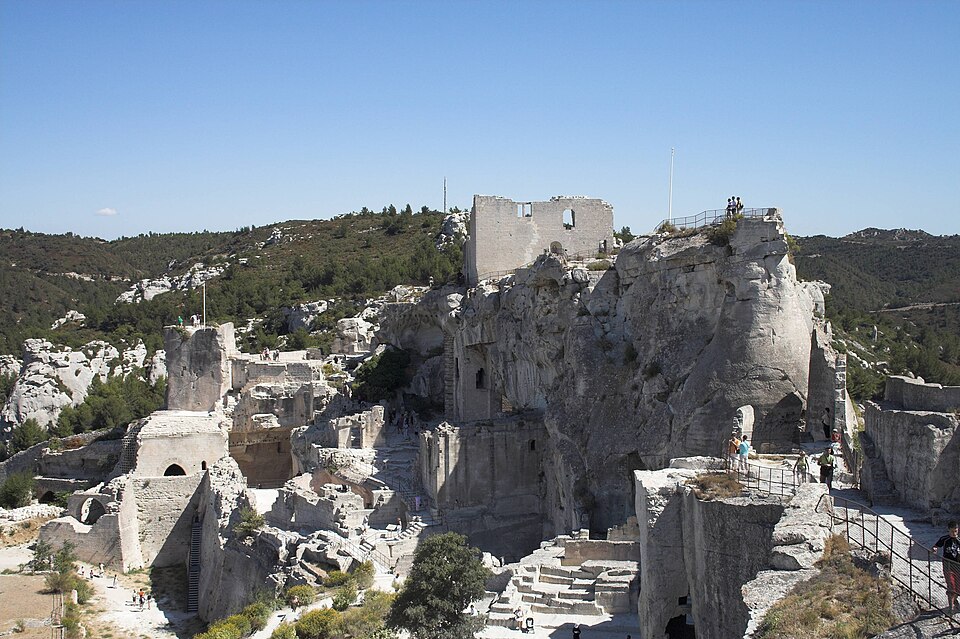
The ticketed site covers about seven hectares — most of the crag. Allow an hour and a half. It is entirely exposed: no shade, sheer drops, uneven rock, and the mistral funnels across it hard enough to be genuinely unpleasant. Shoes with grip, water, a hat.
The view from the edge takes in the Alpilles, the Camargue and, on a clear day, the sea.
Among the ruins stand full-size replica siege engines — a trebuchet, a ballista and a battering ram. The trebuchet is said to be the largest working one in France, able to throw a stone of 50 to 100 kg around 200 m, and it is fired regularly for visitors. A small Romanesque chapel on the site, Saint-Blaise, once used by the local wool-workers’ guild, now shows a short film of Provence seen from the air.
Two funerary monuments, known as the Tremaïe and the Gaïe, stand on the plateau’s eastern edge, reached by a narrow path. The larger of the two, set in a stone niche framed by pilasters, is traditionally said to show the two Saint Marys of Provençal legend and their servant Sarah.
The village
The lower half of the crag is the inhabited village: a single street of Renaissance houses, chapels and a church partly cut into the rock, and — inevitably — a great many shops. Roughly 1.5 million people a year pass through 300 residents, and the village has effectively become the approach to the castle.
The street runs past the Hôtel de Manville, a Renaissance mansion built in 1571 for a Protestant family and now the town hall, and the Church of St Vincent, a twelfth-century building whose south side is simply cut into the rock; inside are modern stained-glass windows and, in the Manville family’s burial chapel, flamboyant Gothic vaulting also hewn straight from the stone. Outside, a small round tower topped with a lantern — the lanterne des morts, or lantern of the dead — is said to have been lit whenever someone in the village died.
The old gate into the village, Porte Eyguières, kept that role until the mid-nineteenth century and opens onto the path down into the Fontaine valley. The arms of the Grimaldi family are carved above it: the princes of Monaco held the title of Marquis des Baux from the seventeenth century, and still hold it.
Opposite the Hôtel de Manville, a single carved window is all that survives of a mansion dated 1571, inscribed with the Calvinist motto Post Tenebras Lux — “after darkness, light”. Les Baux had a substantial Protestant community under the tolerant barons of the time, and the window is thought to be a relic of a temple that once stood on the site.
Two small museums sit on the street. The Musée Yves Brayer occupies the Hôtel de Porcelet, a late-sixteenth-century mansion that keeps its original façade and a carved hall painted with the four seasons and the four cardinal virtues; a fireplace medallion carries a fresco of the fall of Phaethon. The collection is a retrospective of Yves Brayer (1907–1990), a French painter of everyday life who travelled widely, including in Russia, and who later decorated the nearby Chapelle des Pénitents Blancs with murals of a Provençal nativity. Nearby, a museum of santons — the painted clay figures used in Provençal nativity scenes — occupies a building raised on the old ramparts and bought by the village in 1619; it holds pieces from Naples dating back to the seventeenth century alongside work by well-known local makers.
The Fondation Louis Jou, in the sixteenth-century Hôtel Jean de Brion, shows the work of the typographer who restored the building: his own typefaces, his press and engraving tools, and a collection of old books and prints, including engravings by Dürer and Goya. Jou first came to Les Baux in 1916 and settled here for good in 1942.
In the Fontaine valley below the village, the Pavillon de la Reine Jeanne is a small Renaissance garden pavilion, built for the wife of a sixteenth-century baron of Les Baux; the poet Frédéric Mistral later had a copy of it built over his own grave, at Maillane.
Carrières des Lumières
In a disused limestone quarry just outside the village, an immersive show projects paintings across the walls, floor and ceiling of the vast underground galleries, set to music. The rooms are 14 m high and the effect is genuinely impressive; the programme changes each year.
It is also cool, and it is the answer to what to do at Les Baux in the middle of a July afternoon.
Olive oil
The valley below produces Vallée des Baux-de-Provence AOP olive oil, one of the most highly regarded in France, and the mills around Maussane and Fontvieille sell direct and give tastings. This, and not the castle, is what most French visitors come back for.
See Provençal cuisine.
The village has its own wine appellation too, alongside the olive oil: Coteaux des Baux-de-Provence.
Getting to Les Baux
- By car — the only realistic way. 30 minutes from Arles, 40 from Avignon, 10 minutes from Saint-Rémy. The village is pedestrian; the car parks are below it and paid, and they fill by mid-morning in season.
- By bus — a seasonal service from Arles and Saint-Rémy, thin.
- By tour — day trips run from Avignon, Arles and Marseille.
See parking in France.
Around Les Baux
- Saint-Rémy-de-Provence — 10 km, with Glanum and Van Gogh
- The Alpilles — walking and cycling through white rock and olive groves
- Maussane and Fontvieille — the olive mills, and Daudet’s windmill
- Arles — 30 minutes, and the Camargue beyond it
- Gordes and Ménerbes — two more of the Most Beautiful Villages of France, further east in the Luberon
When to go
Spring and autumn, and early. Les Baux is at its worst in the middle of a summer day: no shade on the rock, the street packed, and nowhere to park. It is at its best in the first hour after opening, or in winter — cold, empty and vast.
The last stretch before closing is worth the same trick: the coach parties leave for dinner well before the gates shut, and on a still evening what is left of the citadel gets the low light, the birds and the quiet to itself.
Photo credits
Photographs on this page come from Wikimedia Commons under free licences:
- The crag and citadel — Christian Ferrer, CC BY-SA 4.0, via Wikimedia Commons
- The castle ruins — Ignis, CC BY-SA 3.0, via Wikimedia Commons


Weather in Les Baux-de-Provence
| Month | Day | Night | Rainfall |
|---|---|---|---|
| January | +10° | +1° | 51 mm |
| February | +11° | +1° | 33 mm |
| March | +16° | +4° | 41 mm |
| April | +19° | +7° | 59 mm |
| May | +23° | +11° | 56 mm |
| June | +28° | +14° | 34 mm |
| July | +31° | +16° | 23 mm |
| August | +30° | +16° | 30 mm |
| September | +25° | +13° | 80 mm |
| October | +20° | +10° | 86 mm |
| November | +14° | +5° | 94 mm |
| December | +10° | +2° | 47 mm |
Updated: