Lurs
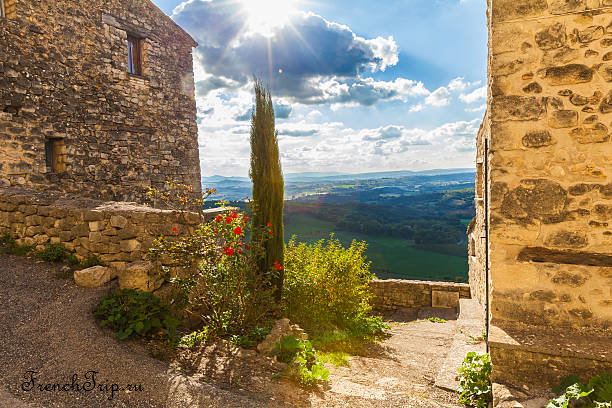
Lurs stands along a ridge high above the olive groves of the Durance valley, east of Forcalquier and north of Manosque, in the south-west of the Alpes-de-Haute-Provence.
Legend gives its founding to Charlemagne in the eighth century. What is certain is that the bishops of Sisteron had their summer residence here for the best part of a thousand years, and that the village was then almost completely abandoned — until the 1950s, when it was resettled, largely by printers, typographers and artists.
That is what makes Lurs unusual. It is a village saved by a profession.
The printers
In 1952 the typographer Maximilien Vox founded the Rencontres Internationales de Lure, an annual summer meeting on typography and the printed word that still runs and still draws designers from across Europe. Vox’s classification of typefaces — the one that groups them as Humanist, Garalde, Didone and so on — was formulated in this village.
The legacy is visible on the ground: the chemin des Écritures, a path lined with panels of lettering and inscriptions, runs along the ridge and is the best short walk in the village.
What to see
The view of the village, spread down the ridge, is visible before you reach the centre and is one of the sights in its own right. Start at the small square at the far end, where the tourist information point is, and work back: a single narrow road runs the length of Lurs and passes most of what there is to see, with a few smaller streets worth a detour.
Before entering the main village, a short walk in the other direction leads to the Chapelle Saint-Michel. The historic centre itself is entered through a stone gate beneath the fifteenth-century clock tower, topped by a traditional Provençal campanile.
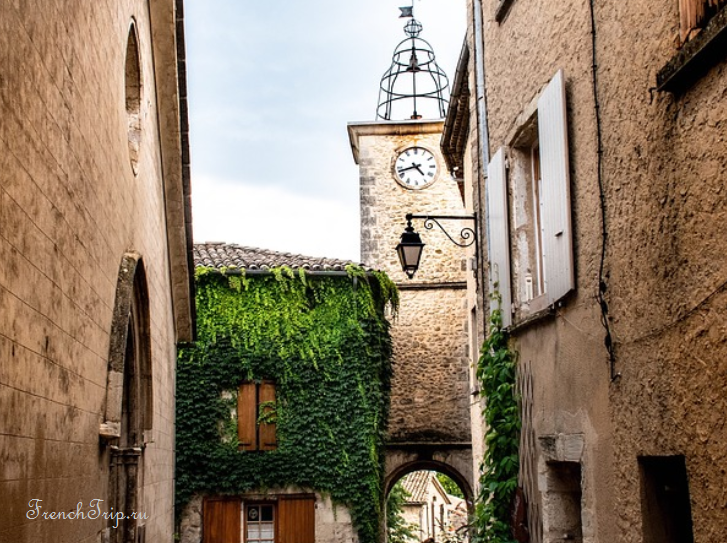
- The clock tower — with the oldest bell in the region, cast in 1499
- The bishops’ palace — in ruins, at the high end of the village
- Promenade des Évêques — the bishops’ walk along the ridge, lined with fifteen oratories, ending at the chapel of Notre-Dame-de-Vie with a view over the whole Durance valley
- Église Sainte-Croix — the parish church, fifteenth–sixteenth century
- Église Saint-Martin — twelfth century
- Théâtre Marius — an open-air theatre used in summer
- The old ice house and the oil mill — the working fabric of a village that made its living from olives
- Chapelle Notre-Dame-du-Plan
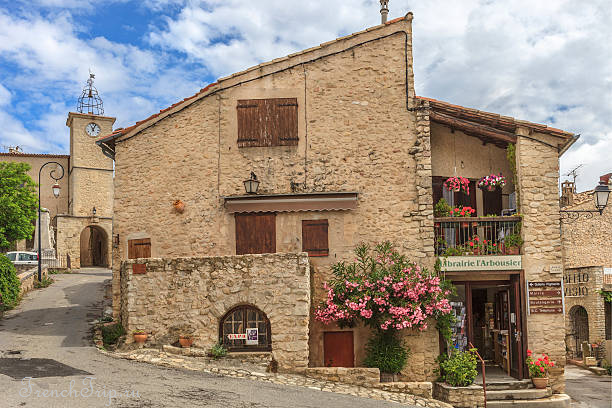
As in many small Provençal villages, it is Lurs as a whole that is the attraction rather than any single monument, and the historic centre bears this out: narrow streets are framed by carefully restored traditional houses, most of them dating from the seventeenth and eighteenth centuries, though some of the oldest are said to go back to the fifteenth. Just past the entrance stands the parish church, with a decorated doorway and a bell tower built into the facade that holds three bells. Saint-Martin, the other twelfth-century church, has for years served as a barn. Further on is the Chapelle des Pénitents, and then Théâtre Marius; there is also a memorial to villagers killed in the two World Wars.
At the far end of the village is the old château that once belonged to the bishops of Sisteron. Their palace was abandoned after the French Revolution, having been ravaged, and a former junior seminary of the diocese, founded in the 1680s, stands near the entrance to the village.
Chapelle Notre-Dame de Vie
The walk along the Promenade des Évêques is worth taking for itself: a few hundred metres along the ridge, with open views over lavender, olive and poppy fields and the hills beyond. The chapel at the end was built in 1552, destroyed during the Wars of Religion and rebuilt in 1662. A bell tower and an unexpected neoclassical porch with two columns were added in 1864, and the chapel still keeps a polychrome wooden statue of the Virgin.
The Roman bridge
On the boundary between Lurs and Ganagobie, in the Buès gorge, stands one of the oldest bridges in France — a single stone arch built to carry the Via Domitia between Segustero (Sisteron) and Alaunium. It has been a listed monument since 1963. Its older local name was the pont de l’homme mort, the dead man’s bridge.
Other Roman remains are scattered through the commune: an aqueduct, the foundations of villas.
The bridge stands where the Buès meets the Durance and once formed a small marsh there; the stream could also run high enough to block the road, so the Via Domitia was routed about 300 metres upstream of the direct line to cross it. Construction is dated to the early second century AD, begun under Hadrian — who toured Gaul with his engineers in 121–122 to improve the road network — and continued under Antoninus Pius, between 141 and 145.
The royal route, later the route nationale 96, carried traffic over the bridge until the middle of the nineteenth century, when an embankment was built across the marsh and the crossing was reduced to a secondary approach to Lurs. It had long been overlooked until the historian Guy Barruol identified it as the ancient bridge during a survey in 1963, the year it was listed.
The chapel of Notre-Dame-des-Anges
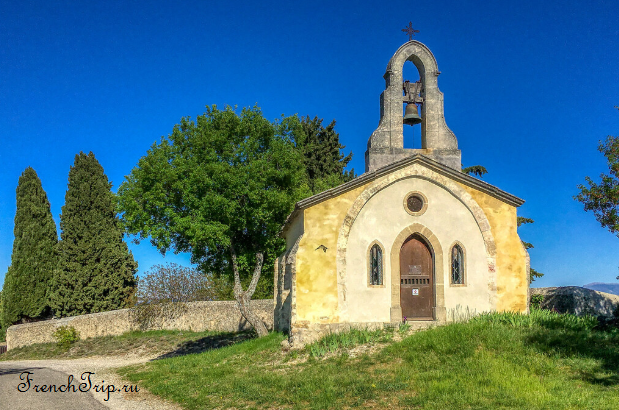
Twelfth-century, and a place of pilgrimage after the Black Death. It stands apart from the village on the old Roman road, and it is the sort of building — plain, small, precisely placed — that this part of Provence does better than anywhere.
The chapel stands on the site of the Roman town of Alaunium, and after a number of miracles were reported there its dedication changed from Notre-Dame d’Alaunion to Notre-Dame-des-Anges. The building seen today dates from 1662 to 1674, when it was built as the chapel of a Récollet monastery; six side chapels were added in the eighteenth century, and the chapel was substantially restored in the early 1750s. The square bell tower sits at the corner of the choir, which is raised above a crypt extending beyond the present building.
The Lurs murders
On 4 August 1952 the English scientist Sir Jack Drummond was murdered near Lurs, together with his wife and daughter. The case made national news. A local farmer, Gaston Dominici, was convicted in 1954; his death sentence was commuted and he was later released, and the verdict is still disputed.
Getting there
- By car — off the N96 in the Durance valley, then up. 15 minutes from Forcalquier, 25 from Manosque, 45 from Sisteron. See parking in France.
- Parking — outside the village; the lanes are for walking.
- By train — the nearest station is Lurs–La Brillanne in the valley, on the Marseille–Briançon line, with a steep 4 km up to the village.
Around
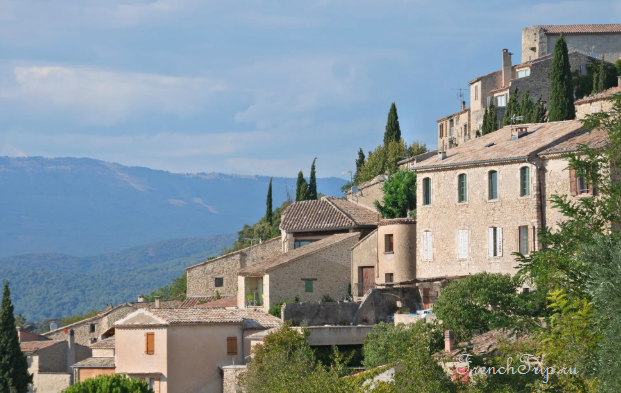
Lurs sees fewer visitors than the better-known villages of the Luberon to the west, and the towns and villages nearby keep more of an everyday, working character as a result.
- Prieuré de Ganagobie — 10 minutes, a Romanesque priory with twelfth-century floor mosaics that are among the finest in France
- Forcalquier — 15 km, with the Monday market
- Mane and the priory of Salagon — 20 minutes
- Manosque — 25 minutes, Giono’s town
- The Valensole plateau — 40 minutes, for the lavender in July
When to go
April to October. Lurs is small and quiet at any time, and there is very little in the way of shops or cafés — bring what you need. The ridge is windy and the views are best in the clear light after the mistral.
Lavender around Valensole and Manosque to the south flowers from about mid-June to mid-August.
See Provence and the most beautiful villages in France.
Nearby
Other places on this site within easy reach, as the crow flies:
- Riez — 23 km
- Moustiers-Sainte-Marie — 30 km
- Colorado Provençal — 32 km
- Sault — 39 km
- Saint-Saturnin-lès-Apt — 41 km
- Apt — 41 km
Weather in Lurs
| Month | Day | Night | Rainfall |
|---|---|---|---|
| January | +10° | +1° | 45 mm |
| February | +11° | +1° | 36 mm |
| March | +15° | +3° | 42 mm |
| April | +18° | +6° | 65 mm |
| May | +22° | +10° | 65 mm |
| June | +27° | +13° | 50 mm |
| July | +30° | +16° | 34 mm |
| August | +29° | +16° | 50 mm |
| September | +24° | +12° | 56 mm |
| October | +19° | +9° | 76 mm |
| November | +13° | +5° | 97 mm |
| December | +10° | +2° | 57 mm |
This page in Russian: Lurs (Люр)
Updated: