Valensole
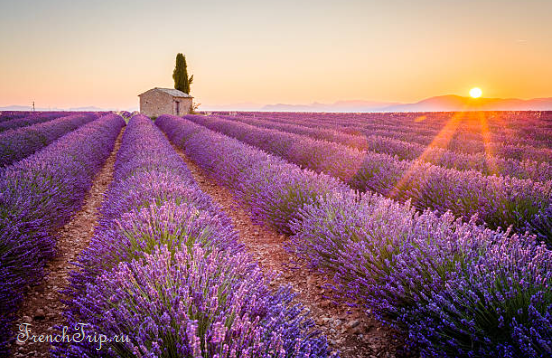
Valensole is a village of about 3,000 on a plateau east of Manosque, and its name has become shorthand for a photograph: rows of lavender running to the horizon, a stone farmhouse, a line of trees, and the Alps somewhere behind.
That plateau is about 800 km² of open farmland at 500 m, and it is the largest lavender-growing area in France.
The flowering
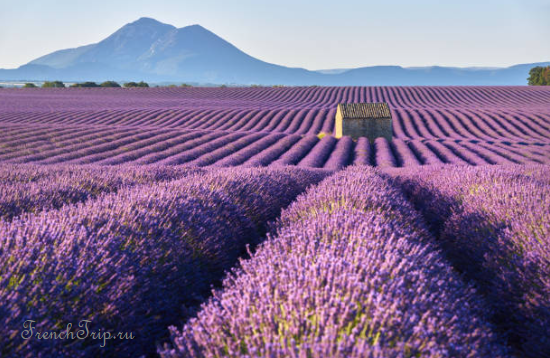
The single fact that decides your trip: Valensole flowers from about mid-June to mid-July, and the harvest often begins in the second week of July. A field photographed on Monday can be cut by Wednesday.
Dates move by a week or two with the season. Check the tourist office’s flowering bulletin a few days before you travel rather than trusting a fixed date — and if you can only come in late July, go to Sault instead, which flowers later.
Almost everything grown here is lavandin — the hybrid used for soap and detergent, which gives the dense uniform rows. True lavender needs altitude and grows at Sault. This does not make the fields less beautiful; it does mean the “lavender” oil in the shops is usually lavandin.
Where the fields are
Not in the village. The pictures are taken on the roads out of it:
- D6 towards Manosque — the classic run, with the farmhouses
- D8 towards Riez — wider fields, fewer cars
- D953 towards Puimoisson — the plateau at its most open
Drive slowly and stop in the marked places. In late June the roads carry a great deal of traffic doing exactly the same thing.
Rules that matter
- The fields are private property and a crop. Walking into the rows breaks the plants; growers have had enough trouble that some now fence and post guards. Photograph from the edge of the field.
- Do not fly a drone over farms without permission, and not at all near the Manosque research site.
- Bees. A flowering field is loud with them. They are uninterested in you, but do not stand in the middle of a row if you react badly to stings.
- Go at dawn or in the last hour of light. Midday flattens the colour and fills the verges with cars.
The village
Modest, and most visitors drive through it: a fountain, arcaded houses, and the Romanesque church of Saint-Blaise with a twelfth-century bell tower. There is a lavender museum, several producers selling honey and oil, and the Fête de la Lavande on the third Sunday of July, with the harvest floats.
Valensole also grows almonds, and is one of the largest producers in France — the blossom in March is a second, much quieter season.
Getting to Valensole
- By car — the only way. 20 minutes from Manosque, an hour from Aix, an hour and a half from Avignon.
- Nearest station — Manosque, 20 km, then a car.
- By tour — day trips run from Aix, Avignon and Marseille in season, and they solve the driving problem.
See parking in France.
Combining it
Valensole is on the road to the Gorges du Verdon, and the two make one day: lavender in the morning, the gorge in the afternoon, Moustiers-Sainte-Marie at the far end.
- Riez — a small town with four standing Roman columns in a field
- Lac de Sainte-Croix — the turquoise reservoir at the mouth of the gorge, 30 minutes
- Gréoux-les-Bains — the spa town, 20 minutes
When to go
Mid-June to early July, and no other time if lavender is the reason. Late July and August: cut fields. Spring: green rows. March: almond blossom, and the plateau to yourself.
See lavender in Provence.
Weather in Valensole
| Month | Day | Night | Rainfall |
|---|---|---|---|
| January | +10° | +1° | 45 mm |
| February | +11° | +1° | 36 mm |
| March | +15° | +4° | 42 mm |
| April | +18° | +6° | 65 mm |
| May | +22° | +10° | 65 mm |
| June | +27° | +14° | 50 mm |
| July | +30° | +16° | 34 mm |
| August | +30° | +16° | 50 mm |
| September | +24° | +12° | 56 mm |
| October | +20° | +9° | 76 mm |
| November | +13° | +5° | 97 mm |
| December | +10° | +2° | 57 mm |
Updated: