Le Havre
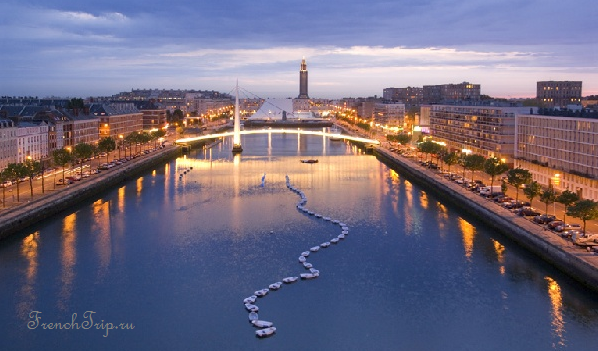
Le Havre is a port city of about 165,000 people in Normandy, where the Seine flows into the English Channel, some 200 km west of Paris. It is the largest city in Normandy and one of the largest ports in France. Its name simply means “the harbour”. For centuries it was the sea gate of Paris, where cargo from ocean ships was loaded onto barges for the trip up the Seine.
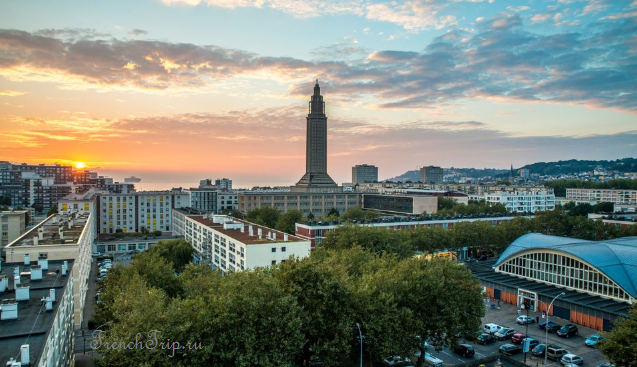
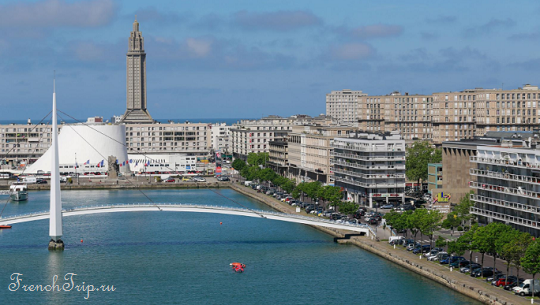
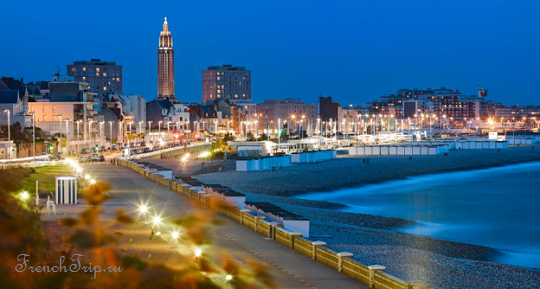
Le Havre is not a pretty old town: it was almost entirely destroyed in 1944 and rebuilt in concrete. But it is a fascinating and surprisingly beautiful example of post-war architecture, listed by UNESCO, with wide skies, long views of the sea and a remarkable light, the same light that gave its name to Impressionism.
A short history
King Francis I founded the port in 1517, on the marshes at the mouth of the Seine, to replace the old harbours of Harfleur and Honfleur, which were silting up. Le Havre grew rich on transatlantic trade, on coffee, cotton and, in the 18th century, the slave trade, and in the 19th and 20th centuries it was the great port for the liners to New York.
In September 1944, during the battle to free the port from the German army, Allied bombing destroyed almost the whole city centre: some 150 hectares, more than 12,000 buildings, and around 5,000 civilians killed. The French state entrusted its rebuilding to the architect Auguste Perret, a pioneer of reinforced concrete, in whose office the young Le Corbusier had once worked. Perret and his team rebuilt the centre between 1945 and 1964 on a regular grid, with wide avenues, open squares and buildings of a sober, classical concrete. In 2005 UNESCO added the rebuilt centre of Le Havre to the World Heritage list, as an outstanding example of post-war architecture and town planning. See UNESCO sites in France.
Le Havre and Impressionism
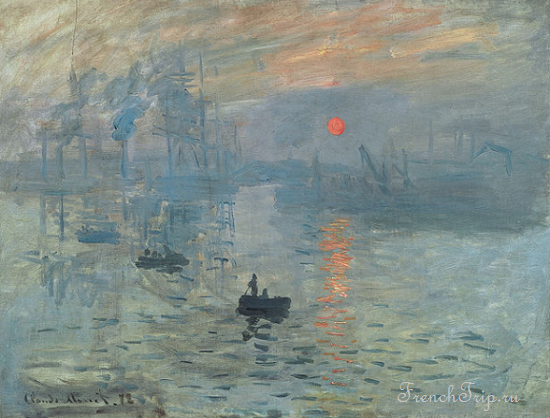
In 1872 Claude Monet, who had grown up in Le Havre, painted the port at dawn from a window overlooking the harbour. He called the picture Impression, Sunrise, and when it was shown in Paris two years later, a critic mocked the painters around Monet as “impressionists”. The name stuck. The painting is now in the Musée Marmottan in Paris.
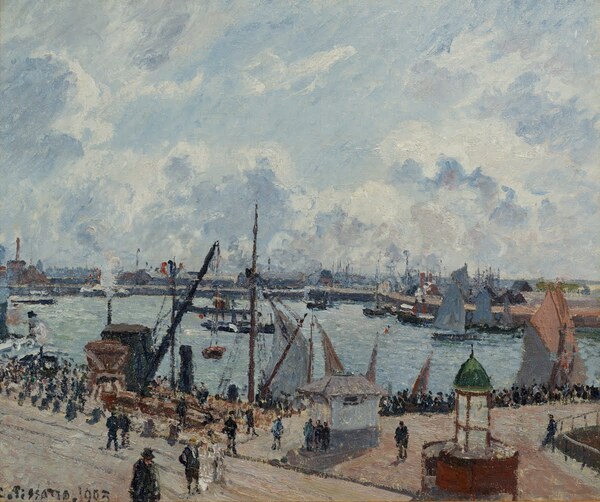
Monet’s first teacher, Eugène Boudin, born in nearby Honfleur, taught him to paint in the open air on the beaches of Le Havre. Later painters, among them Pissarro, Raoul Dufy, Othon Friesz and Georges Braque, who also grew up here, painted the port, the beach and the regattas. A signposted walk, the Impressionist trail, takes you to the places they painted. See French painters.
What to see
The rebuilt centre
- The church of Saint-Joseph, Perret’s masterpiece, finished in 1957. Its octagonal tower, 107 m high, is the landmark of the city and a beacon for ships. Inside, the tower is a lantern lit by more than 12,000 pieces of coloured glass, a breathtaking sight on a sunny day.
- The town hall, with its 72 m tower, on one of the largest squares in Europe.
- The Avenue Foch, the wide avenue from the town hall to the sea, and the Porte Océane at its end.
- The Perret show flat (Appartement témoin), a flat of the 1950s furnished as it was when the first families moved in, visited on guided tours from the tourist office.
The MuMa
The MuMa (Musée d’art moderne André Malraux), a glass building at the entrance to the port, has one of the largest collections of Impressionist painting in France after the Musée d’Orsay: Boudin above all, Monet, Pissarro, Sisley, Renoir and Degas, and the Fauves and painters of Le Havre such as Dufy and Friesz. Its big windows look straight onto the sea and the ships, the subject of many of the paintings inside.
Modern architecture
- Le Volcan, the white cultural centre shaped like a volcano designed by the Brazilian architect Oscar Niemeyer, opened in 1982, with the city library next to it.
- Les Bains des Docks, a swimming pool complex in a former warehouse by Jean Nouvel.
- Catène de containers, two arches of colourful shipping containers on the quay, put up in 2017 for the 500th anniversary of the city.
What survived from before the war
- The cathedral of Notre-Dame, of the 16th and 17th centuries, one of the few old buildings in the centre to survive the bombing.
- The Maison de l’Armateur, an 18th-century shipowner’s house built around a central light well, now a museum.
- The Graville abbey, the oldest building in Le Havre, on a hill above the city.
- The Hanging Gardens (Jardins suspendus), a garden of plants from around the world in a former fort on the cliff, with a view over the city and the estuary.
The beach
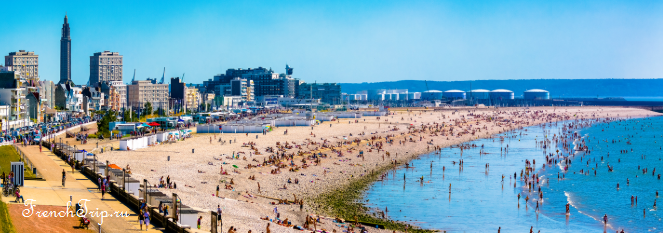
Le Havre has a long pebble beach, with beach huts, bars and a promenade, running north from the port to the resort of Sainte-Adresse at the foot of the cliffs.
Safety
- The beach is steep and of pebbles, with strong currents and big tides. Swim only on the supervised part of the beach in summer and follow the flags.
- Keep off the breakwaters and harbour walls in rough weather, when waves break over them.
- The cliffs of the Cap de la Hève, north of Sainte-Adresse, are crumbling: keep away from their edges and from the foot of the cliffs.
What to eat
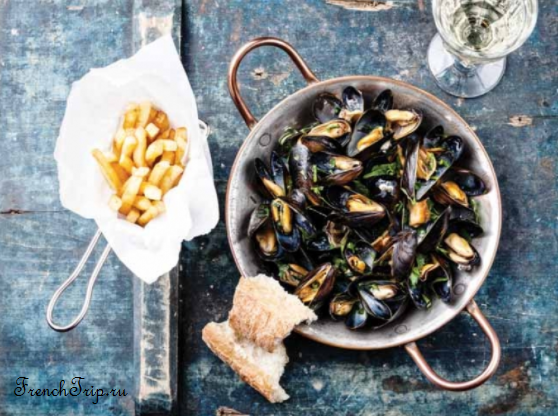
Le Havre is a seafood city: mussels with chips (moules-frites), sole, scallops in season and the fish of the Channel ports. Normandy adds its cream, butter and apples, its cheeses (Camembert, Pont-l’Évêque, Livarot and Neufchâtel), cider and calvados.
Getting there
- By train: direct trains from Paris Saint-Lazare take a little over two hours, and from Rouen under an hour. See trains in France.
- By ferry: ferries sail between Le Havre and Portsmouth in England.
- By car: Le Havre is at the end of the A29 and A131 motorways. The Pont de Normandie, a spectacular cable-stayed bridge over the Seine estuary, links it with Honfleur. Le Havre has a tram line and buses for getting around.
Where to park in Le Havre
| Car park | Spaces | Fee | From centre |
|---|---|---|---|
| Parvis Saint-Michel | 77 | paid | 310 m |
| Place du Chillou | 161 | paid | 330 m |
| Coty underground | — | — | 340 m |
| Place Jules Ferry | 130 | paid | 360 m |
| Oscar Niemeyer underground | 400 | paid | 390 m |
| Place des Halles Centrales | 122 | paid | 460 m |
| Parc de stationnement du Funiculaire underground | 470 | paid | 460 m |
| Arthur Honegger | 55 | paid | 530 m |
Around Le Havre
- Étretat, with its famous chalk cliffs and arches, half an hour’s drive up the coast.
- Honfleur, the old harbour town of the painters, across the Pont de Normandie, and the seaside resorts of Deauville and Trouville beyond.
- Rouen, the capital of Normandy, with its cathedral and its streets of half-timbered houses, an hour away.
See also the most beautiful places in Normandy.
Weather in Le Havre
| Month | Day | Night | Rainfall |
|---|---|---|---|
| January | +8° | +5° | 68 mm |
| February | +9° | +5° | 54 mm |
| March | +11° | +6° | 52 mm |
| April | +14° | +8° | 52 mm |
| May | +17° | +11° | 56 mm |
| June | +20° | +14° | 58 mm |
| July | +22° | +16° | 49 mm |
| August | +22° | +16° | 66 mm |
| September | +20° | +14° | 65 mm |
| October | +16° | +11° | 86 mm |
| November | +12° | +8° | 88 mm |
| December | +9° | +5° | 96 mm |
Updated: