Sainte-Maxime
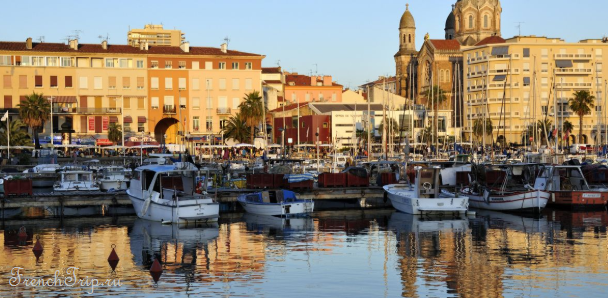
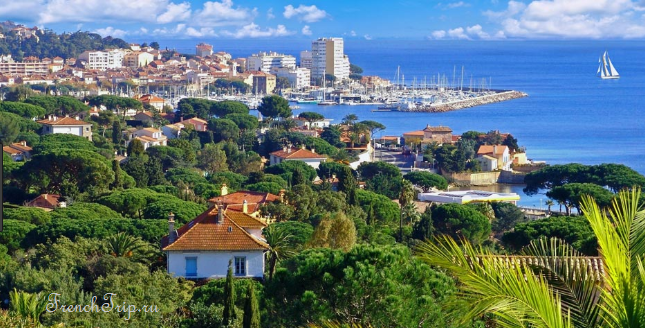
Sainte-Maxime sits on the north shore of the Gulf of Saint-Tropez, directly across the water from Saint-Tropez — and it is the practical answer to the problem Saint-Tropez creates.
The road round the gulf is one lane and jammed all summer. The boat across takes fifteen minutes. Staying here rather than there costs a fraction as much, and you can be on the other side before the traffic has moved.
History
Sainte-Maxime was founded around the year 1000 by monks from the Lérins Islands, off Cannes, who built an abbey and named the village after Maxime, one of the saints of their order. Fishing was the main livelihood for centuries; from the early nineteenth century, growing quantities of timber, cork, olive oil and wine from the area were shipped out through Marseille and on to Italy. The village grew through the century, and in the twentieth it began attracting artists, poets and writers, drawn by the climate, the surrounding countryside and the blue water. The Massif des Maures, the hills behind the town, also shields it from the cold Mistral wind.
The town
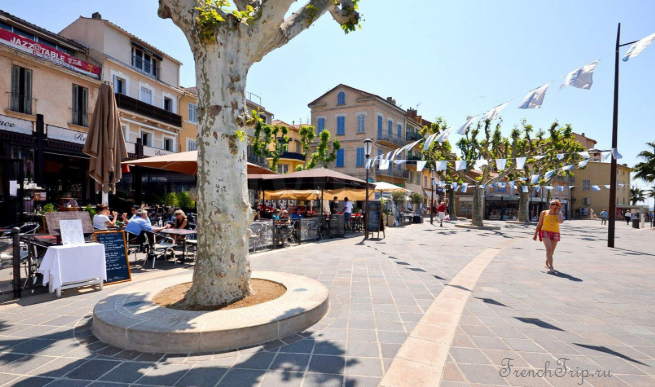
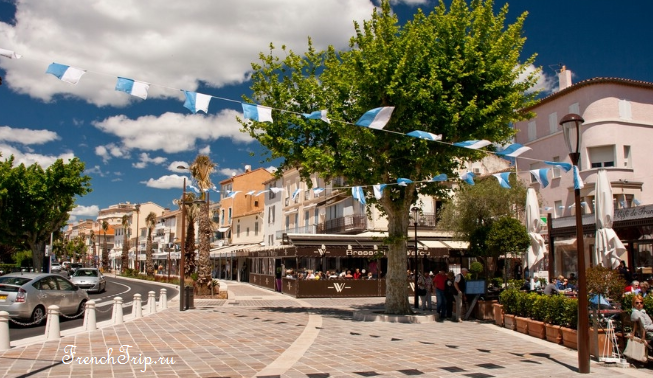
About 14,000 people, facing south across the water, and a proper working town rather than a resort strip: a pedestrian centre with a covered market, plane trees, and a promenade along the front.
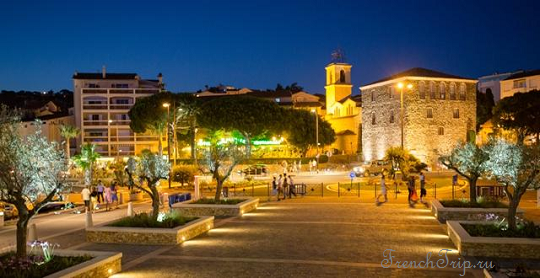
- Tour Carrée des Dames — a sixteenth-century defensive tower on the front, now the local museum
- Inside the tower, the Musée des Traditions Locales covers the region’s history and traditions
- Église Sainte-Maxime — with a green serpentine altar brought from the former Carthusian monastery of La Verne in the Massif des Maures
- In the church, the choir stalls date from the fifteenth century
- The covered market, every morning
- Musée du Phonographe — a collection of early recording machines, more interesting than it sounds
- The phonograph museum, about 10 km north on the road to Le Muy, holds over 300 music boxes, gramophones and barrel organs, including one of Edison’s original phonographs and an audio-visual machine used to teach foreign languages in 1913
- The Hôtel de Ville occupies a building that once bred silkworms
Festivals
Sainte-Maxime opens the Riviera’s festival calendar with the Corso du Mimosa, on the first weekend of February — the first of a run of celebrations that continues with the carnival in Nice, one of the largest in France, and the lemon festival in Menton.
A votive festival in mid-May marks the town’s patron saint, and the town holds a paragliding festival in October. The Théâtre de la Mer hosts concerts through the summer, and the town also puts up a seasonal ice rink.
The beaches
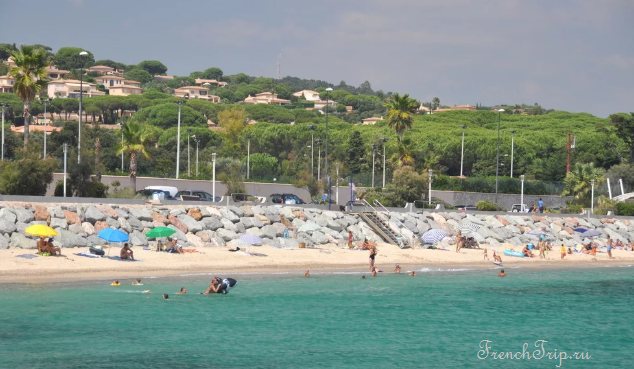
This is the reason families choose Sainte-Maxime: the beaches are sand, they face south, and the water is shallow. Eleven kilometres of them.
- Plage de la Croisette — the town beach, right on the front
- La Nartelle — the largest, 2 km east, with beach clubs and watersports; this was one of the August 1944 landing beaches
- Les Éléphants — named for a Babar illustration drawn here; small and sheltered
- La Madrague and Les Éléphants at the eastern end, quieter
- Plage de la Garonnette — north of the centre, fine sand and clear water
- Plage du Casino — by the casino; narrow, crowded and close to traffic, best avoided
Four of the beaches hold the Pavillon Bleu label, an environmental-quality certification, and many of the town’s shops and restaurants carry France’s Qualité Tourisme or Famille Plus accreditation.
Most beaches within the town charge for a sunbed and parasol; the free stretches exist but fill up fast in summer. The calm water in the gulf also suits windsurfing and water-skiing, and there is a golf course nearby.
See the best beaches in the region.
The boat to Saint-Tropez
The Bateaux Verts run across the gulf roughly every hour from April to October, taking 15 minutes. In summer this is not a scenic extra — it is the only sensible way to get there, and it lands you at the old port rather than in a car park outside town.
The same operator runs seasonal services to Port Grimaud and, further out, to the Îles d’Hyères.
Getting to Sainte-Maxime
- By train — no station. Saint-Raphaël is 25 km away on the main line, with a bus connection along the coast.
- By bus — the coastal service from Saint-Raphaël takes about 50 minutes.
- By car — the A8 to Le Muy, then down. In July and August the last stretch is slow. See parking in France.
- By air — Nice, about an hour and a half.
- Direct buses also run from Marseille and Toulon airports.
Around
- Saint-Tropez — 15 minutes by boat, an hour by road in season
- Port Grimaud — the 1960s lagoon village at the head of the gulf, built as a Provençal Venice
- Grimaud — the hill village above it, with a ruined castle
- The Massif des Maures — cork oak and chestnut forest behind the coast, with almost nobody in it
- Saint-Raphaël and Fréjus — 25 km east
- The Sentier du Littoral (Chemin des Douaniers) — a coastal path towards Saint-Tropez, with sea access along almost its whole length
- The Sémaphore lookout, 1.5 km north along the coast road, with views over the hills and sea
Food
Provençal cooking is the local standard: bouillabaisse, or a simpler fish soup when the real thing is not on the menu; sea bass; and lamb, sometimes served as skewers with olive tapenade. A couple of restaurants near the church and on the seafront have served the same style of cooking since the 1950s and 1960s.
When to go
May, June and September. July and August fill the whole gulf and the road round it. Sainte-Maxime keeps working out of season in a way Saint-Tropez does not — the shops and restaurants stay open, which makes it a reasonable base in spring and autumn.
Weather in Sainte-Maxime
| Month | Day | Night | Rainfall |
|---|---|---|---|
| January | +14° | +3° | 96 mm |
| February | +15° | +3° | 76 mm |
| March | +18° | +5° | 70 mm |
| April | +20° | +8° | 82 mm |
| May | +25° | +11° | 59 mm |
| June | +29° | +15° | 32 mm |
| July | +32° | +17° | 14 mm |
| August | +32° | +17° | 21 mm |
| September | +28° | +14° | 74 mm |
| October | +23° | +11° | 136 mm |
| November | +17° | +7° | 178 mm |
| December | +14° | +4° | 121 mm |
Updated: