La Ciotat
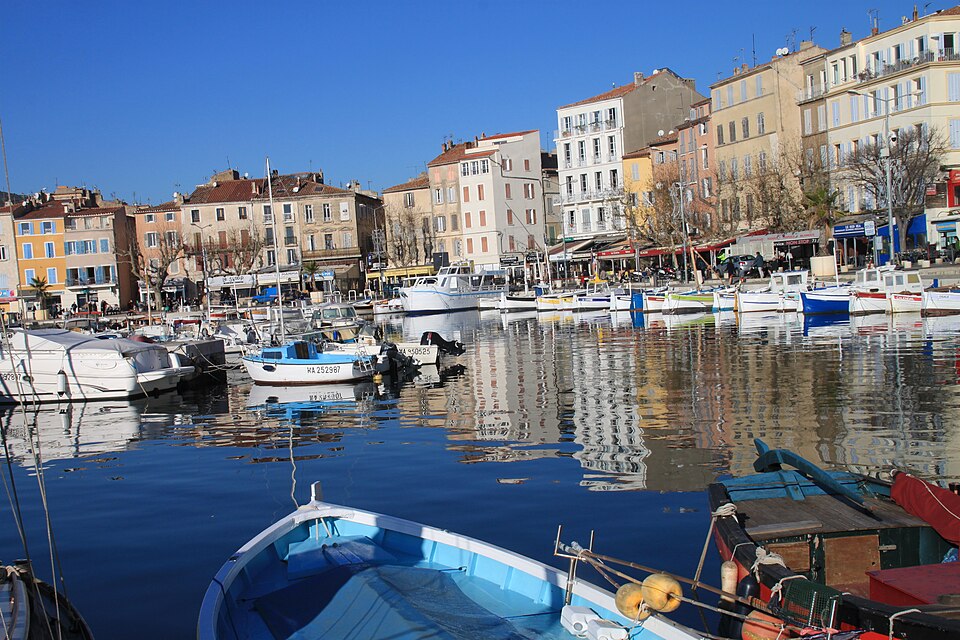
La Ciotat is a shipbuilding town of about 35,000 east of Cassis, on the far side of Cap Canaille. It has an old fishing harbour, red rock calanques of its own, and two claims that are genuinely first in the world: the first film ever shown to a paying audience, and pétanque.
It is also markedly cheaper and less visited than Cassis twelve kilometres away.
Where cinema began
The Lumière brothers’ family had a house at La Ciotat, and they filmed here. L’Arrivée d’un train en gare de La Ciotat — the fifty-second film of a train pulling into the station, which supposedly made the first audiences flinch — was shot at the town’s railway station in 1895.
Antoine Lumière, the brothers’ father, bought ninety hectares of land above the beach in 1891 and built a house there known as the Château Lumière, with forty rooms and three studios built to catch the light for painting. The front of the building is said to be largely unchanged since it opened in 1893. The family gathered at La Ciotat often, and after the first public screening in Paris some of the same films — including the arrival of the train — were shown privately at the house, which became something of a second home for the Lumières after Lyon. It later became a hotel, then flats.
The Eden Théâtre on the seafront hosted a Lumière projection in 1899 and has been showing films on and off ever since, which makes it the oldest working cinema in the world. It was derelict for decades, restored, and reopened in 2013. You can buy a ticket and watch something in it.
Pétanque
The game was invented here in 1907. A local player named Jules Lenoir had rheumatism and could no longer run up to throw in the traditional jeu provençal, so a friend marked a circle and let him throw with both feet planted — pieds tanqués in Provençal, hence the name. The first tournament was held in La Ciotat that year, and there is a plaque where it happened.
Musée Ciotaden, on the old harbour quay and open since 1941, holds about 1,500 objects on the history of the town, among them an early Lumière cinematograph and pétanque memorabilia.
The town and the port
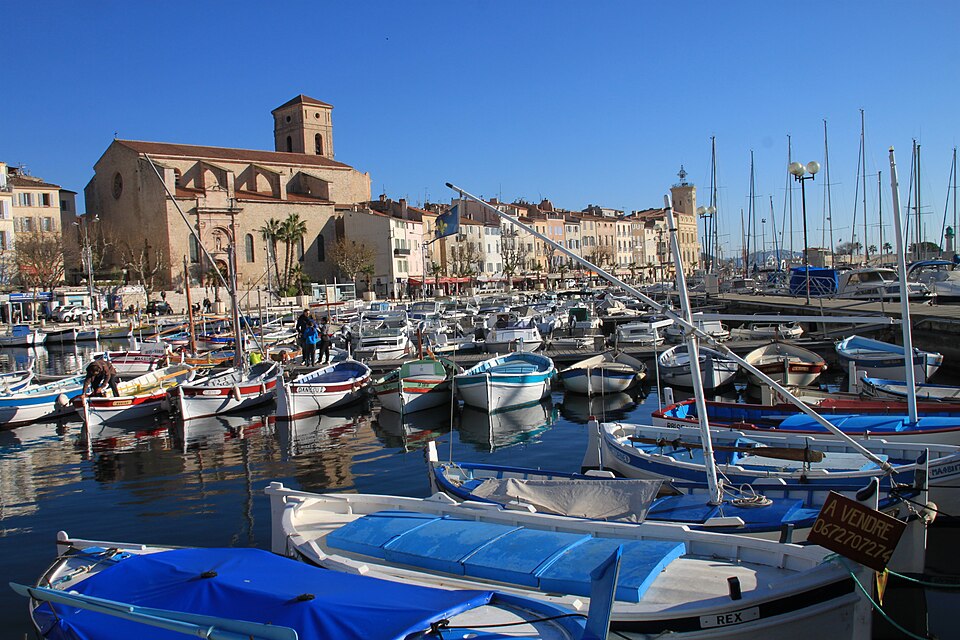
The old port is still a working fishing harbour with a daily fish market on the quay, ringed by ochre buildings and the seventeenth-century church of Notre-Dame-de-l’Assomption. Behind it the old town is a knot of narrow streets that most visitors never enter.
The shipyards next door built ships until 1987 and their closure nearly killed the town; the giant gantry crane still standing over the harbour is a listed monument and the yards now refit superyachts.
Inside the church, a marble Christ above the altar is attributed to Jean de Bologne (Giambologna). It is said to have stood for over a century in a chapel on Île Verte until it was lost in a wartime bombardment in 1944; divers later recovered the broken pieces, and it was restored and its authorship confirmed.
The harbour pier, Bérouard, was built in 1551 to protect the entrance to the port; it later served as a prison and, with a lantern tower added, as a lighthouse. Above the town, the Chapelle Notre-Dame de la Garde is decorated with votive paintings commissioned over the years by local sailors and fishermen.
The old town
The old town dates from the end of the fifteenth century and was substantially rebuilt at the end of the nineteenth; its centre keeps a dense architectural record of both periods.
Several of its squares carry that history. Place Évariste Gras holds an iron-framed covered market opened in 1892; part of the building was later converted into a cinema, the Kursaal, which grew into a three-screen complex known as Le Lumière. Place Sadi Carnot stands on the site of an old cemetery around the church and later did duty as a fruit market and then a fish market; it is now a garden with a fountain and a magnolia tree said to be a century old. Place de la Liberté is said to take its name from a tree planted there in the 1790s and chosen as a “tree of liberty”.
On Rue Adolphe Abeille, a street of houses built by shipowners and merchants in the seventeenth and eighteenth centuries, number 18 is reckoned the finest; it belonged to a branch of the Grimaldi family of Monaco and is held to be the last surviving example of Mannerist architecture in the Bouches-du-Rhône. On Rue Piroddi, the door of number 1 is said to be the oldest in town, dated 1591. On Rue des Poilus, a plaque records that Napoleon Bonaparte, then a young artillery captain, stayed at number 58 in 1793; a former inn further along the street is said to be where the writer Stendhal stayed in May 1838, and he is remembered for writing that he would sooner have made his home in Grasse or La Ciotat than anywhere else in France.
A path from the edge of the old town, past a line of wayside oratories, leads to the ruined Chapelle Sainte-Croix — reckoned the oldest chapel site in La Ciotat and, before a semaphore was built, one of the first lookout points on this stretch of coast. The walk crosses vineyards and fig and almond trees.
The Calanques of La Ciotat
Different from the white ones at Cassis: here the rock is red conglomerate, and the coast between the town and Cap Canaille is a set of coves under ochre cliffs.
- Calanque de Figuerolles — the famous one, a narrow inlet with the Capucin rock standing at its mouth, reached by a stairway from the road
- Calanque du Mugel — with a botanical park behind it
- Anse du Sec and the coves along the Bec de l’Aigle
Figuerolles takes its name from the fig trees that once grew along it. Its rocks have collected other nicknames too, including Tête de Chien (dog’s head) and Îlot du Lion (lion islet), depending on the angle; painters including Georges Braque and Othon Friesz worked here.
Île Verte
The only wooded island off the Provençal coast, a few hundred metres offshore, reached by a shuttle boat in ten minutes. Aleppo pines, coves, a ruined fort and a single seasonal restaurant. It is small — an hour walks round it — and it is the best swim near the town.
The island covers about twelve hectares, measuring some 430 by 260 metres; its high point, Fort Saint-Pierre, stands 49 m above the sea. German forces fortified it during the Second World War, and the bunkers they built, linked by tunnels, are still visible among the trees, along with shell craters. The shuttle runs from April to October only.
The Route des Crêtes
The ridge road over Cap Canaille connects La Ciotat to Cassis along the top of the highest sea cliff in France, 394 m, with viewpoints all the way. It is one of the best drives in Provence, and it closes in high wind and on high fire-risk days.
The road opened in 1964. The semaphore tower at the top of Cap Canaille dates from 1791, built as a lookout for shipping. Near the La Ciotat end, look out for the Cœur d’Honoré, a heart-shaped ruin named after a former landowner, and, further along, a natural rock arch known as Le Pont Naturel.
Beaches
La Ciotat has proper sand, which its neighbours largely do not: the Plage Lumière and the beaches along the Avenue du Président Wilson run for a couple of kilometres in the middle of town, with everything behind them.
Getting to La Ciotat
- By train — on the Marseille–Toulon line, about 30 minutes from Marseille. Note that the station is 3 km from the seafront, with a shuttle bus.
- By car — the A50. See parking in France.
- By boat — seasonal services along the coast to Cassis and the calanques.
Around
- Cassis — 12 km over the Route des Crêtes
- Bandol — 15 km east, and the best red wine appellation in Provence
- Saint-Cyr and Les Lecques — the family beaches next door
- Marseille — 30 minutes, and the calanques between
- Toulon — about 40 km east, on the same rail line
When to go
May, June and September. La Ciotat fills with French holidaymakers in August rather than foreign ones, which gives it a different character from the rest of this coast — and makes it noticeably better value.
See the best beaches in the region.
Photo credits
Photographs on this page come from Wikimedia Commons under free licences:
- The old port — Jeanne Menjoulet, CC BY 2.0, via Wikimedia Commons
- The waterfront — Jeanne Menjoulet, CC BY 2.0, via Wikimedia Commons
.jpg)
.jpg)
Weather in La Ciotat
| Month | Day | Night | Rainfall |
|---|---|---|---|
| January | +14° | +3° | 69 mm |
| February | +14° | +3° | 41 mm |
| March | +17° | +5° | 38 mm |
| April | +20° | +8° | 50 mm |
| May | +24° | +11° | 47 mm |
| June | +29° | +14° | 20 mm |
| July | +31° | +17° | 7 mm |
| August | +31° | +16° | 15 mm |
| September | +27° | +14° | 66 mm |
| October | +23° | +11° | 92 mm |
| November | +18° | +7° | 98 mm |
| December | +15° | +4° | 66 mm |
Updated: