Aigues-Mortes
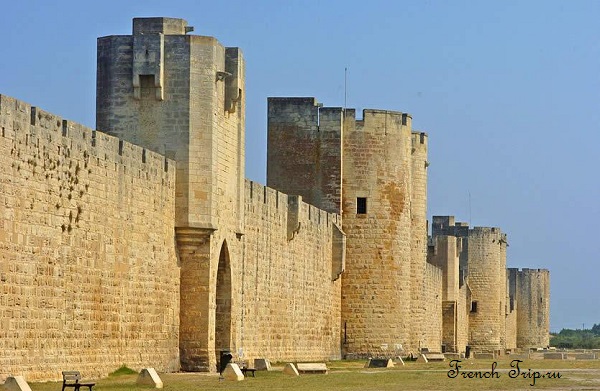
Aigues-Mortes is a walled town in the Camargue, 30 km from Nîmes, and its walls are the point: 1,640 metres of thirteenth-century rampart, complete, with all twenty towers and ten gates standing. Nowhere else in France has kept a full circuit like this.
The name means “dead waters” — this was salt marsh, and the town was built on it deliberately.
Why it exists
In the thirteenth century France had no Mediterranean port of its own: the coast belonged to Provence, then part of the Empire, and to the counts of Toulouse. Louis IX — Saint Louis — bought this patch of marsh from a nearby abbey in 1240 specifically to get one.
He sailed from here for the Seventh Crusade in 1248 with a fleet of 1,500 ships, and again in 1270 for the Eighth, from which he did not return. The Tour de Constance, the great round keep, went up first; the walls followed under his son and grandson.
Then the sea retreated. The port silted up, Marseille and Provence came to France anyway, and Aigues-Mortes stopped mattering — which is exactly why the walls survive. Nobody had a reason to knock them down.
The coast is now about 6 km away, and the town stands amid four navigable canals.
The walls
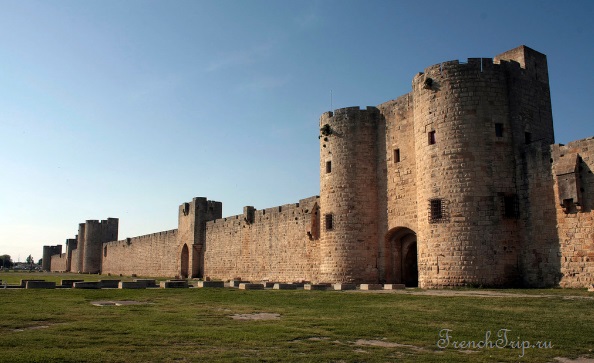
You can walk the full circuit on top, which takes about an hour and gives the salt pans, the marsh and the grid of streets below. The town inside is laid out on a Roman-style plan because it was built all at once, to order — rare in a medieval town and obvious from above.
Inside, the fortifications include ribbed vaults on carved capitals and gargoyles, a decorative touch set against the plain strength of the curtain walls. From the wall-walk and the tower terraces the view runs out over the Camargue and the salt pans, which shift between blue and violet. Guided tours and audio guides are available in French, English, German, Dutch and Italian.
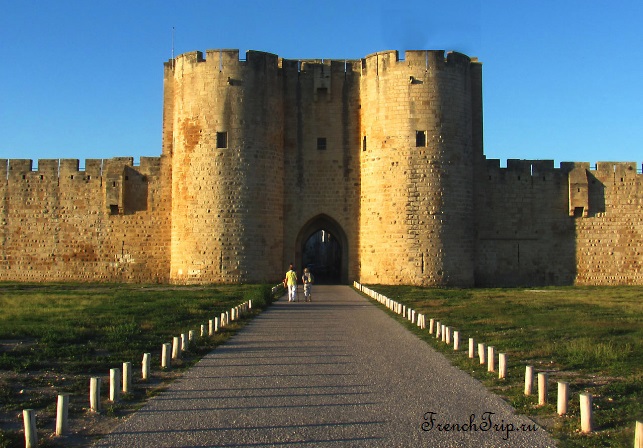
Tour de Constance
The keep by the main gate, 22 m across with walls 6 m thick. It served as a prison, and its most-remembered inmates were Huguenot women held after the revocation of the Edict of Nantes. One of them, Marie Durand, was locked in it for 38 years and is said to have carved RÉGISTER — resist — into the rim of the well. The word is still there.
A lift runs up to a viewing platform at the top of the tower.
The salt
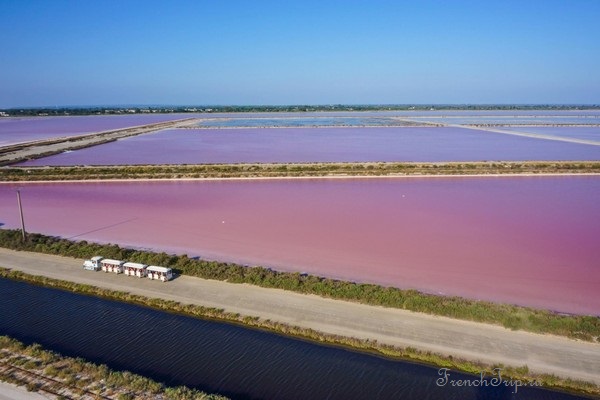
The Salins d’Aigues-Mortes beside the town are among the largest in Europe and have been worked since antiquity. Evaporation concentrates the brine until an alga called Dunaliella salina turns the water pink, and by late summer the pans are an improbable colour against white salt mountains.
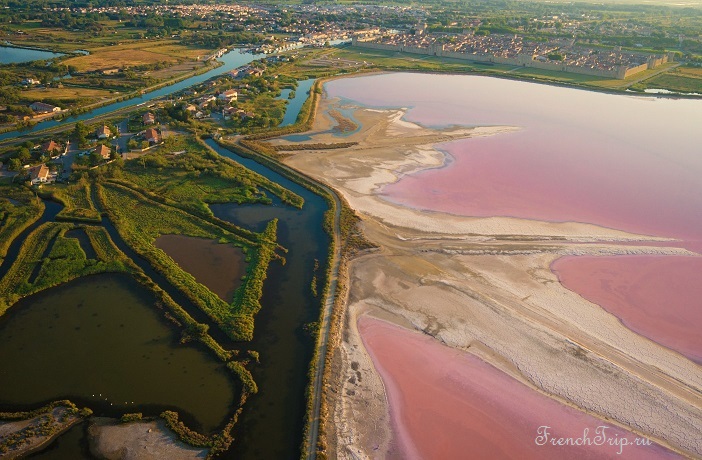
The site runs visits by little train, on foot and by bicycle from March to November. Late summer is when the colour is strongest. Fleur de sel is the thing to buy.
Two ways to see the pans up close: a train ride of around 75 minutes through the salt tables, with a stop at a small salt museum, or a slower circuit by mountain bike, at around three hours. Both can be booked with access for visitors with reduced mobility.
The town inside
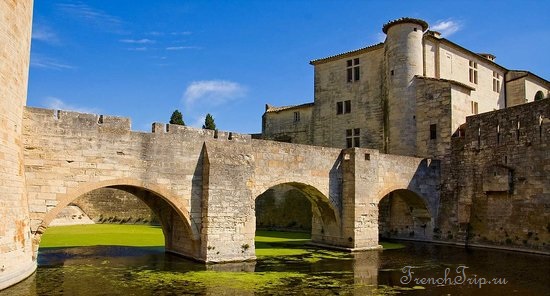
Place Saint-Louis with its plane trees and a statue of the king, the thirteenth-century church of Notre-Dame-des-Sablons, and streets of shops and restaurants. It is small and it is entirely given over to visitors, which is the honest description — the walls and the salt are what you came for.
Notre-Dame-des-Sablons began as a timber church in 1183 and was rebuilt in stone, in the Gothic style, in 1246. Its stained glass is modern, replacing original windows that had been badly damaged.
Two smaller chapels are also open to visitors: the seventeenth-century Chapelle des Pénitents Blancs, with a fresco by Xavier Sigalon and paintings by Auguste Glaize, and the Chapelle des Pénitents Gris, also seventeenth-century, with a stucco altar by Sabatier. A small tourist train runs a 25-minute circuit of the town from the Porte de la Gardette, with audio commentary on Saint Louis, the crusades and the building of the walls, and guided walking tours in English are available year-round by advance booking.
Getting to Aigues-Mortes
- By train — a branch line from Nîmes takes about 45 minutes, running to Le Grau-du-Roi. The station is outside the walls.
- By car — 40 minutes from Nîmes, an hour from Montpellier. Park outside; the walled town is pedestrian. See parking in France.
- By boat — the Canal du Rhône à Sète passes the walls, and trip boats run through the marsh.
Around
- The Camargue — flamingos, white horses and black bulls start at the town gate
- Le Grau-du-Roi — the fishing port and beaches, 6 km
- Nîmes — 40 minutes, with the arena and the Maison Carrée
- Saintes-Maries-de-la-Mer — across the delta
- Écomusée de la Camargue Gardoise — exhibits on the landscape and wildlife of this part of the Camargue, with a signed discovery trail
The Camargue
The reserve has been protected since 1970. It is known for its semi-wild white horses and black bulls, herded by gardiens in the region’s traditional dress, and for a large bird population — some 400 species recorded, including flamingos, herons, kingfishers and birds of prey. A good place to watch the flamingos is near the village of Ginès, on the road north out of Saintes-Maries-de-la-Mer.
The gardien tradition is traced to the 1600s, when local monastic estates broke up and the land passed into private hands. Their traditional dress — leather trousers and a black, wide-brimmed hat — and their old one-storey, windowless thatched huts, known as cabanes, with a pair of bull’s horns fixed over the door, are still part of the local image, though far fewer gardiens work full-time today than in the past.
Stables along the road between Arles and Saintes-Maries-de-la-Mer run day rides suited to first-time riders as well as longer outings.
Camargue bullfighting traditions persist alongside this: small arenas hold contests locally each July and August, though the biggest events are at the Roman arena in Arles, held from Easter to September, generally with matadors from Spain.
Food and drink
Fleur de sel from the surrounding salt pans is hand-raked in the traditional way; the crystals are white and slightly moist, and it is used to finish a dish rather than to cook with. Vin des Sables is wine grown on the sandy ground of the delta, and comes as red, rosé, grey or white. Asperge des Sables, sand-grown asparagus, is harvested by hand and comes white, purple or green depending on whether it is cut before or after it breaks the surface.
Traditionally made only at Christmas, and now available year-round, fougasse d’Aigues-Mortes is a brioche-style bread flavoured with orange flower; customers once supplied the baker with the dough, sugar, butter and orange-flower water themselves rather than buying a finished loaf. Other local produce includes sand-grown potatoes and carrots, and a beer brewed with Camargue rice.
When to go
April to June and September to October. The salt pans are pinkest in late summer, which is also when the town is fullest — go early. The walls are exposed and there is no shade on top; do the circuit in the morning. Mosquitoes are a real consideration from May, as everywhere in the Camargue.
See Occitanie.
Weather in Aigues-Mortes
| Month | Day | Night | Rainfall |
|---|---|---|---|
| January | +11° | +4° | 54 mm |
| February | +13° | +5° | 36 mm |
| March | +16° | +8° | 35 mm |
| April | +19° | +10° | 52 mm |
| May | +23° | +14° | 37 mm |
| June | +27° | +18° | 24 mm |
| July | +29° | +20° | 14 mm |
| August | +29° | +20° | 30 mm |
| September | +25° | +16° | 73 mm |
| October | +21° | +13° | 77 mm |
| November | +15° | +9° | 72 mm |
| December | +12° | +5° | 49 mm |
Updated: