Orange
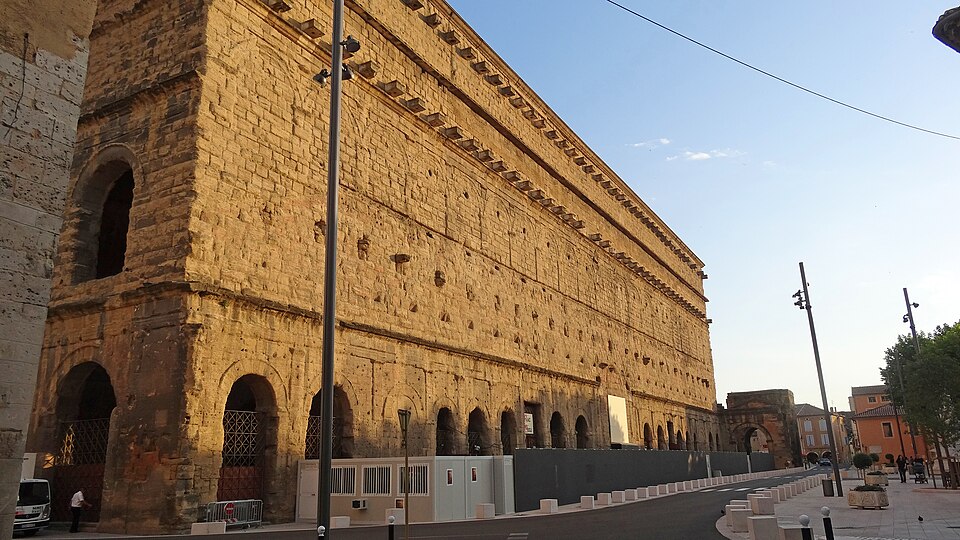
Orange is a town of 30,000 in the Rhône valley, 30 km north of Avignon, and it holds the best-preserved Roman theatre in the world. Louis XIV called its stage wall the finest wall in his kingdom, and he was not being polite: it is the only one anywhere that still stands to its full height.
The theatre and the triumphal arch have been UNESCO-listed since 1981.
The Roman town, Arausio, was one of the prosperous centres of ancient Provence. It stood where routes north and towards Spain and Italy crossed, in the middle of a rich agricultural region, which is why the Romans built here on such a scale; most of what survives is concentrated around the theatre and the Colline Saint-Eutrope behind it. Orange itself lies roughly 100 km north-west of Marseille and 200 km south of Lyon.
The Roman theatre
Built under Augustus, it seated around 9,000 people. What survives that survives nowhere else is the frons scaenae — the stage wall, 103 m wide and 37 m high, which everywhere else was quarried away for building stone. Here it stood because the town built houses against it and it became a wall of the city.
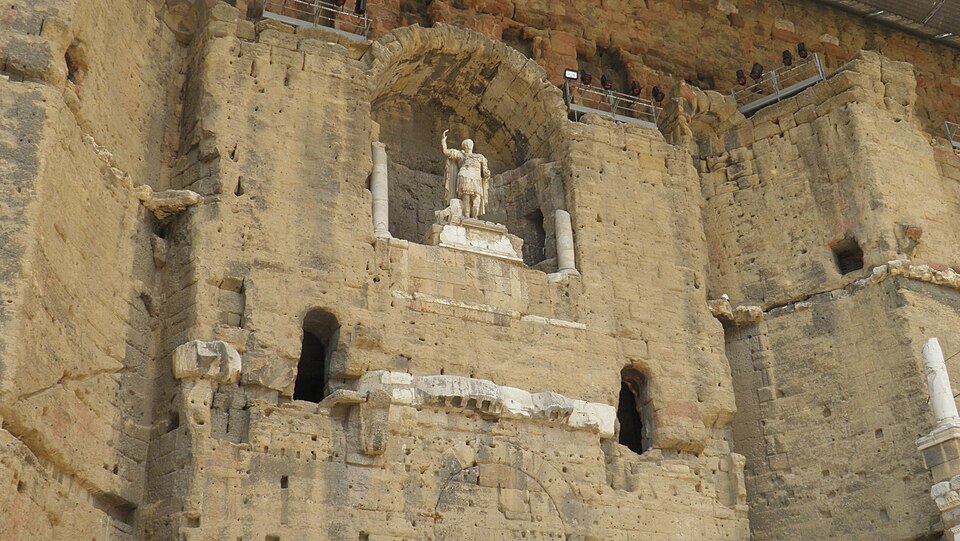
In the central niche stands a 3.5 m statue of Augustus, reassembled from fragments found on the site. The acoustics still work — you can hear a voice from the stage in the top row — and the theatre is used every summer for the Chorégies d’Orange, the oldest music festival in France, running since 1869.
The theatre was restored for the purpose in 1869; the festival took the name Chorégies d’Orange in 1902 and has grown into an international opera festival.
The audio guide is genuinely good, and the museum opposite holds the cadastres — Roman land registry inscriptions carved in marble, showing who owned which field in the first century. They are the most complete Roman survey documents anywhere.
The cadastres are said to be the largest Roman land-survey maps ever found, 7.56 m by 5.90 m, and cover the territory between Orange, Nîmes and Montélimar. A Vaucluse Provence Pass gives reduced admission to the theatre and to other sights in the département.
The triumphal arch
At the north entrance to the town stands a three-arched monument of about 20 AD, 19 m high, carved with naval trophies, chained Gauls and captured weapons. It sat in the middle of a roundabout until the traffic was moved away from it.
The date is disputed. Current research, taking the inscription as evidence, favours the reign of Augustus; the arch also carries a dedication to Tiberius from 27 AD, when it was reworked in honour of Germanicus’s victories over the Germanic tribes of the Rhineland.
The Dutch connection
Orange had been the capital of its own principality since the Middle Ages.
The name is the reason the Netherlands has a royal House of Orange, an Orange Free State once existed in South Africa, and Northern Irish Protestants are called Orangemen.
The principality of Orange passed by inheritance to the House of Nassau in 1544, and William of Nassau — William the Silent — became the leader of the Dutch revolt against Spain. His descendant William III of Orange took the English throne in 1688. The town itself was ceded to France in 1713 and has nothing to do with the fruit, whose name arrived separately from Sanskrit via Arabic.
The annexation was formalised by the Treaties of Utrecht.
The rest of the town
- Colline Saint-Eutrope — the hill behind the theatre, with the remains of the princes’ castle and the best view down into the auditorium
- Ancienne cathédrale Notre-Dame-de-Nazareth — Romanesque, damaged in the Wars of Religion
- The Thursday market, filling the centre
- Hôtel de Jonc and Hôtel Monier-Vinard — mansions in the old town
- Maison Romane — a medieval house, among the oldest buildings in Orange
- The present town hall, itself one of the town’s older buildings
Food and drink
Vaucluse, at the foot of Mont Ventoux, together with the Drôme Provençale produces around 80% of France’s black truffles (Tuber melanosporum). The best are the January ones, once fully matured, and in season the trade is set at the markets of Carpentras and Richerenches, the two most important in the region. Rabassiers, as truffle hunters are known locally, have a saying to justify the price: the “black diamond” is born in the rain that falls between the Assumption and the Nativity of the Virgin. Producers hold open weekends for buyers to meet the rabassiers on site, in Orange and other Vaucluse towns.
The town’s olive groves supply Provence olive oil under its AOC. Among Orange’s own specialities are the shortbread sablé du Théâtre, the sweets Augustines and Orangines, and the sweet vin d’Orange.
Wine
Orange sits among the southern Rhône appellations. Châteauneuf-du-Pape is 10 km south, Gigondas and Vacqueyras 20 km east under the Dentelles, and Tavel and Lirac across the river. See French wines.
The vineyards of the Grès d’Orange terroir produce wines classified as Côtes du Rhône and Châteauneuf-du-Pape; grapes grown there outside those appellations can, after approval, be labelled vin de pays de la Principauté d’Orange.
Getting to Orange
- By train — on the main Rhône valley line, about 20 minutes from Avignon and 15 from Valence-side stations. The station is a 10-minute walk from the theatre.
- By car — the A7 passes the town. Park outside the centre. See parking in France.
- By bus — TransVaucluse runs services across the département, with direct routes to Avignon and Carpentras.
- Regional TER lines also call at the station, alongside the mainline trains.
Around Orange
- Châteauneuf-du-Pape — 10 km
- Carpentras — 26 km, one of the region’s principal truffle markets
- Vaison-la-Romaine — 30 km, with the largest Roman excavation in France
- Dentelles de Montmirail — the limestone combs and the wine villages beneath them
- Avignon — 30 km south
When to go
April to June and September to October. The theatre is a stone bowl facing south and it is punishing in July — which is also when the Chorégies fill it, so if opera in a Roman theatre appeals, that is the trade. Book those months ahead.
Photo credits
Photographs on this page come from Wikimedia Commons under free licences:
- The stage wall from outside — Suwannee Payne, CC BY-SA 3.0, via Wikimedia Commons
- The statue of Augustus — Alainfou, CC BY-SA 4.0, via Wikimedia Commons


Weather in Orange
| Month | Day | Night | Rainfall |
|---|---|---|---|
| January | +10° | +2° | 55 mm |
| February | +12° | +2° | 37 mm |
| March | +16° | +5° | 44 mm |
| April | +19° | +8° | 63 mm |
| May | +24° | +12° | 60 mm |
| June | +28° | +16° | 37 mm |
| July | +31° | +18° | 38 mm |
| August | +31° | +18° | 40 mm |
| September | +26° | +14° | 105 mm |
| October | +20° | +11° | 94 mm |
| November | +14° | +6° | 97 mm |
| December | +11° | +3° | 48 mm |
Updated: