Arcachon
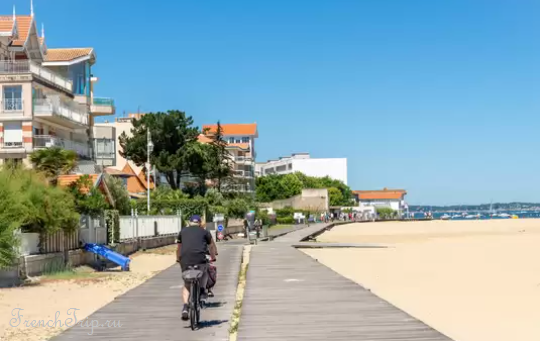
Arcachon is a seaside town 55 km south-west of Bordeaux, on a triangular bay of the Atlantic that is half sea and half tidal flats. It has sand, pine woods, oyster beds, a quarter of extravagant nineteenth-century villas, and — just outside it — the largest sand dune in Europe.
It is one of the historic Atlantic resorts, alongside Royan, Biarritz and La Baule, and it remains a wealthy one: Bordeaux keeps its second homes here, and on a sunny weekend it can feel as though the whole city has emptied into the bay.
A town invented in 1857
Before that date there was no Arcachon — only pine forest, oak and arbutus, a few hundred fishermen and peasants, and huts rather than houses, all of it part of neighbouring La Teste-de-Buch.
Two things changed it: doctors began prescribing sea bathing, and the railway arrived from Bordeaux. The Pereire brothers, bankers and railway builders, put up three bathing establishments for the Bordeaux bourgeoisie, the locals broke away from La Teste, and Napoleon III’s decree of 1857 created the town.
It was laid out in four districts named after the seasons — Ville d’Été, Ville d’Hiver, Ville d’Automne, Ville de Printemps — which is still how people navigate it.
Ville d’Hiver
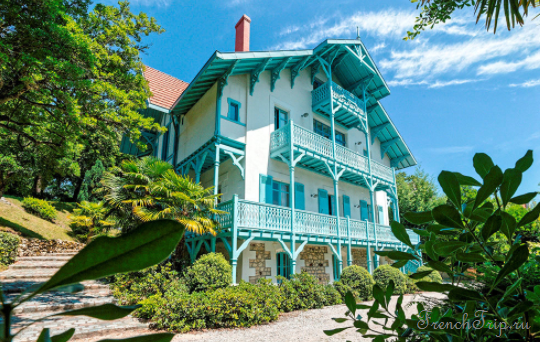
The Winter Town, on the dune ridge behind the beach, is the reason to come here out of season. The Pereires built it for wealthy visitors wintering for their lungs, in the sheltered air behind the pines, and the result is several hundred villas in whatever style their owners fancied: Swiss chalet, neo-Gothic, Moorish, colonial, neoclassical, all with carved wooden balconies and verandas.
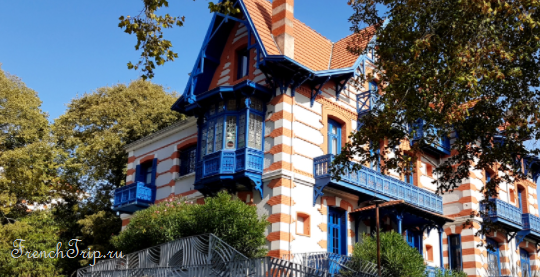
The local name for the type is the arcachonnaise. It was dismissed as vulgar for a couple of generations and is now the town’s chief asset.
The ones to look for: Villa Toledo with its Spanish outside staircase, Villa Trocadéro for the carved woodwork, Villa Alexandre Dumas in its garden, Villa Brémontier (one of the first, later rebuilt as a chalet), Villa Craigcrostan, built by a Scottish aristocrat, and Villa Teresa, restored and now a hotel.
At the top sits the Parc Mauresque, several hectares of arboretum on the dune, with the view down over the summer town and the bay. The Moorish casino that gave it its name burned down; a lift and a stairway still climb up to it from the seafront.
Dune du Pilat
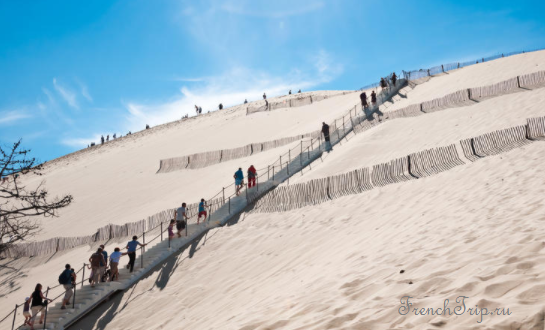
The Dune du Pilat is the highest sand dune in Europe: roughly 100 m tall, about 2.7 km long and 500 m wide, and moving inland a few metres every year — it swallows the pine forest behind it at a measurable rate, and its official height is re-surveyed because it keeps changing.
Over a million people climb it a year. There is a wooden staircase in season and the loose sand beside it out of season; the Atlantic is on one side and the forest on the other, and the sunset from the crest is the classic reason to be there. Bus line 1 runs out from Arcachon.
Bring something for your feet — the sand gets genuinely too hot to stand on in August.
The bay
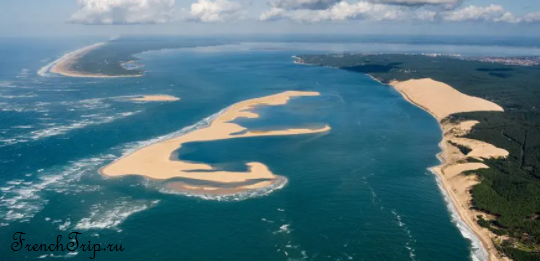
The Bassin d’Arcachon is a triangle of water connected to the ocean by a narrow, shifting channel with a bad reputation among sailors. It is tidal to an extreme degree: the landscape changes completely between high and low water, and at low tide the sea goes a very long way out.
That makes it a bird bay. Much of it is nature reserve, and the waders and waterfowl are there all year.
The cabanes tchanquées
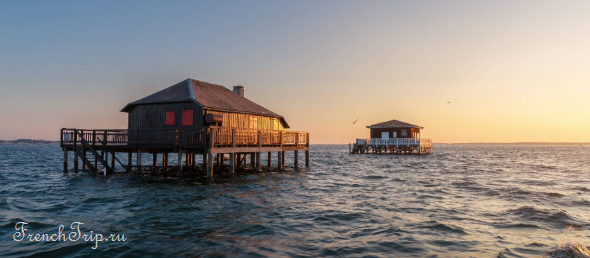
Two wooden huts on stilts stand off the Île aux Oiseaux in the middle of the bay, and they are the image of Arcachon. Tchanque is Gascon for stilt. They were built for oyster watchmen; only boats go there, and boat trips run from the town pier all season.
Oysters
The bay is one of France’s main oyster nurseries — much of the country’s oyster seed starts here before being grown on elsewhere. The oyster villages on the eastern and northern shores (L’Herbe, Le Canon, Gujan-Mestras) sell them straight from the huts with a glass of white wine, which is the cheapest good meal on this coast. See French oysters.
Beaches
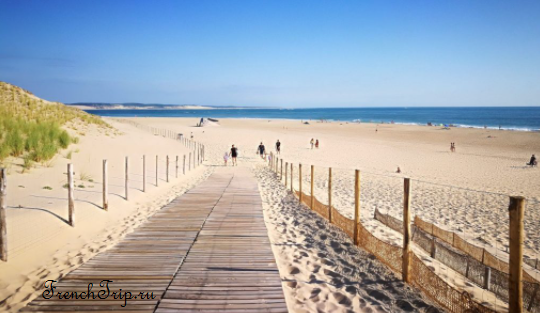
The bay beaches are calm and shallow and suit families; the ocean beaches a few kilometres away are surf. Five main ones:
- Plage d’Arcachon — the town beach, about 800 m between the Eyrac and Thiers piers, right in front of the promenade. Lifeguards from mid-June to mid-September.
- Plage Pereire — the best of them: 3 km, wide, backed by a pine promenade, looking across at the Cap Ferret peninsula. Free parking, beach clubs, surf at the Arbousiers end.
- Plage des Abatilles — south of Pereire, shaded, good on the hottest days. No lifeguards; windsurfers and kitesurfers use it.
- Le Moulleau — a small resort of its own a couple of kilometres south-west, sand either side of a pier, shops and cafés behind, and the Dune du Pilat in view.
All of them are tidal — check the tide times before you plan a swim. See the most beautiful beaches in France.
Warning: the baïnes
On the ocean beaches — not inside the bay — the local hazard is the baïne, and it kills people every year, including strong swimmers.
A baïne is a pool between the beach and a sandbar, tens to hundreds of metres long, running parallel to the shore, spaced every 300–400 m along this coast. Waves push water over the bar into the pool; the water then escapes back to sea through one gap, and that gap becomes a rip current strong enough to carry an adult out.
They are worst in the last hours before low tide and the first hours after. If you are caught in one, do not swim against it: let it take you out to where it weakens, then swim parallel to the beach before turning in. Swim between the flags and read the lifeguards’ notices.
Getting to Arcachon
- By train — the easy option. Regional TER trains from Bordeaux Saint-Jean run roughly hourly and take about 50 minutes, and in high season there are direct TGV services from Paris. The station is in the middle of town, a few minutes from the beach. See regional trains in France.
- By coach — long-distance buses from Bordeaux and beyond, cheaper and slower.
- By air — Bordeaux-Mérignac, about an hour away by road.
- By car — the A660 off the A63. Parking is metered near the front and free further back; the map the tourist office hands out marks which is which. See parking in France.
The town itself is walkable. Buses cover the run out to the dune and along the bay.
What else to see
- Jetée Thiers — the pier, and the standard evening walk
- Belvédère Sainte-Cécile — a metal viewing platform above the Ville d’Hiver, reached by a footbridge attributed to Gustave Eiffel’s workshop
- Basilique Notre-Dame and the chapel of the sailors, with ex-votos from the fishing fleet
- The synagogue, listed as a historic monument
- Château Deganne — a nineteenth-century neo-Renaissance folly, now the casino
- The aquarium-museum — the marine life of the bay, and the history of oyster farming
- The fish auction at the port, which can be visited with a guide
What to eat
Oysters, obviously, and the rest of what the bay and the boats bring in. Beyond that Arcachon eats like the south-west: duck, Bordeaux wine, and the Basque country’s cooking not far down the coast. See the cooking of Nouvelle-Aquitaine and French wines.
There is a market every morning except Monday outside the school holidays, in the covered halls in the Ville d’Été.
When to go
The season runs from June to the end of August, and the town fills. Late May and September are the best time: the weather still holds, the water is at its warmest in September, and the locals have gone back to work.
The climate is mild all year — summers rarely above 30 °C, winters wet and windy but almost never freezing, with around 900 mm of rain spread through the year. The Ville d’Hiver was built for winter visitors and still works in February, when the Atlantic light is at its best.
Around Arcachon
- Cap Ferret — the peninsula across the mouth of the bay, reached by boat from Arcachon in 30 minutes: oyster villages, a lighthouse you can climb, and the ocean on the far side
- Bordeaux — 50 minutes by train, and the reason the town exists
- The Landes forest — the largest planted forest in Europe, all around the bay
- Biarritz and the Basque coast — about two hours south
Tourist office
MA.AT, Esplanade Georges Pompidou, 22 boulevard du Général Leclerc — arcachon.com
Where to park in Arcachon
| Car park | Spaces | Fee | From centre |
|---|---|---|---|
| Centre ville - Plage underground | 600 | — | 20 m |
| Underground car park | — | paid | 320 m |
| Place du Docteur Peyneau | — | paid | 580 m |
Weather in Arcachon
| Month | Day | Night | Rainfall |
|---|---|---|---|
| January | +11° | +3° | 99 mm |
| February | +13° | +3° | 74 mm |
| March | +16° | +5° | 67 mm |
| April | +18° | +7° | 73 mm |
| May | +21° | +11° | 63 mm |
| June | +24° | +14° | 66 mm |
| July | +26° | +16° | 44 mm |
| August | +27° | +15° | 61 mm |
| September | +24° | +12° | 76 mm |
| October | +20° | +10° | 88 mm |
| November | +15° | +6° | 128 mm |
| December | +12° | +4° | 109 mm |
This page in Russian: Arcachon (Аркашон)
Updated: