Grenoble
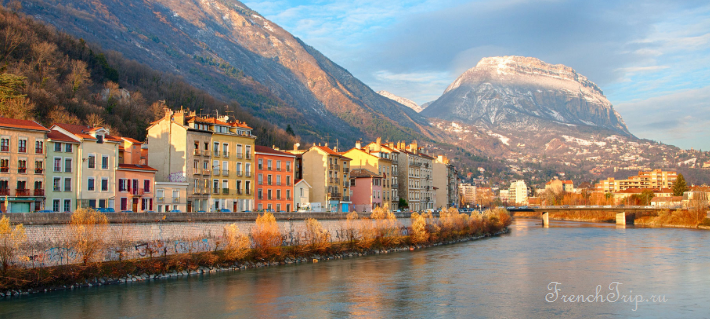
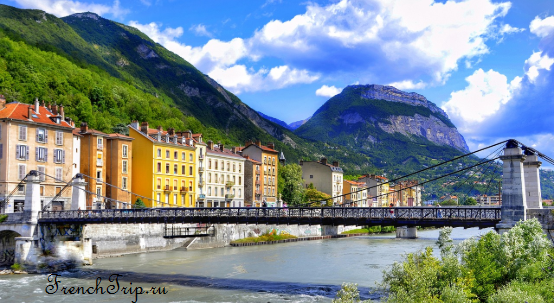
Grenoble is the capital of the French Alps and of the Isère department, a city with more than two thousand years of history set in a wide valley ringed by mountains. From the city centre you can see the cliffs of the Vercors to the west, the Chartreuse to the north and the long, often snowy chain of Belledonne to the east. Few cities in Europe are so completely surrounded by mountains.
It is not as pretty as Lyon or Annecy, but it fits easily into a tour of the Alps, it has good-value hotels, and it has two things worth the trip: the cable car up to the Bastille fort, with its view over the city and the peaks, and one of the best art museums in France.
A short history
Grenoble was a Gallo-Roman town, and from the 11th century it was the capital of the Dauphiné, the land of the counts of Albon, who took the title of Dauphin. In 1349 the last Dauphin sold his lands to the King of France, on condition that the king’s eldest son should bear the title. From then on, the heir to the French throne was always called the Dauphin.
Grenoble became a fortified frontier city facing Savoy. It grew rich on glove-making in the 18th century, and in the 19th on hydroelectric power, the “white coal” of the Alpine rivers. In the 20th century it became one of France’s main centres of science, research and electronics, a tradition that continues today. It hosted the Winter Olympics in 1968. The writer Stendhal was born here, and Champollion, who deciphered the hieroglyphs, went to school and began his studies here.
What to see
The Bastille and its cable car
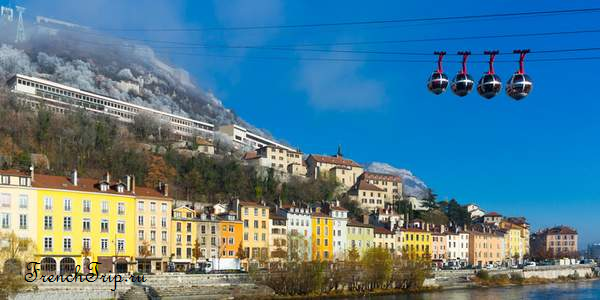
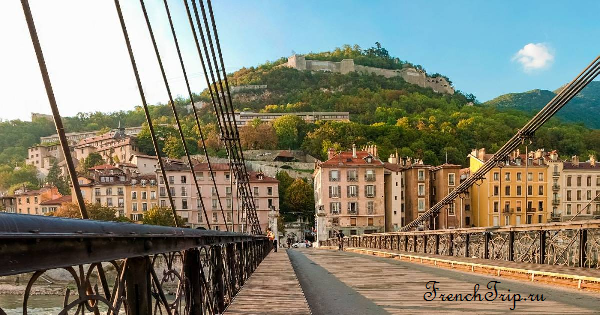
The best thing to do in Grenoble is to ride the cable car from the Quai Stéphane-Jay, on the river, up to the Fort de la Bastille, the 19th-century fortress on the hill above the city. The line opened in 1934, one of the first urban cable cars in the world; its little round cabins, known locally as “the bubbles”, date from the 1970s. From the top there is a view over the whole city and the confluence of the Isère and the Drac, and on a clear day as far as Mont Blanc.
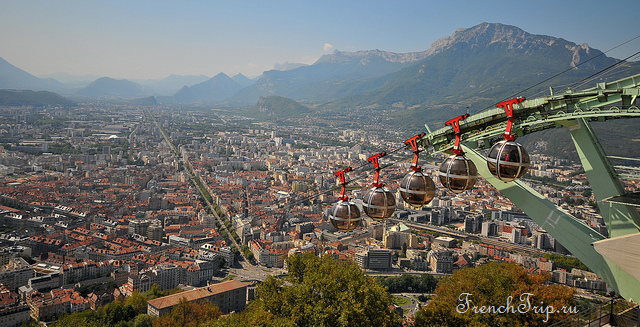
You can also walk up or down by a network of paths and steps through the old fortifications, which takes about 45 minutes to an hour. The paths are steep and slippery in the wet; wear proper shoes.
The old town
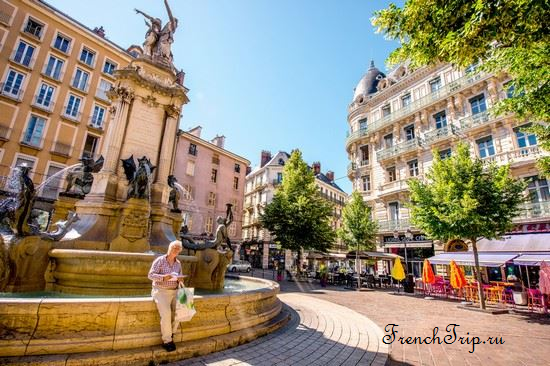
- Place Saint-André, a pedestrian square with café terraces, overlooked by the Gothic and Renaissance façade of the old Parliament of the Dauphiné.
- Place Notre-Dame, with the cathedral and the bishops’ palace, now a museum of the history of the city, and the Fountain of the Three Orders, which commemorates the Day of the Tiles in 1788, one of the first uprisings of the French Revolution.
- The Jardin de Ville, a small park with old trees, beside the Hôtel de Lesdiguières, the former town hall.
- The quays along the Isère, lined with tall, colourful houses, and the footbridges across to the Saint-Laurent quarter at the foot of the Bastille.
Museums
- The Musée de Grenoble, one of the finest art museums in France, with collections from the Middle Ages to modern art, including a strong collection of 20th-century painting.
- The Musée Dauphinois, in a former convent on the slope below the Bastille, about the life and traditions of the people of the Alps.
- The Museum of the Resistance and Deportation of the Isère; Grenoble and the Vercors were major centres of the wartime Resistance.
- The natural history museum, the archaeological museum in the old church of Saint-Laurent, and the Magasin, a centre of contemporary art.
What to eat
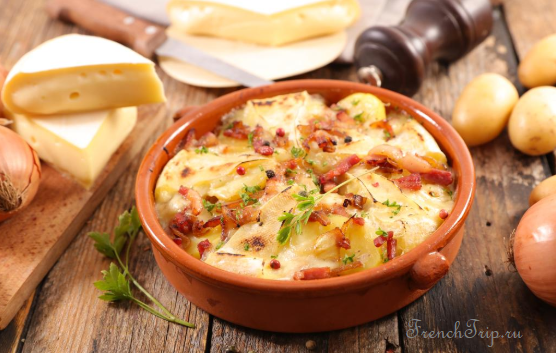
Grenoble is the walnut capital of France: its walnuts, noix de Grenoble, have a protected designation of origin, and you will find them in cakes, tarts and sweets everywhere, especially in winter. The region of which it was the capital gave its name to the gratin dauphinois, potatoes baked slowly in cream. The Chartreuse liqueur, made by Carthusian monks from more than a hundred plants, comes from the mountains just north of the city. In winter, look for Alpine dishes: raclette, fondue and tartiflette.
Many good restaurants are in the centre, between the station, Place Saint-André and Place Notre-Dame. For food markets, try the covered market at Les Halles Sainte-Claire, near the cathedral, and the open-air market on the Place aux Herbes.
Getting there
- By train: TGVs from Paris take about three hours. Regional trains run from Lyon (Part-Dieu) about every hour and take around an hour and a quarter, and there are trains to Geneva, to Valence (for TGVs to the south) and to the southern Alps. See trains in France.
- By air: Grenoble has a small airport, but Lyon and Geneva airports are better connected, with buses to the city.
- By car: Grenoble is on the A48 motorway from Lyon and the A41 from Chambéry and Geneva; see toll roads in France. The city has an extensive tram network, so it is easy to park at a park-and-ride and take the tram into the centre.
Where to park in Grenoble
| Car park | Spaces | Fee | From centre |
|---|---|---|---|
| Verdun underground | 110 | paid | 320 m |
| Stade des Alpes underground | — | paid | 350 m |
| Chavant multi-storey | 385 | paid | 380 m |
| Esplanade du Souvenir Français | — | free | 460 m |
| Place Valentin Haüy | — | paid | 500 m |
| Place Jean Achard | — | paid | 530 m |
| Lafayette underground | — | paid | 570 m |
| Place Vaucanson | — | paid | 590 m |
Around Grenoble
- The Vercors and the Chartreuse, two mountain massifs with cliffs, forests and walking trails, each about half an hour away; the Grande Chartreuse monastery itself is closed to visitors, but its museum is open.
- The ski resorts of the Isère, including Alpe d’Huez and Les Deux Alpes, about an hour and a half away; see ski resorts in France.
- Annecy and its lake, and Lyon, each about an hour and a half away.
Mountain roads around Grenoble can be closed or require snow chains or winter tyres in winter. Check the conditions before you set out, and carry chains if you are heading for the passes.
Nearby
Other places on this site within easy reach, as the crow flies:
- Sisteron — 111 km
- Vaison-la-Romaine — 117 km
- Mont Ventoux — 118 km
Weather in Grenoble
| Month | Day | Night | Rainfall |
|---|---|---|---|
| January | +7° | -1° | 77 mm |
| February | +10° | 0° | 59 mm |
| March | +15° | +3° | 78 mm |
| April | +19° | +6° | 71 mm |
| May | +23° | +10° | 99 mm |
| June | +27° | +14° | 81 mm |
| July | +29° | +15° | 77 mm |
| August | +28° | +15° | 92 mm |
| September | +24° | +12° | 75 mm |
| October | +19° | +8° | 92 mm |
| November | +12° | +3° | 95 mm |
| December | +7° | -1° | 84 mm |
This page in Russian: Grenoble (Гренобль)
Updated: