Cernay
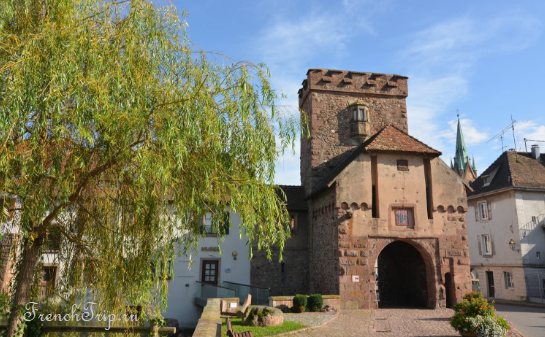
Cernay is a town of about 12,000 in the Haut-Rhin, where the Doller valley opens onto the Rhine plain, 15 km from Mulhouse and 6 from Thann.
It sits at the southern end of the wine route and at the foot of the Vieil-Armand, and its history is largely the history of being in the way: it was destroyed in the Thirty Years’ War, again in 1914–18, and again in 1944–45. What survives is worth the stop, and what is around it is worth more.
History
The town is first recorded in 1144, as Seyrenay. By the late thirteenth century it had town walls (1268), a seal (1292) and a council governing under the counts of Pfirt, and in 1324 the marriage of Johanna von Pfirt to the Habsburg duke Albrecht II brought Cernay under Austrian rule. Plague struck in 1349. The town took its French name in the seventeenth century, when Alsace passed to the French crown.
Textile manufacturing arrived with nineteenth-century industrialisation; the first mill opened in 1860. Alsace, Cernay included, was annexed to Germany in 1871 and stayed German until 1918; sitting on the front line during the First World War, the town was destroyed by about 80 per cent. German troops occupied it again from June 1940, and from 1940 to 1945 the town housed an SS training school, where among others the recruits of the Division Charlemagne were trained.
The town
- Porte de Thann — the thirteenth-century gate, the only substantial piece of the medieval walls left, holding a small museum of the two world wars
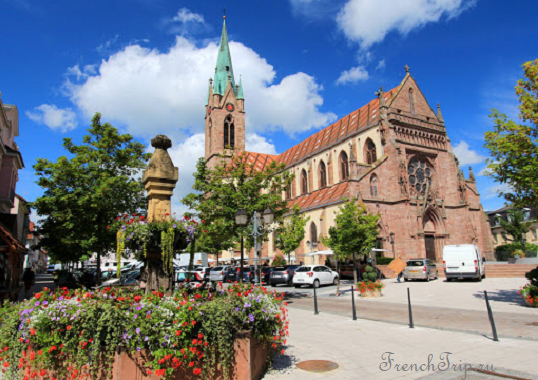
- Église Saint-Étienne — rebuilt in the nineteenth century in neo-Gothic after the older church burned
- The Thur — the river through the town, with walks along it
- Inside Saint-Étienne — completed in 1925 on a Latin-cross plan; the walls were painted by the Alsatian artist René Kuder (1882–1962), and the transept holds a five-metre crucifixion.
- The Tour Ronde — a round tower from Cernay’s medieval walls, at the south-eastern corner, dated to 1422.
- Hôtel du Maréchal de Schönbeck — a mansion bought in 1647 by Marshal Schönbeck, who enlarged it with his sons, adding a keep. Sold off after the Revolution, it later became a notary’s office. Louis XIV is said to have stayed here with the queen and their court on a night in June 1683.
- The military cemeteries — Cernay’s own national cemetery, built in 1920 and separate from the one on the Vieil-Armand, holds 3,643 graves of French and allied soldiers — British, Russian, Serbian and Czech — killed in the two world wars. A German war cemetery on the other side of town holds German soldiers killed on the Hartmannswillerkopf, buried there after 1918.
- Markets — a weekly market is held on Tuesday mornings at the place de l’église and on Friday mornings at the place du Grün, with a larger braderie twice a year, in early summer and in autumn.
The stork park
Storks are a symbol of Alsace, and Cernay’s parc à cigognes, opened in 1978, was one of the first built to save them: numbers in Alsace fell from around 140 breeding pairs in 1938 to just seven by 1967. The park now holds around 60 birds, and storks are a regular sight over the town, which has taken the nickname “Cernay, cité des cigognes”.
The park sits in the wetlands between Cernay and Vieux-Thann, a stretch of the Thur valley that is rare habitat in Alsace and is now protected. A two-hour trail along the riverbank, with thirteen information panels on the local plants and wildlife, follows the water.
The steam railway
The Train Thur Doller Alsace runs restored steam locomotives 14 km up the Doller valley from Cernay to Sentheim, from May to October. It is worked by volunteers, the rolling stock is period, and it is one of the better preserved lines in eastern France.
The route follows part of an older line that connected Cernay with Sewen from the early 1920s until 1960; the stations and track have kept much of their old appearance, which has made the line popular with film crews. A tourist service reopened here in the late 1960s, among the first of its kind in France.
Vieil-Armand
Ten minutes up the mountain, and the reason many people come to Cernay. The Hartmannswillerkopf — the French called it the Vieil-Armand — is a spur of the Vosges at 956 m that dominates the plain, and in 1915 both armies decided it had to be held.
Some 30,000 men died there over four years of fighting that moved the front line by almost nothing. The site is one of the four French national monuments of the First World War: a national cemetery with 1,264 graves, a crypt holding the bones of 12,000 unidentified men, and kilometres of trenches, tunnels and concrete positions preserved in the woods.
A Franco-German historial opened in 2017. The trenches are freely accessible and it takes a couple of hours to walk them properly. It is a sobering place and one of the most important sites in Alsace.
Vignoble du Rangen
The Rangen, on a steep (45°) south-facing slope above Thann, is the southernmost vineyard in Alsace and the only one classified entirely as Grand Cru. Its volcanic soil and the pitch of the slope have given the wine a reputation recorded since the Middle Ages. The vineyard was once overseen by “bangards” elected each year by the people of Thann, who at the end of their term marked the year’s notable events in paintings or carvings.
Getting to Cernay
- By train — on the Mulhouse–Thann line, with the tram-train running through to Mulhouse city centre; about 20 minutes.
- By car — off the N66. Mulhouse 20 minutes, Colmar 40. See parking in France.
Around Cernay
- Vieil-Armand / Hartmannswillerkopf — 10 minutes up
- Thann — 6 km, with the finest Gothic spire in Alsace
- Soultz and Guebwiller — 10 and 15 km north on the wine route
- Grand Ballon — 30 minutes, and the Route des Crêtes beyond it
- Écomusée d’Alsace — 20 minutes at Ungersheim
- Wattwiller — 3 km, known for its mineral springs and a water festival held each June. Its church of Saint-Jean-Baptiste, rebuilt on a thirteenth-century Romanesque foundation and listed as a historic monument in 1930, is among the five oldest in the Haut-Rhin, with an old graveyard and notable headstones around it.
When to go
May to October, for the steam train and for the mountain. The Vieil-Armand is at 956 m and can be in cloud when the plain is clear; check before driving up. November 11 is marked there properly.
See Alsace.
Weather in Cernay
| Month | Day | Night | Rainfall |
|---|---|---|---|
| January | +5° | -1° | 93 mm |
| February | +7° | 0° | 76 mm |
| March | +12° | +2° | 72 mm |
| April | +16° | +6° | 60 mm |
| May | +20° | +10° | 81 mm |
| June | +24° | +13° | 74 mm |
| July | +26° | +15° | 66 mm |
| August | +26° | +14° | 71 mm |
| September | +21° | +11° | 60 mm |
| October | +16° | +7° | 81 mm |
| November | +9° | +3° | 76 mm |
| December | +6° | 0° | 111 mm |
Updated: