French breakfast
The French breakfast is the smallest meal of the day and deliberately so. It is pastry or bread with butter and jam, coffee, and not much else — because lunch is the meal that matters here, and nobody wants to arrive at it full.

What is on the table
Savoury breakfast barely exists. The French rarely eat porridge, eggs or meat in the morning. What you get is an assortment of baked things:
- Croissants — the obvious one, plain, with jam beside them rather than in them.
- Baguette — a length of it, cut, buttered and spread with jam. Dipped in coffee at home, which nobody admits to in public.
- Pain au chocolat — the same laminated dough wrapped round two sticks of chocolate. In the south-west it is called chocolatine, and the argument about which is correct has been running for a century.
- Brioche — enriched with egg, light, faintly sweet.
- Cereal — des céréales, increasingly common and mostly for children.
To drink: coffee, tea, or hot chocolate for children. The usual morning coffee is café au lait, coffee with hot milk, served in a bowl at home and in a large cup in a café. Hotels add fresh fruit juice.
And note the «or» in all this: most people have one of these things, not a buffet assembled from all of them.
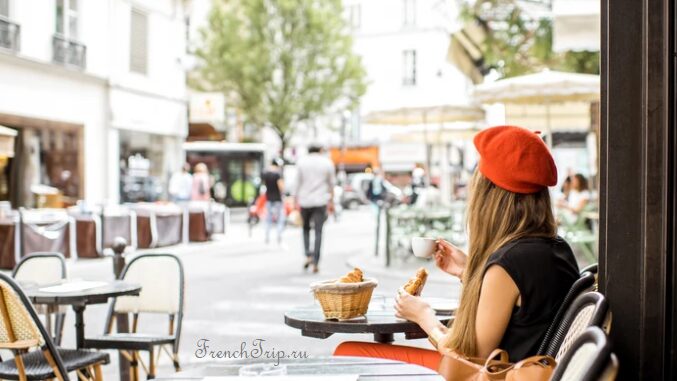
Ordering the coffee
The words matter, and they are few:
- un café — an espresso. This is what «a coffee» means in France, at any hour.
- un café allongé — the same with more water, the closest thing to what most visitors mean by coffee.
- une noisette — an espresso with a drop of milk.
- un café crème — espresso with steamed milk; the morning drink in a café. Ordering one after lunch marks you out, though nobody will mind.
- un café au lait — coffee with hot milk, mostly a domestic thing, served in a bowl.
Prices depend on where you stand: at the counter (au comptoir) a coffee is cheaper than at a table inside, and a table on the terrace costs more again. This is posted by law, so the price list on the wall settles it. Reckon on 1–2€ at a counter, 3€ or more on a terrace in a tourist town, and roughly 1.10–1.40€ for a croissant at a bakery.
Why it is so light
Because lunch is the serious meal. Even formal companies will overlook an employee taking more than an hour over it, and it is expected to carry you through the day. An afternoon snack is perfectly acceptable for children — it has its own name, le goûter — but for an adult, snacking between meals is regarded as worse manners than smoking.
That is also why restaurant kitchens work lunch and dinner and shut in between: roughly 12:00 to 14:00, then from 19:00 or 19:30. Outside those hours a bakery is your option, and a good one — a sandwich on a fresh baguette runs 4.5 to 7€.
The official advice in France is to add dairy — milk or yoghurt — and fruit to breakfast. Cheese at breakfast, incidentally, is unheard of, whatever hotel buffets abroad may suggest.
Breakfast in hotels

In inexpensive hotels expect exactly what is described above: coffee, juice, a roll or two. Some add a little sliced ham or cheese. If you want a fuller spread, look for the words continental breakfast in the description — that usually means a proper buffet, and it is worth paying for only if you plan to skip lunch, which in France would be a waste of a day.
The better alternative, in most towns, is to skip the hotel breakfast altogether and go to the nearest boulangerie for something baked that morning, then drink your coffee at a café on the square.
See also French cuisine and restaurants in France.
Updated: