French croissants
The croissant is the emblem of French baking and it is not originally French at all. It came from Vienna, arrived in Paris in the 19th century, and only then became the thing the rest of the world pictures when it thinks of a French breakfast.

Where it came from
The ancestor is the Kipferl, the crescent-shaped roll baked in Austria since at least the 13th century. It reached Paris in 1839, when an Austrian artillery officer named August Zang opened the Boulangerie Viennoise in the city and sold Kipferl among other Viennese baking. Zang went back to Austria in 1848, but the bakery kept its reputation for years, and writers of the period list its croissants among the refinements of Parisian eating.
There is an older and more decorative story, which has the croissant arriving in France in 1770 with Marie-Antoinette. Either way, by the second half of the 19th century it was a fixed part of the French breakfast, and the French version had parted company with the Austrian one: laminated dough, layer upon layer of butter folded into it, rather than a plain sweet roll.
What to buy
Bakeries sell two kinds, and the shape tells you which is which. The croissant au beurre — made with butter — is baked straight, with its ends in line. The croissant ordinaire, made with margarine, keeps the crescent curve. It is a French labelling convention, it is followed almost everywhere, and it means you can choose from across the counter without asking.
A good one is crisp enough to shatter and leave flakes on the plate, hollow-sounding, and deep gold rather than pale. If it is soft and uniformly yellow it was baked from frozen dough.
Beyond the plain version, bakeries sell croissants filled with chocolate, with cheese and ham as a lunch item, with almond cream and flaked almonds on top — the croissant aux amandes, traditionally made from yesterday’s croissants — and with pâtissier cream. With a plain croissant you get thick fruit jam, and coffee.
The frozen question
In the late 1970s the industry worked out how to produce part-baked frozen croissants that could be finished on site by unskilled staff. That put fresh-smelling pastry into supermarkets, petrol stations and chains — and into a good many bakeries too. Around 30 to 40% of the croissants sold by French bakeries today are baked from frozen dough.
Which is how the croissant became, in effect, the French answer to fast food, and why the label on the window matters. Boulangerie artisanale, or a sign saying the bread is fait maison or baked on the premises, is the thing to look for. A bakery that makes its own will usually say so, because it is the only thing distinguishing it from the chain on the corner.
When to buy
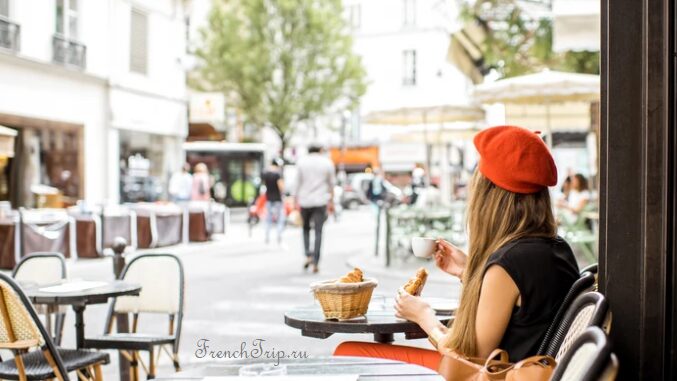
Early. Croissants are baked for the morning, and by midday what is left has been sitting for hours; by evening a bakery may have none at all. They do not keep — a croissant is stale by the next morning, though it revives for a few minutes in a hot oven, and yesterday’s batch is exactly what the almond version is for.
See also French breakfast, traditional dishes from France and French cuisine.
Updated: