Roussillon
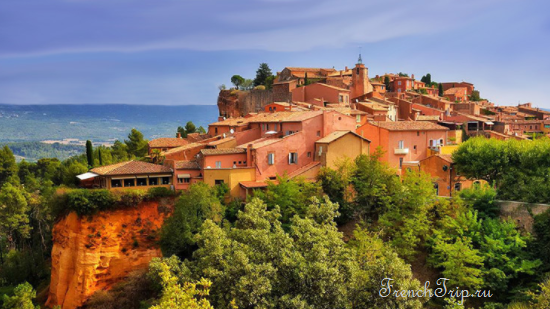
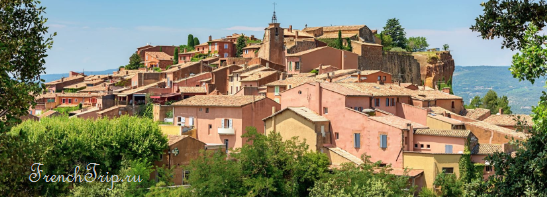
Roussillon stands on a ridge of ochre in the middle of the Luberon, and every house in it is rendered in a colour dug out of the ground underneath — red, orange, pink, yellow. Against the green of the pines and the blue of a Provençal sky, it is the most saturated village in France.
It is one of the Most Beautiful Villages of France, and it is 10 km from Gordes — the two are always visited together and could not look less alike.
History
In the Middle Ages Roussillon was a fortified place with a small castle and a church answerable to the abbey of Villeneuve-lès-Avignon. Ochre quarrying and a processing works arrived with the Ancien Régime and made the pigment the area’s principal source of wealth: the iron oxide, in shades from yellow to red, was used to dye cloth, and the trade employed more than a thousand people until the end of the First World War.
The village’s population today is around 1,300. In the second half of the twentieth century Roussillon became the second most-visited village in the Luberon after Gordes, largely on account of the colour of its houses.
The ochre
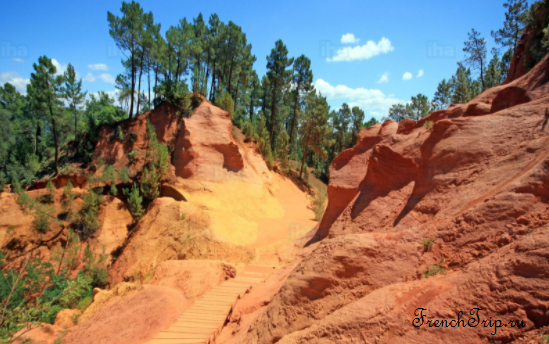
The hill is one of the largest ochre deposits in the world — iron oxide in sand, laid down when this was a shallow sea. It was quarried industrially from the eighteenth century until 1930, when synthetic pigments killed the trade, and the workings left behind a landscape of cliffs, pinnacles and gullies in seventeen distinct shades.
The Sentier des Ocres runs through the old quarries from the edge of the village — a short loop of about 30 minutes or a longer one of an hour, on marked paths through the cut faces. It costs a few euros, it is the best thing here, and one practical warning: the dust stains. Do not wear white, and expect your shoes to be orange afterwards.
The routes are named for their rock formations, among them the Aiguilles (“needles”) and Le Géant (“the giant”), shaped by erosion as well as by the old quarrying. Removing stone from the site is no longer allowed. Immediately outside the entrance there is a free view of an ochre outcrop for anyone who would rather not pay to go in.
The Conservatoire des Ocres, in a former factory below the village, explains how the pigment was washed, settled and fired, and still sells it.
The village
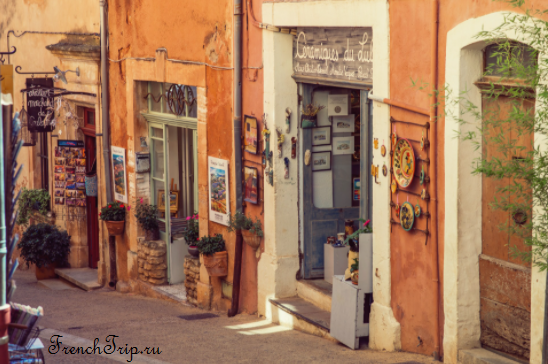
Small and steep, and the pleasure is simply walking it: the renders in every shade from cream to blood red, blue and green shutters against them, and a Provençal ritual of repainting to a locally agreed palette.
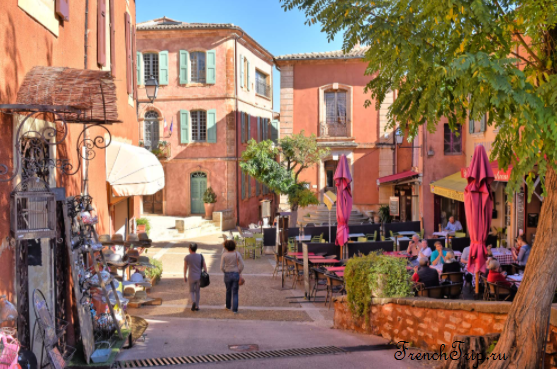
The main square is planted with flowers and lined with restaurant terraces. The village as a whole looks out towards two named rock formations, the Val des Fées (“fairies’ valley”) and the Chaussée des Géants (“giants’ causeway”). Painters and potters keep galleries in the streets nearby.
Climb to the Castrum, the viewing table at the top where the castle was, for the whole Luberon on one side and Mont Ventoux on the other. The church of Saint-Michel and the belfry over the old gate are on the way up.
A walk through the village
The route up starts at place du Pasquier, by the old gate in the medieval walls; the belfry standing over it was rebuilt in the nineteenth century and now doubles as the church’s spire. A path to the left follows the old rampart walk, with a view back over the village and the surrounding country.
The church, built hard against the cliff edge, keeps a seventeenth-century facade and an eighteenth-century choir over a much-altered medieval base; inside are paintings, a statue of Saint Michael and a wooden font under a stone canopy. A viewing point close to the cliff edge, though safe, looks out over the Luberon.
The walk down passes eighteenth-century houses on the square by the Hôtel de Ville, a fountain with a cattle motif near the old post office, and the Naiad fountain below the village.
Samuel Beckett
Beckett hid here from 1942 to 1945, having fled Paris after his Resistance cell was betrayed, and worked as a farm labourer while writing Watt. Roussillon is named in Waiting for Godot. There is a plaque, and not much more — which is probably in keeping.
What to eat
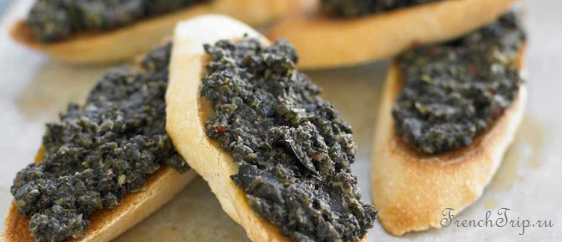
Provençal, and the market is the thing: tapenade, goat cheese, melon from Cavaillon, Ventoux wine. The village market is on Thursday mornings. See Provençal cuisine.
Getting to Roussillon
- By car — the practical way. 50 minutes from Avignon, 10 minutes from Gordes. Paid car parks below the village; it fills in season.
- By bus — a thin service from Cavaillon and Apt. Check the return before you rely on it.
- By train — there is no station in Roussillon itself. The nearest mainline (TGV) station is at Avignon, and the nearest regional (TER) station is at Cavaillon.
See parking in France.
Around Roussillon
- Gordes — 10 km, and the Sénanque abbey beyond it
- Rustrel — the “Colorado Provençal”, a larger and wilder set of ochre workings, 15 km east
- Bonnieux and Ménerbes — across the valley
- Apt — the market town, with a big Saturday market
- Bories — a park of the Luberon’s traditional dry-stone huts near Gordes; the Sénanque abbey close by holds one of Provence’s best-known lavender fields
The Luberon regional park has its own network of marked trails; see walking tours in the Luberon.
When to go
The ochre is at its most intense in low sun — early morning or the hour before sunset — and washed out at midday, which is exactly when the coaches arrive. Spring and autumn; the paths are hot and exposed in summer.
See the natural sights of Provence.
Weather in Roussillon
| Month | Day | Night | Rainfall |
|---|---|---|---|
| January | +10° | +2° | 56 mm |
| February | +11° | +1° | 38 mm |
| March | +15° | +4° | 41 mm |
| April | +18° | +7° | 65 mm |
| May | +23° | +11° | 64 mm |
| June | +27° | +14° | 43 mm |
| July | +30° | +16° | 34 mm |
| August | +30° | +16° | 40 mm |
| September | +25° | +13° | 88 mm |
| October | +20° | +10° | 89 mm |
| November | +14° | +5° | 97 mm |
| December | +10° | +2° | 55 mm |
Updated: