Biarritz
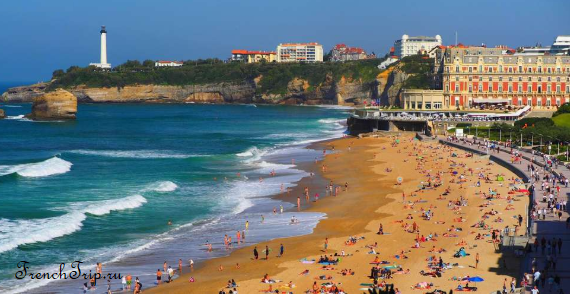
Biarritz is a seaside resort of about 25,000 people on the Atlantic coast in the far south-west of France, in the French Basque country, some 30 km from the Spanish border. It is famous for its long sandy beaches and Atlantic surf, its Belle Époque villas and grand hotels, its mild climate, and its history as the summer playground of emperors and kings. It is also the birthplace of European surfing, and one of the liveliest places on the French coast in summer.
A short history
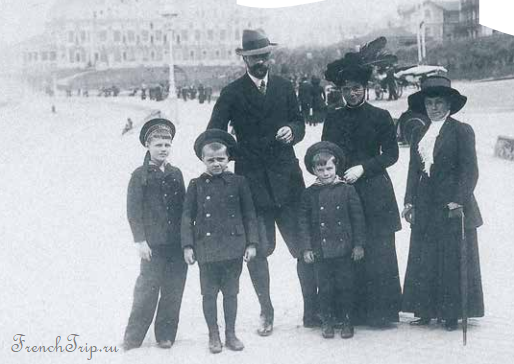
Until the middle of the 19th century Biarritz was a small fishing and whaling village around its old port. Then sea bathing came into fashion, and in 1854 the empress Eugénie, the Spanish wife of Napoleon III, who had known the coast since her childhood, persuaded the emperor to build a summer palace on the beach. The court followed, the railway arrived, and Biarritz became one of the most fashionable resorts in Europe. Queen Victoria, Empress Elisabeth of Austria (“Sissi”) and King Edward VII of Britain, who came almost every spring, all stayed here, and in the years before the First World War it was known as “the queen of resorts and the resort of kings”.
Russian aristocrats came in such numbers, especially after the Franco-Russian alliance of 1892, that they built their own Orthodox church, and a street was renamed the Rue de Russie in 1909. Between the wars Biarritz was the resort of film stars and fashion designers, and in 1957 the American screenwriter Peter Viertel, in town for the filming of The Sun Also Rises, rode the first surfboard seen on the beaches of the Côte des Basques. Since then Biarritz has been a capital of surfing as well as of luxury.
What to see
The Grande Plage and the Hôtel du Palais
The Grande Plage, the main beach, curves along the centre of town under the Art Deco Municipal Casino, built in 1929. At its northern end stands the Hôtel du Palais, built in 1854–1855 as the Villa Eugénie, the empress’s summer residence. After the fall of the Second Empire it was sold, turned into a hotel, burned in 1903 and rebuilt in grander style. It remains the most famous luxury hotel on the coast. Next to it, the Imperial Chapel, built in 1864 for Napoleon III and Eugénie in a mixture of Romano-Byzantine and Hispano-Moorish styles, is dedicated to Our Lady of Guadalupe, the patron of Mexico.
The Rocher de la Vierge
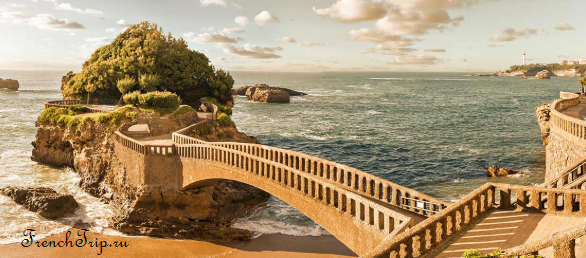
The Rock of the Virgin is a rocky islet topped by a statue of the Virgin Mary, placed there in 1865 by grateful fishermen who, according to legend, had been guided to safety in a storm by a mysterious light. It is joined to the shore by an iron footbridge built in 1887 by the workshops of Gustave Eiffel. The walk out to it, with the Atlantic breaking on the rocks around you, is the classic image of Biarritz, and on a clear day you can see the mountains of the Spanish Basque coast.
The ports
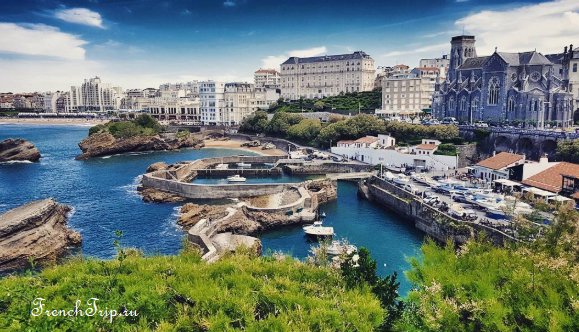
- The Port des Pêcheurs, the little fishermen’s harbour built in 1870 below the town, with old fishermen’s houses that are now seafood restaurants.
- The Port Vieux, the old whaling port, with a small beach sheltered from the waves, popular with locals all year round. The Rue du Port-Vieux, Rue Mazagran and Rue Gambetta behind it are the main streets for shops, bars and restaurants.
The lighthouse
The lighthouse, built in 1834 on the Pointe Saint-Martin at the northern end of town, is 44 m high, with its light 73 m above the sea. You can climb its 248 steps for a view over the whole coast. It is a favourite place to watch the sunset.
Museums
- The Musée de la Mer (Aquarium de Biarritz), in an Art Deco building of 1933 next to the Rocher de la Vierge, with the fish and seals of the Bay of Biscay, and its modern sister, the Cité de l’Océan, opened in 2011, about the ocean and surfing.
- The Asiatica museum of oriental art, with a large collection from India, Tibet, Nepal and China.
- The Planète Musée du Chocolat, on the history of chocolate, for which the Basque country has been famous since the 17th century.
- The historical museum, in a former Anglican church, on the transformation of Biarritz from a fishing village into a resort.
The Belle Époque villas and the Russian church
Walk along the cliffs and the Plage Miramar to see the villas of the Belle Époque, such as the Villa Belza, built in 1895 on a rock above the sea, with its pointed turret. Near the Grande Plage, the Orthodox church of the Protection of the Mother of God and Saint Alexander Nevsky, built in 1892 in the Byzantine style, with its blue dome, recalls the Russian summers of Biarritz. The covered market, Les Halles, open since 1885, is the place to buy Basque ham, cheese and pastries.
Beaches and surfing
Biarritz has about 6 km of beaches. The Grande Plage and the Plage Miramar are the central ones, the little Port Vieux the most sheltered, and the Côte des Basques, under the cliffs to the south, the home of surfing, with surf schools for beginners. The Atlantic water, rich in iodine, also made Biarritz a centre of thalassotherapy, with seawater spas. See the most beautiful beaches in France.
Safety on the beach
- Waves and currents. The Atlantic here is powerful, and strong currents, called baïnes, can carry swimmers out to sea, even close to the shore. Swim only on supervised beaches in summer, between the flags, and respect the colour of the flag: green for safe, yellow for caution, red for no swimming. If a current pulls you out, do not swim against it: let it carry you, then swim parallel to the beach and signal for help.
- Tides. At high tide the beach of the Côte des Basques disappears completely under the sea, and the walk along the foot of the cliffs can be cut off. Check the tide times.
- Cliffs. The cliffs are crumbling; keep away from their edges and do not sit right below them.
- If you are new to surfing, take lessons with a qualified school; surfers have to keep away from the swimming zones.
What to eat
Basque cooking is one of the great regional cuisines of France: piperade (peppers, tomatoes and onions with eggs), Bayonne ham, axoa (a stew of minced veal with Espelette pepper), squid and tuna from the fishing ports, ttoro fish soup, sheep’s cheese from the mountains with black cherry jam, and the gâteau basque. Try the pintxos, Basque tapas, in the bars. See the cuisine of Nouvelle-Aquitaine.

Getting there
- By air: Biarritz Pays Basque airport is just outside town, with flights from Paris and other European cities.
- By train: direct TGVs from Paris Montparnasse take about four hours; from Bordeaux it is about two hours. The station, Biarritz, is about 3 km from the centre, with buses to the beaches. See high-speed TGV trains in France.
- By bus: long-distance coaches run from Paris, Bordeaux and Spain, and regional buses connect Biarritz with Bayonne, Anglet, Saint-Jean-de-Luz and San Sebastián.
- By car: Biarritz is just off the A63 motorway between Bordeaux and Spain. Parking in the centre is difficult in summer; use the park-and-ride car parks and the shuttle buses.
Where to park in Biarritz
| Car park | Spaces | Fee | From centre |
|---|---|---|---|
| Open car park | 42 | — | 460 m |
| Gare du Midi underground | — | paid | 960 m |
| Parking Halles - Clémenceau multi-storey | — | paid | 1.2 km |
| Parc Relais d’Iraty | 250 | free | 1.3 km |
| Bellevue underground | — | paid | 1.4 km |
| Casino underground | — | paid | 1.4 km |
| Parking Bellevue underground | — | — | 1.5 km |
Around Biarritz
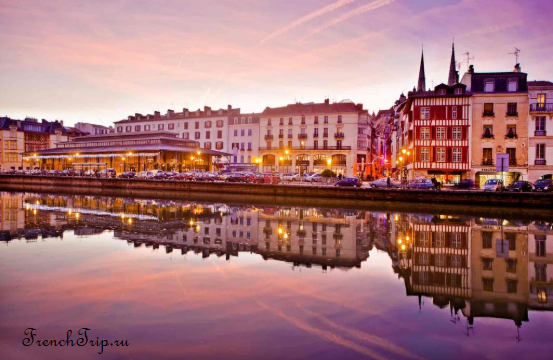
- Bayonne, next door, the capital of the French Basque country, with its riverside houses with coloured shutters, its cathedral, its chocolate and ham, and the huge Fêtes de Bayonne at the end of July, when the whole town dresses in white and red; see festivals in France.
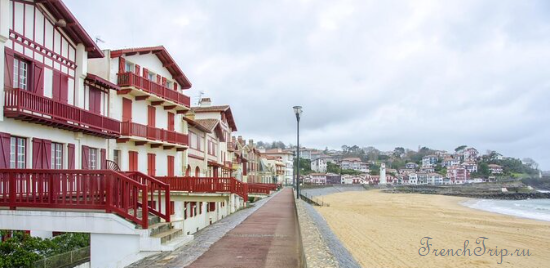
- Anglet, just north, with long surfing beaches and a pine forest, and the villages of Bidart and Guéthary along the coast to the south.
- Saint-Jean-de-Luz, an old fishing and corsair port with a sheltered beach, where Louis XIV married the Spanish infanta in 1660.
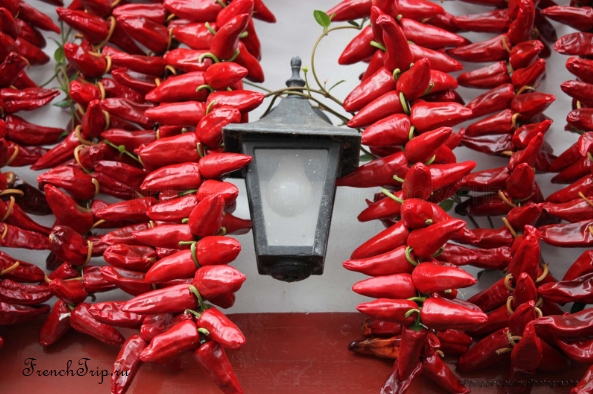
- Espelette, famous for its red peppers, hung to dry on the house fronts in autumn, with a pepper festival at the end of October.
- Ainhoa, Sare and Arcangues, Basque villages of white houses with red and green timbers; see the most beautiful villages in France.
- La Rhune, the mountain on the Spanish border, reached by an old rack railway, with views over the ocean and the Pyrenees.
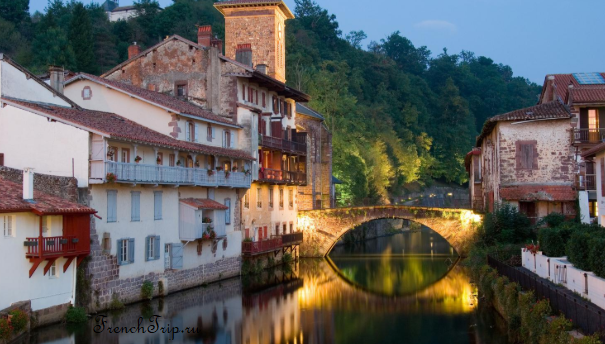
- Saint-Jean-Pied-de-Port, a walled town at the foot of the Pyrenees on the pilgrim route to Santiago de Compostela.
- Cambo-les-Bains, with the Villa Arnaga, the house and gardens of Edmond Rostand, the author of Cyrano de Bergerac, and Hendaye, with its beach and the neo-Gothic Château d’Abbadia.
- Across the border, San Sebastián, with the bay of La Concha and its famous food, and Bilbao, with the Guggenheim Museum, about an hour and a half away.
For the rest of the region, see Nouvelle-Aquitaine, Bordeaux and Arcachon.
Weather in Biarritz
| Month | Day | Night | Rainfall |
|---|---|---|---|
| January | +12° | +5° | 140 mm |
| February | +13° | +5° | 110 mm |
| March | +15° | +7° | 103 mm |
| April | +17° | +9° | 118 mm |
| May | +20° | +12° | 116 mm |
| June | +23° | +15° | 99 mm |
| July | +24° | +17° | 77 mm |
| August | +25° | +17° | 88 mm |
| September | +23° | +15° | 118 mm |
| October | +20° | +12° | 147 mm |
| November | +15° | +8° | 207 mm |
| December | +13° | +6° | 151 mm |
Updated: