Montmartre
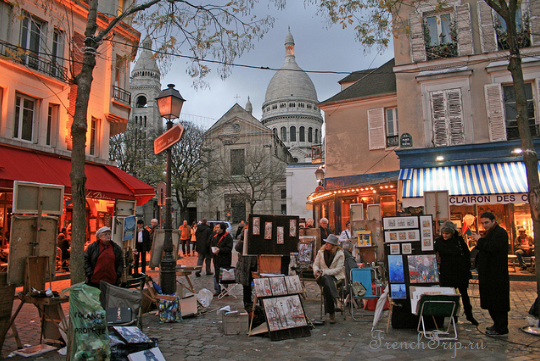
Montmartre is the hill in the north of Paris, in the 18th arrondissement, crowned by the white domes of the Sacré-Cœur. At about 130 m it is the highest point in the city, and Parisians simply call it la Butte, the mound. It was a village of windmills, vineyards and quarries outside the city walls until it was joined to Paris in 1860, and its narrow, steep streets still feel like a village.
In the late 19th and early 20th centuries Montmartre was the cheapest and liveliest place in Paris for artists: Renoir, Toulouse-Lautrec, Van Gogh, Picasso, Modigliani, Suzanne Valadon and Utrillo all lived and worked here, among the cabarets, dance halls and cheap lodgings. Today it is one of the most visited parts of Paris, crowded around the Sacré-Cœur and the Place du Tertre, but a few streets away it can still be quiet and charming.
A short history
The name is traditionally explained as the “mount of the martyr”: according to legend, Saint Denis, the first bishop of Paris, was beheaded here in the 3rd century, and walked away carrying his own head. Some historians prefer an older origin in a Roman temple of Mercury, Mons Mercurii. In the Middle Ages the hill belonged to a large abbey of Benedictine nuns, which was destroyed in the Revolution; its church, Saint-Pierre de Montmartre, survives.
In March 1814 Russian and allied troops fought their way up the hill in the battle of Paris and camped on it. A well-known story says that Russian soldiers in the cafés shouted “bystro!” (“quickly!”) for their food, and so gave the French language the word bistro. It is a good story, told on a plaque at the restaurant La Mère Catherine on the Place du Tertre, but linguists doubt it, since the word appears only decades later. In 1871 the rising of the Paris Commune began on this hill, when the people of Montmartre stopped the army from taking away the cannons kept here.
What to see
The Sacré-Cœur
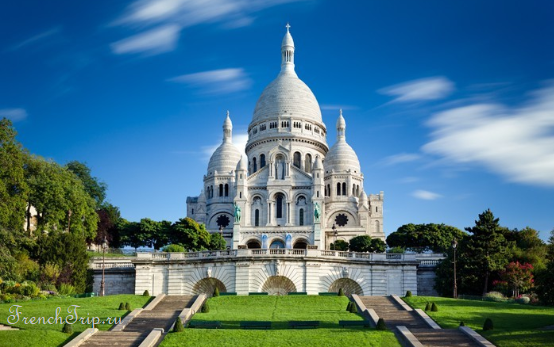
The basilica of the Sacré-Cœur (Sacred Heart) was built between 1875 and 1914 and consecrated in 1919, in a Romano-Byzantine style, of a white stone that cleans itself in the rain. Inside, a huge mosaic of Christ fills the apse. From the steps in front of it there is one of the great views over Paris, and for a wider one you can climb about 300 steps to the top of the dome. Entry to the basilica is free; it is a working church, so dress and behave accordingly.
Saint-Pierre de Montmartre
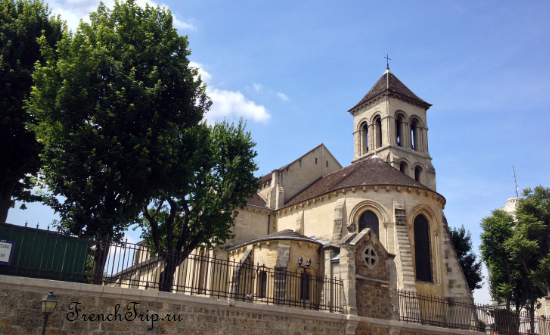
Just west of the basilica, in its shadow, the church of Saint-Pierre de Montmartre was consecrated in 1147 and is one of the oldest churches in Paris. Inside are columns that are said to have come from a Roman building on the hill. It is quiet and worth a few minutes.
Place du Tertre and the painters
The Place du Tertre, the old village square, is filled with the easels of portrait painters and caricaturists, and ringed by restaurants. It is touristy and the art is uneven, but it is lively and good fun. Agree the price before you sit for a portrait.
The streets
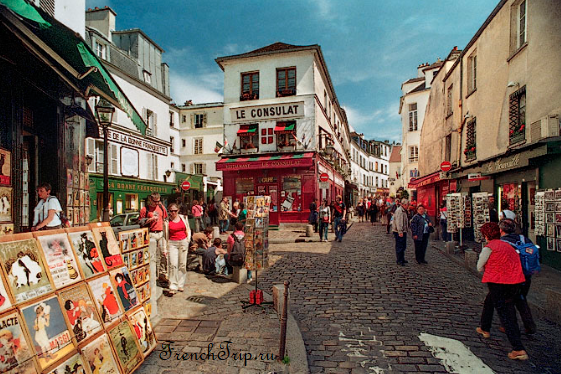
The best way to see Montmartre is simply to wander. A few places worth looking for:
- The Rue de l’Abreuvoir and the pink house of La Maison Rose, one of the most photographed corners of Paris.
- The Clos Montmartre vineyard on the Rue des Saules, the last vineyard in Paris, with a harvest festival every October, and the old cabaret Au Lapin Agile opposite.
- The Bateau-Lavoir on the Place Émile-Goudeau, where Picasso had his studio and painted Les Demoiselles d’Avignon in 1907; the building was rebuilt after a fire in 1970.
- The Moulin de la Galette and the Moulin Radet, the last two of the windmills that once covered the hill; Renoir painted the dances held at the Moulin de la Galette.
- The quiet Allée des Brouillards, the Avenue Junot with its artists’ houses, and the Rue Lepic, where Van Gogh lived with his brother Theo.
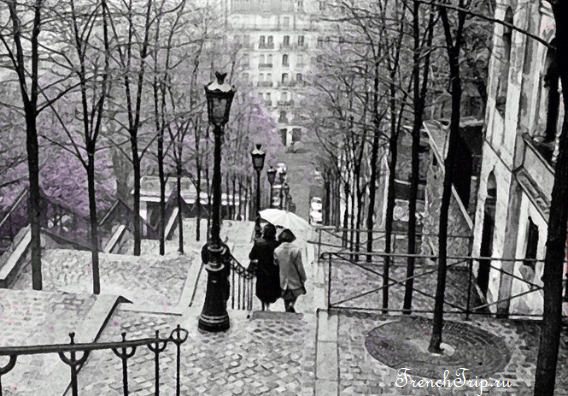
- The steep staircases and old street lamps on the slopes of the hill, such as the Rue Foyatier beside the funicular.
- The Wall of Love (Mur des je t’aime) in the little square by the Abbesses metro, with “I love you” written in some 250 languages.
Museums
- The Musée de Montmartre, on the Rue Cortot, in one of the oldest houses on the hill, where Renoir, Suzanne Valadon and Utrillo had studios. It tells the story of the artists and cabarets of Montmartre, and its garden looks over the vineyard.
- Dalí Paris, near the Place du Tertre, a museum of sculptures and engravings by Salvador Dalí.
For the painters of Montmartre and where to see their work, see French painters.
Pigalle and the Moulin Rouge
At the foot of the hill, along the Boulevard de Clichy, lies Pigalle, long the red-light district of Paris and still a place of nightclubs and sex shops, though the neighbourhood around it is now fashionable. Here stands the Moulin Rouge, the cabaret with the red windmill, opened in 1889, home of the French cancan and painted by Toulouse-Lautrec; its shows still run every night. The Café des Deux Moulins on the Rue Lepic, where the heroine of the film Amélie worked, is a short walk away.
Montmartre Cemetery
The Montmartre Cemetery, below the hill on the west side, is one of the most interesting in Paris, a peaceful place where Degas, Stendhal, Berlioz, Offenbach, Truffaut and the singer Dalida are buried.
Safety
- Pickpockets and scams. The steps below the Sacré-Cœur are notorious for scams: people who tie a “friendship bracelet” on your wrist and then demand money, fake petitions, and the shell game. Keep walking, keep your hands in your pockets and do not sign anything. Watch your bag and phone in the crowds and on the metro.
- Pigalle at night is lively, but avoid the bars that tout for customers on the street, which are known for huge bills.
- The hill is steep, with many stairs; wear comfortable shoes, and take the funicular if you need to.
Getting there
- By metro: line 2 to Anvers, the nearest station to the Sacré-Cœur, or to Pigalle or Blanche for the Moulin Rouge; line 12 to Abbesses, in the heart of old Montmartre (it is one of the deepest stations in Paris, so take the lift), or to Lamarck-Caulaincourt on the quieter north side.
- The funicular of Montmartre climbs from the Square Louise-Michel, below the basilica, to the top of the hill in under two minutes, and takes ordinary metro tickets.
- The small Montmartrobus runs round the narrow streets of the hill.
See also the arrondissements of Paris.
This page in Russian: Монмартр (Monmartre)
Updated: