French foie gras
Foie gras is the fattened liver of a duck or a goose, and one of the few foods French law describes as part of the country’s protected cultural and gastronomic heritage. It tastes rich, buttery and mild — a different thing from an ordinary duck-liver pâté, which is coarser and stronger.
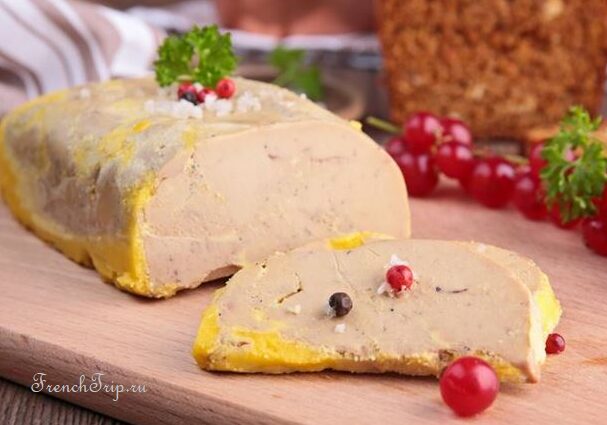
How it is made
The birds are fattened on maize through a feeding tube: ducks twice a day for about 12.5 days, geese three times a day for around 17. Ducks are slaughtered at roughly 100 days old, geese at 112. The technique is old — it goes back to about 2500 BC, when the Egyptians noticed that geese fatten themselves before migrating and set about doing it for them.
Geese used to be the source. By 2004 they accounted for under 10% of world production, and by 2014 only 5% of the French output: 95% of it is duck.
The argument about it
Force-feeding is contested, and honestly so. The objections are the feeding itself, the close confinement, and the liver, which grows to around ten times its normal size — the birds develop what amounts to hepatic steatosis. A number of countries and jurisdictions ban the production, import or sale of foie gras, and in places where it is legal some retailers will not stock it.
There is an alternative, sold as ethical or humane foie gras, pioneered in the Spanish region of Extremadura: the geese are kept in conditions that trigger their natural pre-migration gorging, and are slaughtered when their livers have enlarged on their own. Production is small and the product is expensive, but it exists, and it is worth asking for if the method matters to you.
Where to try it
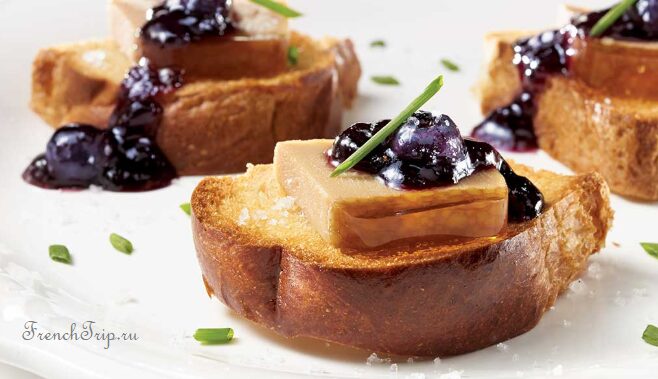
You will find it anywhere in France, from Paris to Lyon, but it belongs to the south-west — the former Midi-Pyrénées, now part of Occitanie, and the Périgord, where duck, duck fat and fried potatoes are the everyday cooking rather than a treat. In restaurants it is usually a starter, from about 10–12€ a portion.
In winter, the marchés au gras of the Périgord — Périgueux, Sarlat — sell whole raw livers, confits and prepared foie gras across a table. See the cuisine of Nouvelle-Aquitaine.
How it is cooked
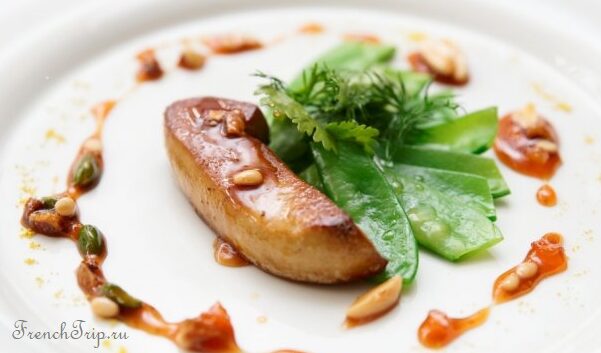
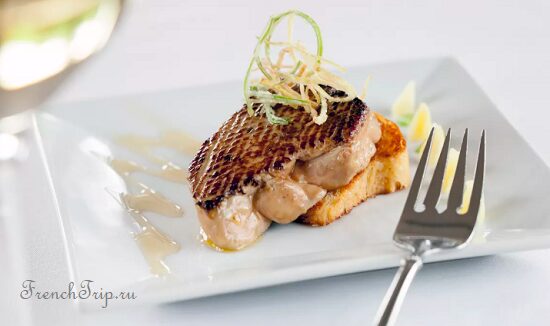
Three main forms. Terrine or mi-cuit: gently cooked, then chilled and sliced — the standard starter. Pan-seared (poêlé): thick slices in a dry, very hot pan for half a minute a side, served immediately with fruit, a fig or a reduction. And as an accompaniment: a slice melted over a steak, where it behaves like butter, or folded into a sauce or a stuffing.
The French tradition is slow and cold. Goose fat melts faster than duck, so goose livers in particular are cooked gently — and the terrines, pâtés, parfaits, mousses and foams that come out of it are chilled and served at room temperature or below, often with truffle, mushrooms or a spirit such as cognac or Armagnac worked in. The most traditional form is au torchon, «in a cloth»: the whole liver is rolled into a sausage, wrapped in a towel and poached slowly in a water bath, sometimes after a few seconds over a fire of vine cuttings for the smoke. It is then sliced cold.
Hot preparations are more common outside France, where duck liver is the norm: in Hungary the goose version is fried in goose fat, which is then poured over it to set, and some cooks smoke the liver over cherry wood.
Look at the label when buying. Foie gras entier is whole lobes; foie gras is pieces pressed together; bloc de foie gras is an emulsion; anything called mousse or parfait contains other ingredients.
How it is served
The standard is a disc of foie gras on warm toast, a pinch of coarse sea salt, and something sweet beside it: fig jam most often, sometimes lingonberry or even strawberry. Onion confit is the other classic — sweet and sharp at once. Fresh figs, in season, beat all of them.
To drink, a sweet white: Monbazillac, Sauternes, Juraçon. A dry red also works, and in a good pairing the combination is complicated enough that nothing else is needed on the table.
Mind the bread, because the wrong one buries the taste. A French baguette suits it best; plain toast is neutral enough; dark rye is too strong and the liver disappears under it.
As a souvenir
Tins and jars travel well and keep for years, which makes them the obvious present to bring home. Airport duty free sells them everywhere, and charges for the convenience: from about 25€ a jar. Ordinary supermarkets are cheaper, and the spread there tells you what you are buying. Good foie gras costs around 80€ a kilo and upwards — the production is slow and that price does not fall, even in Spain. A tin at 5€ exists too, but it is a coarser product in a plain can, and it tastes like one.
Between the two sits mousse de foie, a duck liver mousse which is not legally foie gras but can be delicate and costs a fraction. As a rule, the more you pay, the finer the texture. And check your country’s import rules for animal products before filling the suitcase.
See also duck in French cuisine and French cuisine.
Updated: