Duck in French Cuisine
Nothing says French restaurant cooking quite like duck with a slightly sweet sauce. The French eat more duck than anyone in Europe and know exactly what to do with it — and unlike Peking duck, which takes hours, most French duck cooking is quick.
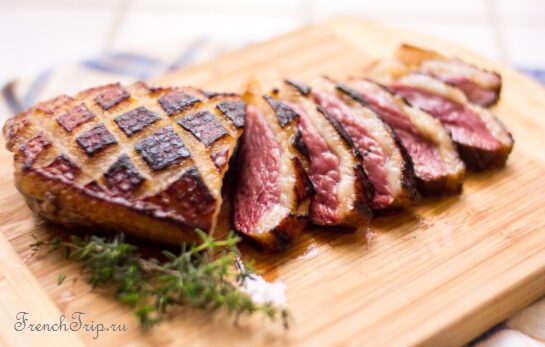
Five ways it reaches the table
- Magret de canard — the breast, cooked fast and served pink.
- Cuisse de canard — the leg, usually roasted or confited.
- Whole roast duck — a household dish more than a restaurant one.
- Duck liver — pan-seared, a course of its own.
- Foie gras — the fattened liver, which has its own rules and its own article.
Duck meat is darker than chicken or turkey and much richer. It is also fatty, which is the point: the breast is cooked with no oil at all, in its own rendered fat, and the potatoes are fried in what is left. How the French eat this and stay thin is a separate question, but the meat is heavy, so once in a while is the right frequency.
Confit de canard
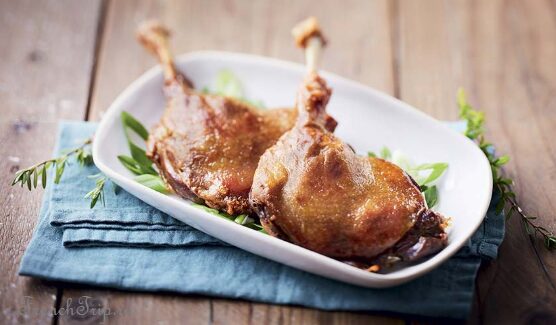
Confit is a preserving method centuries old: salt the meat, then cook it slowly in its own fat and store it there. The leg is rubbed with salt, garlic and sometimes thyme, covered and left in the cold for up to 36 hours — the salt does the preserving — then cooked gently and packed in fat.
It is made across France but belongs to Gascony, where the household tradition uses every part of the bird: the neck, for instance, goes into garbure, the thick soup of the south-west.
The method in full: the salt and garlic are rinsed off and the meat patted dry, then it goes into a dish deep enough to hold it and the melted fat, and into a low oven — 76 to 135 °C — for four to ten hours, until it is soft enough to give under a fork. Meat and fat then cool together, and the meat is packed into a jar and covered completely, with two or three centimetres of fat above it. Sealed that way it keeps up to six months in the fridge, or a few weeks in a plastic container; tinned confit keeps for years. Skip the salting stage and the keeping time collapses.
The fat is half the point. After the confit it goes on to fry green beans with garlic, mushrooms, savoury toasts, eggs and omelettes, and into shortcrust for tarts and quiches. The classic plate is a leg crisped in a little of its own fat with potatoes and garlic fried in the rest — pommes de terre à la sarladaise. The other standard side is red cabbage stewed slowly with apples and red wine.
In restaurants the leg arrives roasted with vegetables and the inevitable thyme and rosemary, with home-style potatoes and, more often than you would expect, a spoonful of lingonberry jam.
In an ordinary restaurant a duck leg costs around 15€. In the cheaper parts of Paris — the Latin Quarter, for one — it turns up inside a 15€ set menu with onion soup or a galette first and a dessert after. Whole duck is a home dish; you will not often see it on a menu.
Magret
The breast is the refined version and the one to order in a better restaurant. It is scored on the fat side, started cold in a dry pan so the fat renders, then finished quickly and rested — served pink, sliced across. It comes with potatoes, with cèpes, or with fruit: figs, cherries, peaches, or the redcurrant and lingonberry preserves that appear beside the leg as well.
Where to eat it
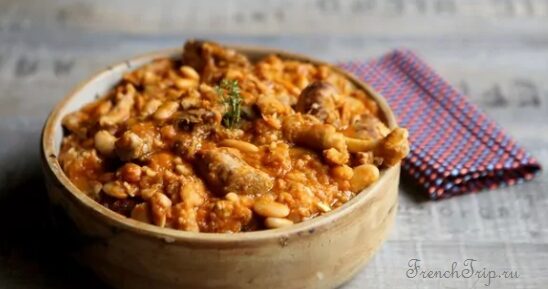
The south-west is duck country: the Périgord, the Landes, Gascony, Toulouse. There the bird is not a delicacy but the basis of the cooking — confit in the cassoulet, fat in the potatoes, liver in the foie gras, neck in the soup. See the cuisine of Nouvelle-Aquitaine for the rest of that table.
Elsewhere in France duck is a restaurant dish: canard à l’orange in the classic repertoire, canard au sang in a handful of Paris institutions, and magret nearly everywhere.
For the rest of the country’s cooking, see French cuisine.
Updated: