Calanques
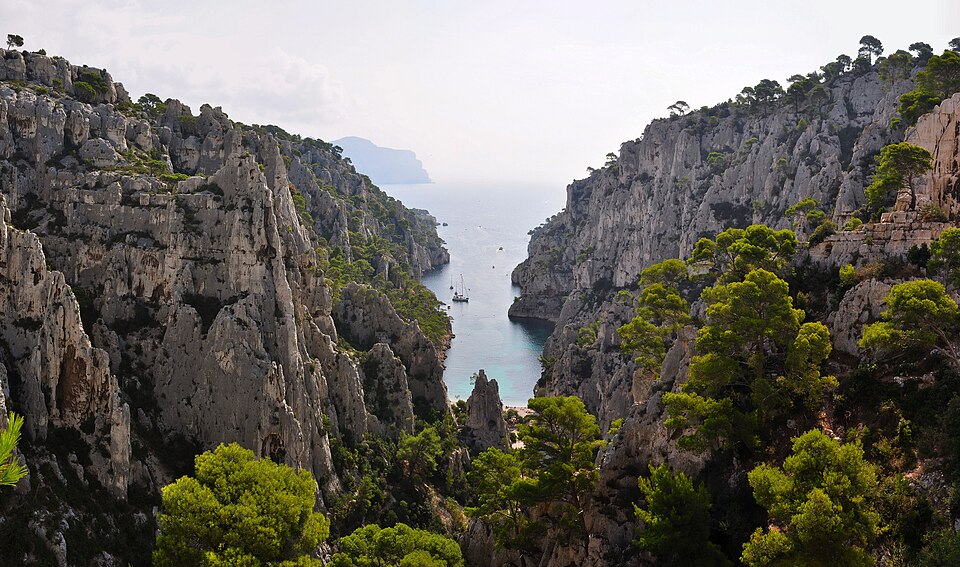
The Calanques are a 20 km stretch of white limestone coast between Marseille and Cassis, cut by narrow steep-sided inlets running back into the rock. They became France’s tenth national park in 2012 — and the first in Europe to cover land, sea and a major city at once.
The water is turquoise because the limestone floor reflects the light. The cliffs go up to 400 m. There are no roads.
What a calanque is
A drowned river valley. The rivers cut these gorges when the Mediterranean was far lower during the ice ages; when the sea came back it flooded them, leaving inlets with vertical sides and a small beach at the head. The result behaves like a fjord and looks like nothing else in France.
The main ones, west to east
- Sormiou and Morgiou — the closest to Marseille, both with a handful of fishermen’s cabins and a beach. Road access is restricted in summer.
- Sugiton — below the university campus, deep and dramatic, and now under a booking system in high season because it was being loved to death.
- En-Vau — the famous one: a narrow gorge between sheer white walls with a small beach at the end. The most photographed and the hardest to reach.
- Port-Pin — smaller, with pines to a pebble beach; the best swim for the effort.
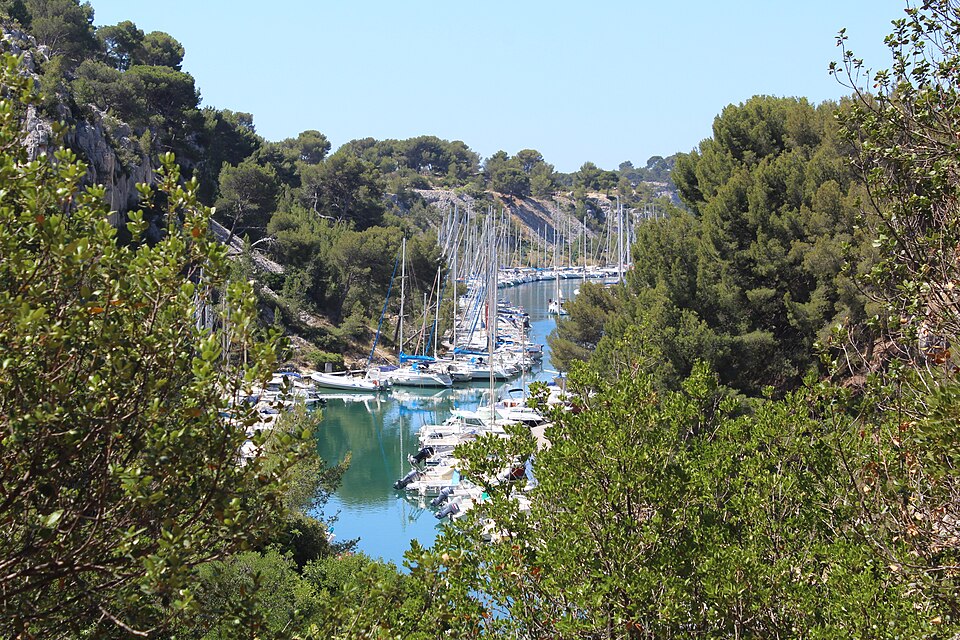
- Port-Miou — the longest, now a natural marina full of moored boats, and the easiest to walk to from Cassis.
How they were made
The cliffs are limestone, over 400 m high in places, laid down around 120 million years ago. What turned them into inlets was the sea: an ancient valley system drowned as the water rose, by some 120 m since the last glaciation, leaving the narrow flooded clefts that get called Provençal fjords.
The Massif des Calanques covers about 26,000 hectares, from the southern edge of Marseille to the boundary of the Var, with ground running from sea level to around 1,000 m and dropping straight into the water. Towards the north-east, near the Sainte-Baume, the inlets become shallower and finally fade out.
The stone was quarried and shipped. Rock from Bestouan and Port-Miou went into harbour works around the Mediterranean and into the great buildings of Marseille: the Prefecture, the courthouse, the Bourse and the cathedral.
And the massif holds water as well as stone. Rain sinks through the limestone and travels underground to the coast, where the submarine springs of Port-Miou and Bestouan discharge fresh water in quantities that would supply the whole region — which is why the karst here is studied as closely as it is walked.
Smaller calanques cut the coast near Saint-Raphaël as well. They are nothing like this in scale, but the rock there is red rather than grey, and worth a look if you are on that stretch of coast.
How to see them
On foot
The proper way, and it is real walking: white rock, no shade, steep rough descents, and it takes longer than the map suggests. From Cassis, Port-Miou is 20 minutes, Port-Pin 40, En-Vau about an hour and a half with a steep scramble at the end. From Marseille, Sugiton is about an hour from Luminy.
Proper shoes, two litres of water per person, and not in the middle of the day.
By boat
Operators run from Cassis and from the Vieux-Port in Marseille, from about 45 minutes for three calanques to a couple of hours for eight or nine. Most sail past without stopping — check whether yours allows a swim.
By kayak or paddleboard
The best of the three: you get into the inlets that boats cannot enter, at your own pace. Guided trips leave from Cassis and Marseille.
The closures — read this before you go
From 1 June to 30 September the massif is subject to daily fire-risk classification, and on orange and red days access is closed or restricted to the early morning. The decision is published by the prefecture the previous evening, on a colour-coded map by sector.
This catches people out constantly: they drive to Cassis in July, walk to the trailhead and find a barrier. Check the daily map before you leave, and have a fallback.
Sugiton additionally requires a free booking in high summer, with a daily cap on numbers.
Practical
- No shade, no water, no facilities anywhere in the massif
- No fires, no camping, no dogs in the core zone
- Swimming is unsupervised and the rock underfoot is sharp
- Parking at Cassis and Luminy is limited and full by mid-morning in season; buses reach both
Under the water
The marine part of the park holds seagrass meadows, red coral and — the extraordinary part — the Cosquer cave, whose entrance lies 37 m below the surface near Morgiou. Its walls carry paintings of horses, bison, seals and penguins made 27,000 years ago, when the sea was 100 m lower and the entrance was on dry land. It is closed to the public for good reasons; a full-scale replica opened in Marseille in 2022.
Around
- Cassis — the eastern gateway, with the boats and the wine
- Marseille — the western end; Callelongue is inside the city boundary
- Cap Canaille — the highest sea cliff in France, on the far side of Cassis, with the Route des Crêtes along the top
- La Ciotat — beyond Cap Canaille, with calanques of its own in red rock
When to go
April to early June, and October. The paths are open, the temperature is walkable and the light is good. July and August combine the heat, the crowds and the closures — if that is when you are here, take a boat or a kayak instead of walking.
See the natural sights of Provence and the best beaches in the region.
Photo credits
Photographs on this page come from Wikimedia Commons under free licences:
- Calanque d’En-Vau — Tobi 87, CC BY-SA 3.0, via Wikimedia Commons
- Calanque de Port-Miou — Chabe01, CC BY-SA 4.0, via Wikimedia Commons


Weather in Calanques
| Month | Day | Night | Rainfall |
|---|---|---|---|
| January | +13° | +6° | 58 mm |
| February | +14° | +6° | 41 mm |
| March | +17° | +8° | 34 mm |
| April | +19° | +10° | 66 mm |
| May | +23° | +13° | 47 mm |
| June | +28° | +17° | 24 mm |
| July | +30° | +19° | 10 mm |
| August | +30° | +20° | 23 mm |
| September | +26° | +16° | 79 mm |
| October | +22° | +14° | 90 mm |
| November | +17° | +10° | 83 mm |
| December | +14° | +7° | 60 mm |
Updated: