Versailles
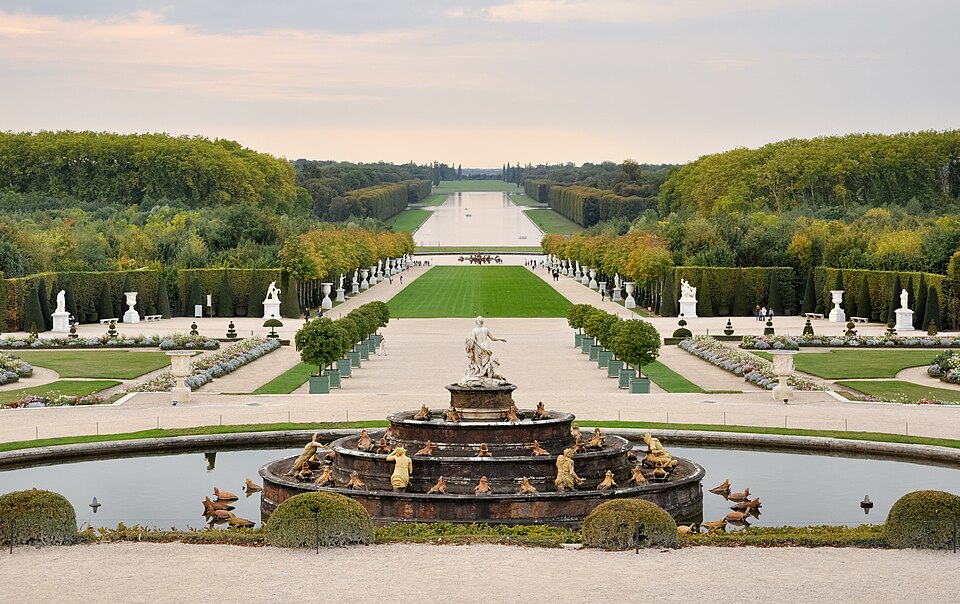
Versailles was a village with a hunting lodge until Louis XIV decided he did not trust Paris. He moved the court out here in 1682, and for a century the palace was the seat of the French state — a building designed to make everyone who entered it understand exactly where power sat.
It is 20 km west of Paris, about 35 minutes by train, and it is the single most-visited monument in France after the Eiffel Tower. It is also, in high season, one of the most crowded places in Europe. Most of this page is about how to handle that.
A short history
Versailles first appears in a charter of 1038. It was a small provincial village around a castle and the church of Saint-Julien, prosperous until the Hundred Years’ War left barely a handful of people living there.
Louis XIII came hunting, liked the country, bought land in 1622 and built a modest lodge of brick and stone. He acquired the rest of the estate from the Gondi family ten years later and kept enlarging it until his death in 1643.
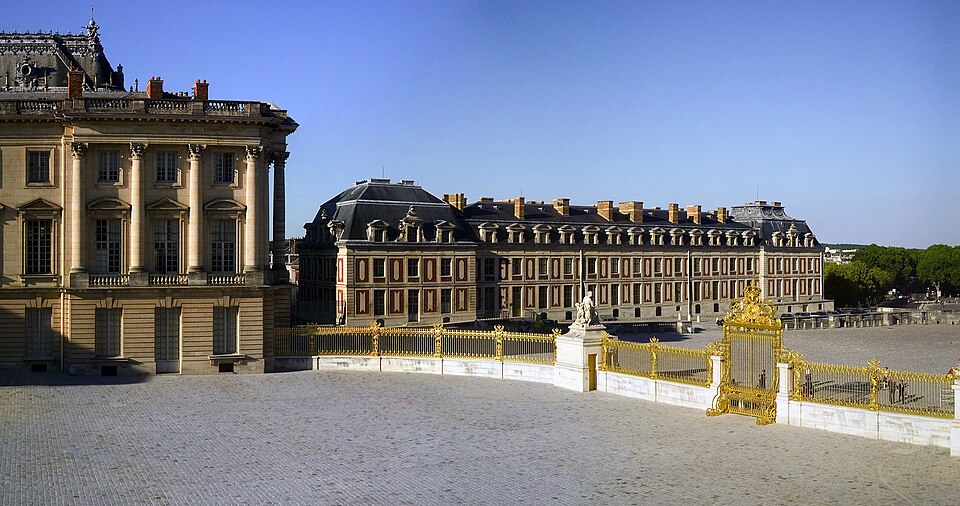
Louis XIV — the Sun King — took an interest from 1662. He distrusted Parisians and wanted his residence away from the Louvre and its permanent political scheming. He hired the architect Louis Le Vau and the painter Charles Le Brun, and André Le Nôtre for the gardens, and turned his father’s lodge into the baroque model that every palace in Europe then copied.
After Le Vau died, Jules Hardouin-Mansart was told to triple the size of it: the north and south wings, the Orangerie, the Grand Trianon and the Royal Chapel are his. The opera house and the Petit Trianon came later, built for Louis XV between 1761 and 1764.
The Revolution emptied it. The paintings and antiquities went to the Louvre, the books to the national library, and most of the furniture was auctioned off. Napoleon summered here; Louis-Philippe turned the place into a museum “to all the glories of France” in 1830, keeping the chapel, the opera and the Hall of Mirrors but knocking small rooms together for exhibition space. In the 1960s the curator Pierre Verlet managed to buy a great deal of the original furniture back and restore the royal apartments.
Inside the palace
The Hall of Mirrors
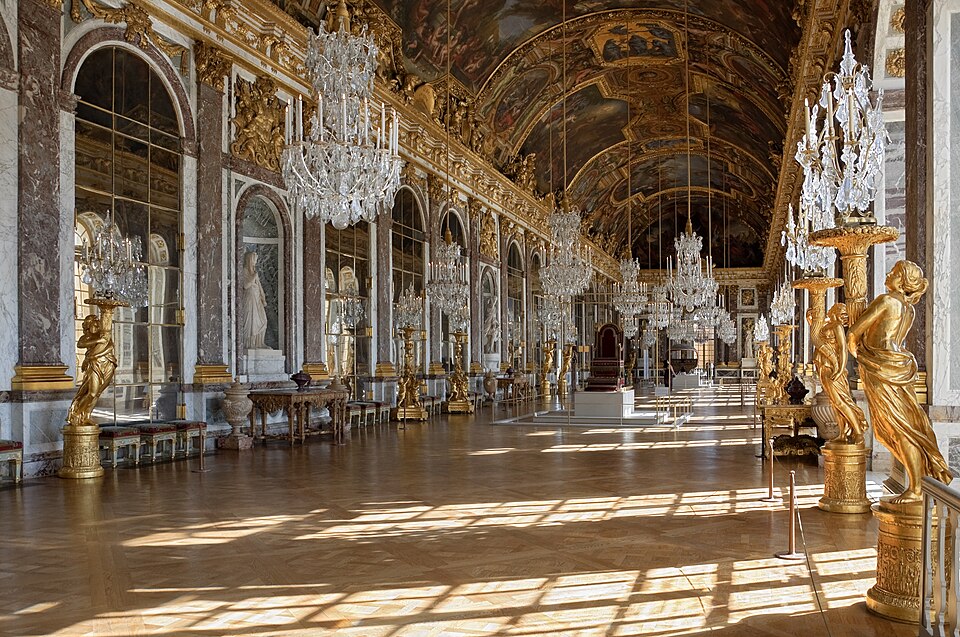
The Galerie des Glaces is 73 m long, 10.5 m wide and 12.3 m high. Seventeen mirrored arches face seventeen windows onto the garden, each arch holding twenty-one mirrors — 357 in all, at a time when a single mirror was a luxury object and Venice guarded the technique as a state secret. Making them in France was an act of economic warfare as much as decoration.
The room has kept turning up in history: the German Empire was proclaimed in it in 1871, and the Treaty of Versailles ending the First World War was signed in it in 1919.
The Grands Appartements
Originally the Planet Rooms — each of the seven salons is named for a planet and painted accordingly. These were Louis XIV’s state apartments, and the ceilings by Le Brun and his team are the reason to look up.
The Royal Chapel
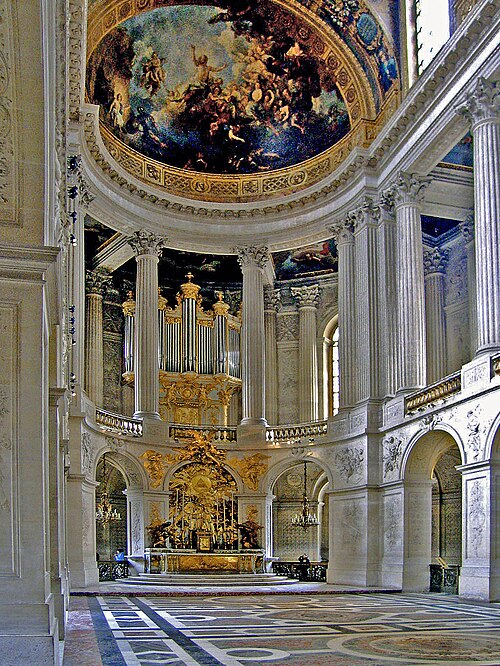
The fifth chapel on the site, built between 1689 and 1710. The king heard mass from a tribune on the level of his own apartments, looking down into the nave. The architecture is an odd and successful hybrid: baroque proportions with details borrowed from medieval cathedrals — gargoyles, a steep roof, coloured marble paving.
The Royal Opera
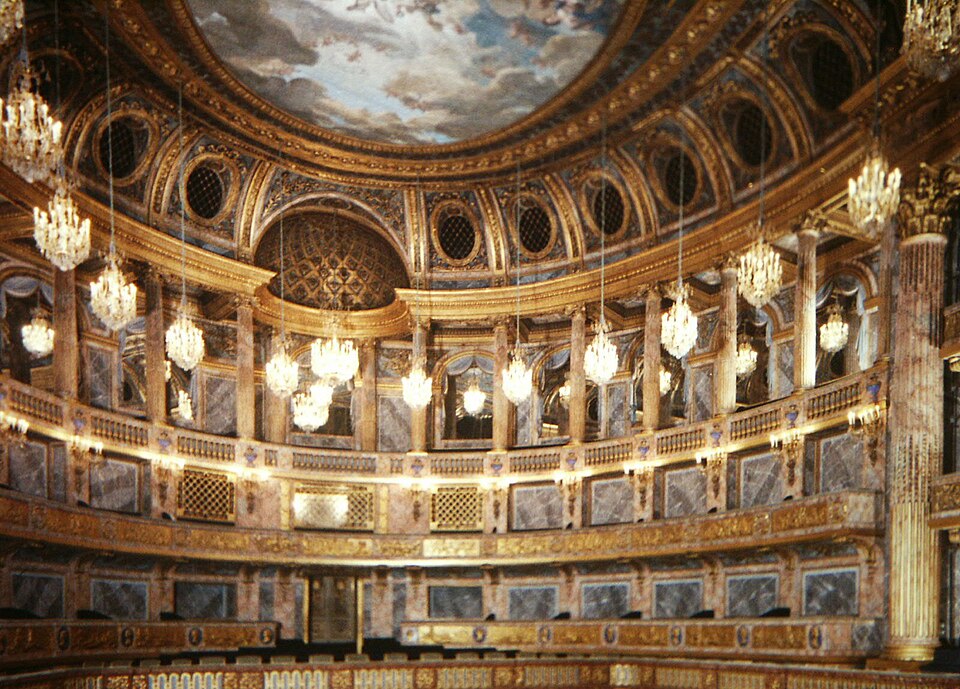
Finished in 1770 and lined entirely in wood, which makes it one of the most acoustically live theatres anywhere. It holds over 700 people, is decorated in gold, pink and green, and has a mechanism that raises the stalls floor to stage level to turn the auditorium into a ballroom. It opened for the wedding ball of the future Louis XVI and Marie-Antoinette, and it still stages concerts and opera.
The gardens
Le Nôtre’s park covers about 800 hectares, with roughly 100 hectares of formal garden — the largest palace garden in Europe and the definitive example of the French formal style. He drained the marshy, sloping ground and imposed geometry on it: axes, parterres, clipped hedges, basins, and the Grand Canal on the main sightline.
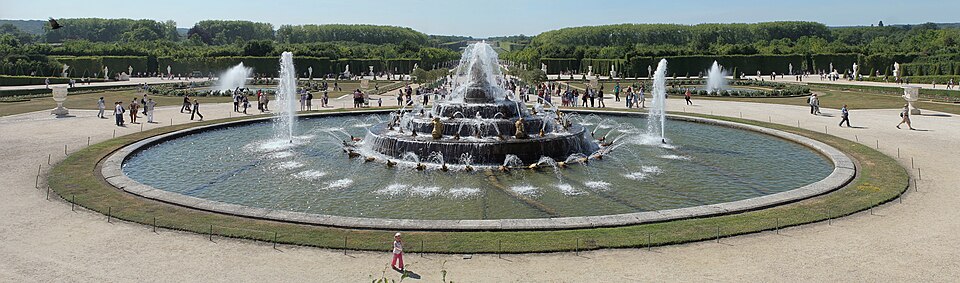
The fountains were entertainment for the king’s guests, and the famous ones are the Latona Fountain and the Apollo Fountain, the sun god driving his chariot out of the water — the Sun King’s own emblem, unsubtly. The Colonnade, a circle of marble columns by Hardouin-Mansart, is tucked into a bosquet and missed by most visitors.
The fountains only run during the Grandes Eaux shows on certain days — check before you go if that matters to you, because the difference is considerable.
The Trianons
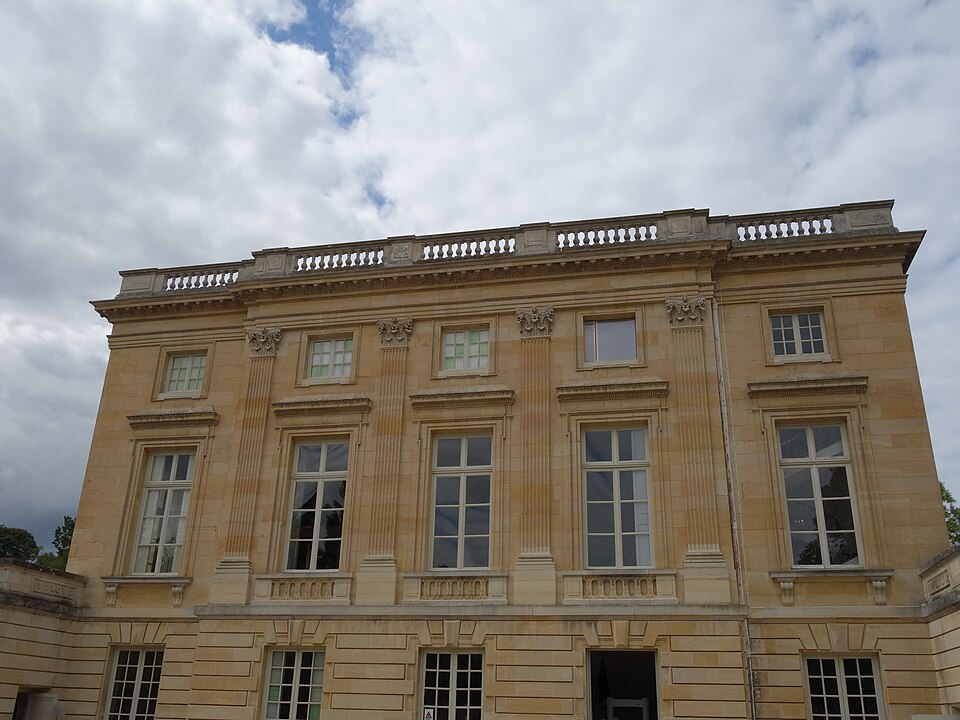
Around 10,000 people worked at Versailles, so there was no privacy anywhere. Louis XIV built the Grand Trianon, in pink marble, as somewhere to escape the etiquette of his own court. Louis XV built the smaller Petit Trianon for the same reason, and Marie-Antoinette made it hers, adding the Hameau de la Reine — a working model farm and village where the queen played at rural life.
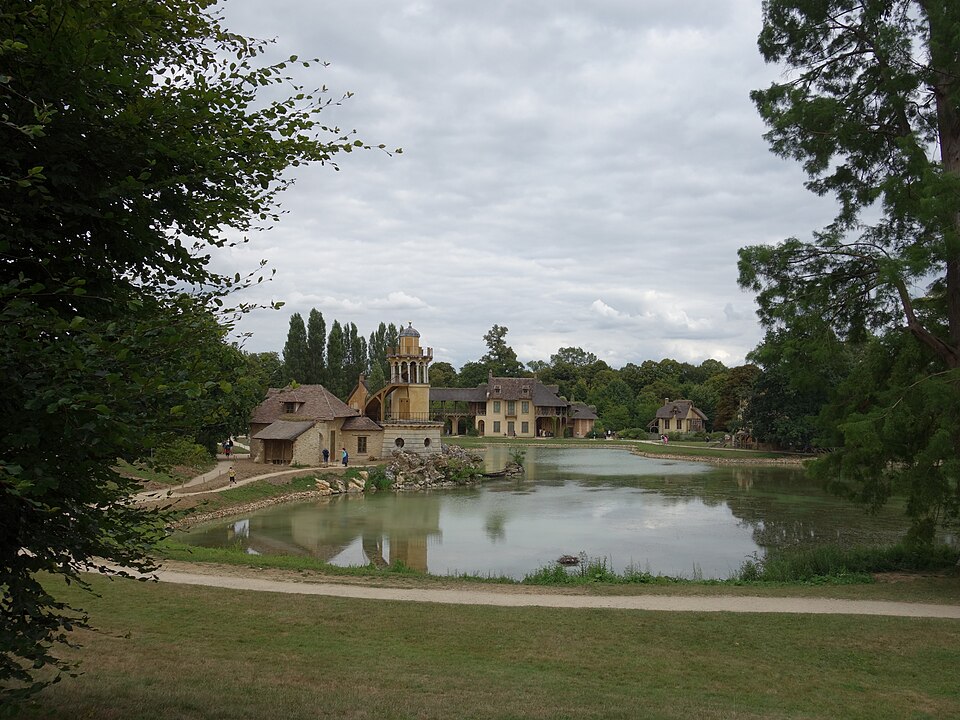
The Trianon estate is a 30-minute walk from the palace across the park, opens later in the day than the château, and is far quieter. If you only have half a day and dislike crowds, it is arguably the better half.
Getting there
Three stations, all about 20–35 minutes from central Paris:
- RER C → Versailles Château–Rive Gauche — the closest, about 10 minutes’ walk from the gates. Note that an ordinary Paris t+ ticket does not cover it; you need a ticket to the suburban zone.
- Versailles Rive Droite — trains from Paris Saint-Lazare.
- Versailles Chantiers — trains from Paris Montparnasse, about 15 minutes’ walk.
By car it is 22 km and around 35 minutes from Paris, traffic permitting.
Practical advice
Opening hours and ticket prices change every year; check the official site before you travel. What does not change:
- The palace is closed on Mondays. The gardens and park are not.
- Book a timed slot online. Turning up without one in summer means a long queue for the security check and another for tickets.
- Go early or late. The coach parties arrive mid-morning and the Hall of Mirrors becomes very hard work between 11:00 and 15:00. Late afternoon is markedly calmer.
- The park is free on days without the fountain shows, and it is enormous — you can spend a whole day in it without paying anything.
- Combined Paris rail-and-entry tickets sold at SNCF stations are usually the simplest option if you are coming out for the day.
- Some months bring a free first Sunday; the rule has changed several times, so check rather than assume.
- Bicycles and small electric trains cover the park, which is worth it — the Trianons are a long walk.
Allow a full day for palace, gardens and Trianons. Half a day covers the palace and the nearest gardens, and no more.
Around Versailles
- The town of Versailles — a planned eighteenth-century town, with the Notre-Dame covered market and the royal tennis court where the Third Estate swore the Tennis Court Oath in 1789
- Marly-le-Roi — the ruins of Louis XIV’s other retreat
- Paris — 35 minutes back
See also UNESCO sites in France and Île-de-France.
Photo credits
Photographs on this page come from Wikimedia Commons under free licences:
- The garden front and the main axis — Paolo Costa Baldi, CC BY-SA 3.0, via Wikimedia Commons
- The Cour d'Honneur and the royal gate — Groume, CC BY-SA 2.0, via Wikimedia Commons
- The Hall of Mirrors — Myrabella, CC BY-SA 3.0, via Wikimedia Commons
- The Royal Chapel — JC Allin, CC BY-SA 3.0, via Wikimedia Commons
- The Royal Opera — Gary Todd, CC0, via Wikimedia Commons
- The Latona basin and the Grand Canal — Coyau, CC BY-SA 3.0, via Wikimedia Commons
- The Petit Trianon — DiscoA340, CC BY-SA 4.0, via Wikimedia Commons
- The Hameau de la Reine — DiscoA340, CC BY-SA 4.0, via Wikimedia Commons


.jpg)


Where to park in Versailles
| Car park | Spaces | Fee | From centre |
|---|---|---|---|
| Place d'Armes | — | paid | 90 m |
| Parking place de l'Europe | — | paid | 220 m |
| Parking Saint-Cloud underground | — | paid | 470 m |
| Parking Cathédrale underground | — | paid | 470 m |
| Marché Notre-Dame underground | — | paid | 510 m |
| Parking de l'avenue de Sceaux | 550 | paid | 640 m |
| Carré à l'Avoine | — | paid | 680 m |
| Carré à la Terre | — | paid | 710 m |
Weather in Versailles
| Month | Day | Night | Rainfall |
|---|---|---|---|
| January | +7° | +2° | 55 mm |
| February | +8° | +2° | 47 mm |
| March | +12° | +4° | 50 mm |
| April | +16° | +6° | 50 mm |
| May | +19° | +9° | 68 mm |
| June | +23° | +12° | 55 mm |
| July | +25° | +14° | 53 mm |
| August | +25° | +14° | 58 mm |
| September | +21° | +11° | 52 mm |
| October | +16° | +8° | 61 mm |
| November | +11° | +5° | 61 mm |
| December | +7° | +2° | 66 mm |
Updated: