Lyon
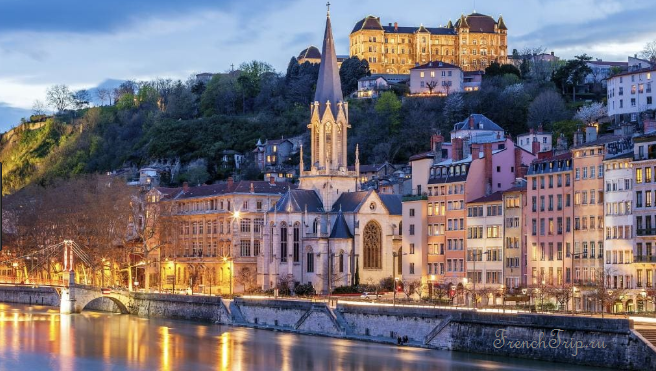
Lyon is France’s third city and, by most French accounts, its best table. It was the capital of Roman Gaul, then of the European silk trade, and it kept the buildings from both — Vieux Lyon is the second-largest Renaissance quarter in Europe after Venice, and the historic centre is UNESCO-listed.
Around 520,000 people live in the city proper and about 2.3 million in the metropolitan area, which makes it big enough to be a real city and small enough to walk across. It sits where the Saône meets the Rhône, between two hills — Fourvière, which prays, and Croix-Rousse, which works, as the local saying has it.
What to see
Vieux Lyon
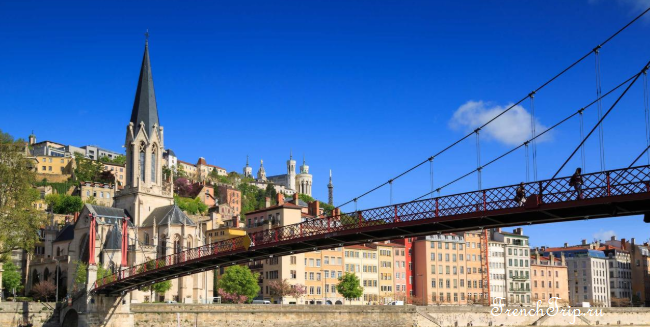
The Renaissance quarter along the right bank of the Saône: fifteenth- to seventeenth-century houses built by Italian, Flemish and German merchants who settled here for the trade fairs and the silk. Rue Saint-Jean is the spine of it, with the Hôtel de la Chamarerie, the Maison des Avocats and the Hôtel Laurencin along its length.
Cathédrale Saint-Jean stands at the bottom: Gothic, four towers, thirteenth-century glass, the flamboyant Bourbon chapel, and a fourteenth-century astronomical clock that still runs.
The traboules
Lyon’s peculiarity. A traboule is a covered passage cutting through a building — or several buildings — from one street to the next, with courtyards, spiral staircases and galleries along the way. They were built so that silk could be carried between workshops without getting wet, and there are several hundred, of which a few dozen are open to the public and marked with a plaque.
The best are in Vieux Lyon and on the Croix-Rousse slopes. They are entrances to private houses: go quietly and shut the door behind you.
Fourvière and Roman Lyon
The hill above Vieux Lyon holds the Roman city — Lugdunum, founded 43 BC and capital of the Gauls. Two theatres survive in an archaeological park: the grand théâtre, the oldest Roman theatre in France, and the smaller Odéon. Both are still used, for the Nuits de Fourvière festival every summer.
The Lugdunum museum beside them is built into the hillside and holds the mosaics, sculpture and — its centrepiece — the Claudian Tables, a bronze plaque recording the speech the emperor Claudius, born in Lyon, gave to the Senate in AD 48.
The Basilique Notre-Dame de Fourvière on the summit is nineteenth-century, enormous and unmissable in every sense; the terrace beside it gives the view over the whole city and, on a clear day, to Mont Blanc. A funicular runs up from Vieux Lyon.
Croix-Rousse
The other hill, and a different city: the quarter of the canuts, the silk weavers whose tall-windowed workshops still line the streets, and the site of their revolts in the 1830s. The Maison des Canuts explains the trade with working looms.
Croix-Rousse is also where to see Lyon’s trompe-l’œil murals — the city has dozens of them, and the Mur des Canuts here is the largest in Europe. The Fresque des Lyonnais on Rue de la Martinière, at the bottom of the hill, paints thirty famous residents onto a blank wall and is the one everybody photographs.
Presqu’île
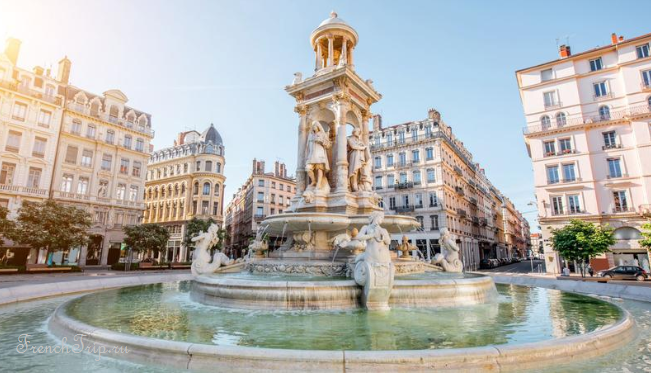
The tongue of land between the two rivers is the nineteenth-century city and the commercial centre: Place Bellecour, one of the largest open squares in Europe, Place des Terreaux with its Bartholdi fountain and the town hall, and the Musée des Beaux-Arts in a former abbey — the best collection in France outside Paris.
Museums
The Beaux-Arts and Lugdunum are the big two. Also worth the time: the Musée des Confluences, natural history and anthropology in a striking building at the point where the rivers meet; the Institut Lumière, in the house where the brothers lived; and the Centre d’Histoire de la Résistance et de la Déportation, in the building the Gestapo used — Lyon was the capital of the Resistance.
Museums are more or less the only sights in Lyon you have to pay for. The Lyon City Card covers them all plus public transport and some river cruises, sold by the day at the tourist office, and pays for itself if you visit two or three.
Cinema was invented here
The Lumière brothers shot the first film in 1895 in the yard of their father’s factory in Monplaisir — workers leaving the gates — and patented the cinématographe in Lyon. The factory is now the Institut Lumière, and the city’s film festival is named after them.
So is the Fête des Lumières, though that one is older: it began as a votive candle in every window on 8 December 1852 and is now four nights of light installations across the whole city in early December, and the busiest week of Lyon’s year. Book far ahead. See festivals of light in France.
Eating in Lyon
Lyon has called itself the gastronomic capital of France since Curnonsky said so in the 1930s, and it defends the title with two things: the bouchon and Paul Bocuse.
A bouchon is a small, loud, cheap restaurant serving the offal-heavy Lyonnais repertoire — quenelles, andouillette, tablier de sapeur, salade lyonnaise, praline tart — with a pot of Beaujolais. Genuine ones carry the Authentique Bouchon Lyonnais label; many places in Vieux Lyon that call themselves bouchons are not.
The Halles de Lyon — Paul Bocuse, at 102 Cours Lafayette, is the covered market named after the chef who ran a three-star restaurant outside the city for over fifty years. Producers, cheesemongers, oyster bars, and counters where you eat on the spot.
South of the city, on the right bank of the Rhône, are the Côte-Rôtie and Condrieu vineyards — Côte-Rôtie covers about 200 hectares of terraced slope and is among the oldest planted ground in France. Beaujolais is an hour north.
See the cooking of Rhône-Alpes, French cheeses and wine routes in France.
Getting to Lyon
By train
Lyon has three stations and the difference matters:
- Lyon Part-Dieu — the TGV station, in the business district. Paris in 2 hours, Marseille in 1 h 40, and most regional services.
- Lyon Perrache — the older station on the Presqu’île, a few minutes’ walk from Place Bellecour and the better arrival if you are staying in the centre. The coach station is next to it. Trains north to Villefranche-sur-Saône and Mâcon leave from here.
- Lyon Saint-Exupéry TGV — out at the airport, useful only if you are flying.
Perrache and Part-Dieu are 8 minutes apart by TER, about 15 by tram. See trains in France.
By air
Lyon Saint-Exupéry is 25 km east, connected by the Rhônexpress tram to Part-Dieu in half an hour. Geneva airport is an alternative — well served by low-cost airlines, with a train on to Lyon in about two and a half hours.
Getting around
The centre is compact enough to walk, though the two hills are real hills — use the Fourvière funicular rather than the steps. Otherwise there are four metro lines, trams, buses and the Vélo’v bike scheme. You only really need tickets if your hotel is out of the centre.
Shopping
Shops in the centre open roughly 10:00 to 19:00, Monday to Saturday, and close on Sundays — except in December and in Vieux Lyon, where Sunday is the busiest day of the week.
Rue de la République is the main pedestrian shopping street, with Rue Édouard Herriot (more expensive) and Rue de Brest running parallel across the Presqu’île. La Part-Dieu, on Boulevard Vivier-Merle, is one of the largest city-centre shopping centres in Europe.
For something local: silk, from the workshops that still operate on Croix-Rousse, and coussins de Lyon or pralines from the confectioners.
Around Lyon
- Pérouges — a walled medieval village 35 km north-east, reachable by train, and one of the most beautiful villages in France
- Beaujolais — the vineyards and golden-stone villages an hour north
- Vienne — a Roman town 30 minutes south, with a temple and a theatre
- The Rhône valley wine road — Côte-Rôtie, Condrieu and on south towards Avignon
- Annecy and the Alps — two hours east
When to go
Lyon works all year. May, June and September are the most comfortable — July and August are hot and the city empties of Lyonnais. Early December brings the Fête des Lumières, which is worth planning a trip around but needs booking months ahead. See UNESCO sites in France for the wider list.
Where to park in Lyon
| Car park | Spaces | Fee | From centre |
|---|---|---|---|
| LPA Antonin Poncet | 662 | 3,4 €/h, 53 €/day | 330 m |
| LPA Saint Georges | 677 | 3,4 €/h, 53 €/day | 400 m |
| LPA Fosse aux Ours | 335 | 3,2 €/h, 47 €/day | 660 m |
| LPA Grolée | 225 | 3,4 €/h, 53 €/day | 680 m |
| LPA Saint Antoine | 787 | 3,4 €/h, 53 €/day | 730 m |
| LPA Saint Just | 63 | paid | 830 m |
| LPA Cordeliers | 793 | 3,4 €/h, 53 €/day | 840 m |
| LPA Perrache | 869 | 3,4 €/h, 32 €/day | 980 m |
Weather in Lyon
| Month | Day | Night | Rainfall |
|---|---|---|---|
| January | +7° | +1° | 50 mm |
| February | +9° | +2° | 42 mm |
| March | +14° | +4° | 49 mm |
| April | +18° | +7° | 69 mm |
| May | +22° | +11° | 81 mm |
| June | +26° | +15° | 74 mm |
| July | +28° | +17° | 67 mm |
| August | +28° | +17° | 66 mm |
| September | +23° | +13° | 82 mm |
| October | +18° | +10° | 100 mm |
| November | +12° | +5° | 87 mm |
| December | +8° | +2° | 54 mm |
Updated: