Wissembourg
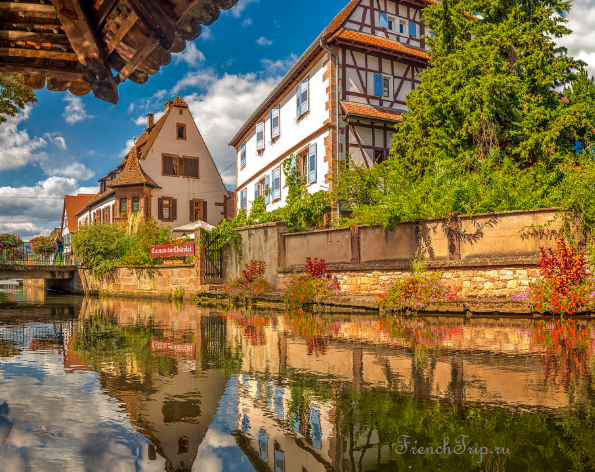
Wissembourg is the northernmost town in Alsace, right on the German border, 60 km north of Strasbourg. It is the top end of the Alsace wine route and it carries the Plus Beaux Détours de France label — the list for towns too small for the “most beautiful villages” ranking and too good to miss.
The name is the French spelling of Weissenburg, German for white castle.
A town that changed country five times
Wissembourg was annexed by France after 1648, taken into the German Empire in 1871, returned to France in 1919, reannexed by Germany in 1940, and French again after 1944. Everything about the place — architecture, cooking, surnames, the shape of the roofs — is a consequence of that.
The town grew around a Benedictine abbey founded in the seventh century, possibly under Dagobert I, and endowed with enormous estates on both banks of the Rhine. By 974 it held Imperial Immediacy, answering to the emperor alone; its abbot outranked the bishop of Speyer, to whom he nominally answered. In the late ninth century the monk Otfrid of Weissenburg wrote his gospel harmony here — the first substantial work of verse in the German language.
Endowed by local nobles, the abbey went on to acquire land across Alsace, the Rhineland-Palatinate and the Ortenau on the right bank of the Rhine, clearing and farming it until it was said to be one of the wealthiest abbeys in the Holy Roman Empire. Of its eleventh-century buildings, put up under Abbot Samuel, only the Schartenturm tower and a few stretches of moat survive; the town itself was fortified in the thirteenth century.
In 1354 Charles IV made Wissembourg one of the ten free cities of the Décapole, with wide rights of self-government. Louis XIV abolished the league on annexing Alsace in 1678. A fire in January 1677 destroyed much of the town including the town hall, which is why the present one dates from the 1740s.
The privileges were bought outright from the emperor and gave the town near-complete political autonomy.
The Battle of Wissembourg on 4 August 1870 was the first engagement of the Franco-Prussian War, and the French defeat opened the road into France. The Geisberg monument commemorates it, and the town cemetery holds a great many soldiers from both sides, including the grave of the French general Abel Douay, killed in the fighting.
Command on the Prussian side was held nominally by the crown prince Friedrich, but the battle was directed by his chief of staff, General Leonhard von Blumenthal.
The old town
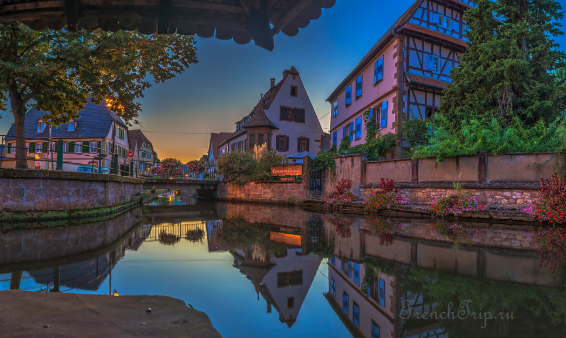
Still partly ringed by its ramparts, and threaded by the river Lauter and its channels — which is what makes it photogenic. The quarter along the water is known as the Bruch, and the row of gabled houses reflected in the river is the image of the town.
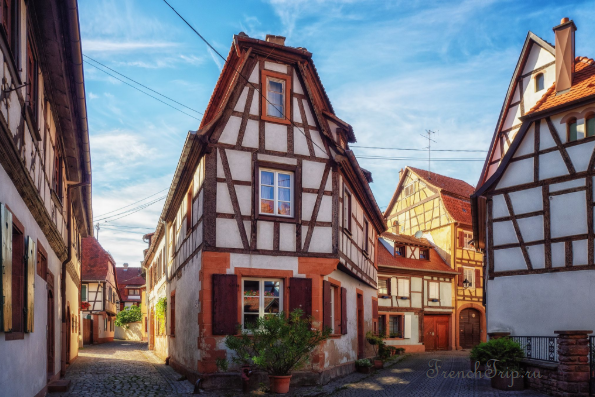
The town stands amid wheat fields.
Église Saints-Pierre-et-Paul
The former abbey church, and after Strasbourg cathedral the largest church in Alsace. It was secularised at the Revolution, stripped of its treasures, and became the parish church in 1803.
What to look at:
- The west bell tower, built around 1074 — the only surviving part of the earlier Ottonian church and one of the oldest and best-preserved Romanesque towers in Alsace. Its diamond-patterned green and yellow tiled roof was restored in 2007.
- An eleven-metre Saint Christopher painted on the wall — the largest medieval figure of its kind in France.
- Wall paintings and stained glass from the fourteenth and fifteenth centuries, and a Romanesque rose window of the Virgin and Child from the later twelfth.
- The 1766 organ by Louis Dubois, in a baroque case that is among the finest in the region.
- The unfinished High Gothic cloister, generally reckoned one of the most beautiful on the Upper Rhine.
- A former Romanesque house attached to the church, now used as a side chapel.
The rebuilding begun under Abbot Edelin proceeded from the east on a basilica plan, with a transept and a polygonal apsed choir flanked by chapels — the same scheme used at Toul cathedral, begun in 1221 and the first church built to it, and later repeated at Mainz and Regensburg. The south rose window, a Blessing of Christ and an Annunciation, was Edelin’s own gift, dated to the 1260s–1290s. The wall paintings take the Passion of Christ as their theme. A second organ, in the south transept, is a comparatively recent addition, built new in the 1950s.
The rest
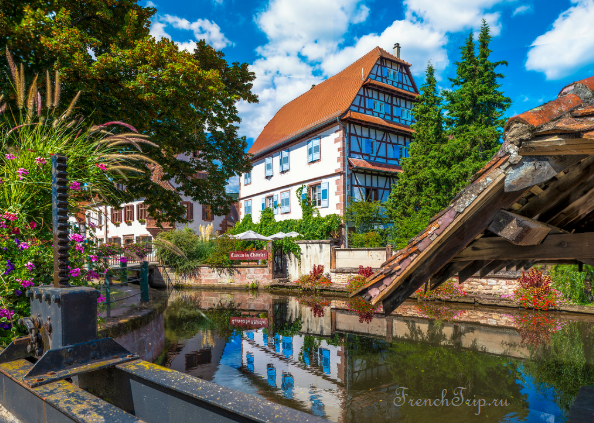
- Maison du Sel (1448) — the Salt House, under an enormous steep Alsatian roof; it was the town’s first hospital, later a salt store and a slaughterhouse
- Maison Vogelsberger — a Renaissance house of 1540 with a carved portal
- Hôtel de ville — classical, 1741–52, by the Strasbourg city architect Joseph Massol
- Église Saint-Jean — the Protestant parish church, plain fifteenth-century Gothic
- La Nef — the thirteenth-century Dominican church, now a cultural centre
- Grenier aux Dîmes — the tithe barn, eighteenth-century on much older foundations
- Musée Westercamp — local archaeology, medieval art and the town’s history
- Maison dite de l’Ami Fritz — a house of about 1550, said to have been used as a filming location for a screen adaptation of the novel
Maison Vogelsberger was built in 1542 for Sebastian Vogelsberger, a military commander; after his execution the property passed to the town. Badly damaged in the 1677 fire, it was rebuilt in the early eighteenth century, and went on to serve in turn as the seat of the sub-prefecture in the early 1800s, then as a post office, then, once taken over by the German military, as a garrison headquarters, and after the Second World War as a school. Traces of the wall paintings Vogelsberger commissioned survive on carved sandstone brackets.
Maison de Stanislas
Stanisław Leszczyński, the deposed king of Poland, lived in exile in Wissembourg from 1719 to 1725 — reduced, by his own account, to near poverty. It was here that he received the news that his daughter Marie was to marry Louis XV; the betrothal was announced in the church of Saint-Jean. The house on Rue Stanislas still stands, and the improbable reversal of fortune is the story the town likes best.
Getting to Wissembourg
- By train — around 21 services a day from Strasbourg, taking about an hour. The station is in the town. Cross-border trains run to Winden, Karlsruhe and Mannheim in Germany.
- By bus — line 312 from Betschdorf, 313 from Seltz, 316 from Niederbronn and Woerth. From Easter to All Saints a seasonal line 317 runs out to the Four à Chaux and Fleckenstein castle.
- By car — the D263 north from Strasbourg, a straight run up the edge of the Vosges.
The old town is small; an hour and a half covers it on foot.
What to eat
Alsatian, with the German half slightly ahead: choucroute, baeckeoffe, flammekueche, and the white wines of the northern wine route — Riesling, Sylvaner, Pinot Gris — from the vineyards immediately south. See the cooking of Alsace.
Festivals
The Festival de l’Ami Fritz at Pentecost is the big one: several days of processions in Alsatian costume, named after the Erckmann-Chatrian novel, and the largest folk festival in Alsace. The Christmas market in December is smaller and better than most.
Around Wissembourg
- Château de Fleckenstein — a ruined castle carved into a sandstone crag in the Northern Vosges, half an hour west, and one of the best in Alsace
- Ligne Maginot — the Four à Chaux fort at Lembach is open to visitors and is a substantial underground works
- Altenstadt — a suburb of the town with an eleventh-century Romanesque church, Saint-Ulrich, and the northern starting point of the route romane through Alsace
- The wine route — which starts here and runs south for 170 km
- Germany — the Palatinate begins across the town boundary, with the Deutsche Weinstrasse a few kilometres on
- Lignes de Wissembourg — an earthwork line of fortifications along the river Lauter, about 13 km south-east, built in 1706 under Marshal Villars. The Austrian general von Wurmser broke through in October 1793, but was defeated two months later by the French general Pichegru and driven back across the Rhine; like the town’s own ramparts, only isolated stretches survive
When to go
May to October, and Pentecost for the festival. Autumn is the wine harvest along the route south. Winter is quiet apart from the Christmas market.
Where to park in Wissembourg
| Car park | Spaces | Fee | From centre |
|---|---|---|---|
| Cour de la Commanderie | — | — | 150 m |
| Tribunal | — | free | 240 m |
| Fossé des Tilleuls | — | free | 320 m |
| Place de la Foire | — | free | 340 m |
| Pépinière | — | free | 560 m |
| Piscine | — | free | 690 m |
| Centre Hospitalier | — | free | 930 m |
| Parking Match | 10 | — | 1.1 km |
Nearby
Other places on this site within easy reach, as the crow flies:
- Hunspach — 9 km
- Haguenau — 23 km
- Obernai — 72 km
- Barr — 79 km
- Mittelbergheim — 80 km
- Sélestat — 94 km
Weather in Wissembourg
| Month | Day | Night | Rainfall |
|---|---|---|---|
| January | +5° | -1° | 77 mm |
| February | +7° | -1° | 65 mm |
| March | +12° | +2° | 64 mm |
| April | +17° | +5° | 51 mm |
| May | +21° | +9° | 76 mm |
| June | +25° | +13° | 64 mm |
| July | +27° | +14° | 69 mm |
| August | +27° | +14° | 59 mm |
| September | +22° | +10° | 62 mm |
| October | +16° | +7° | 75 mm |
| November | +9° | +3° | 79 mm |
| December | +6° | +1° | 92 mm |
This page in Russian: Wissembourg (Висамбур)
Updated: