Haguenau
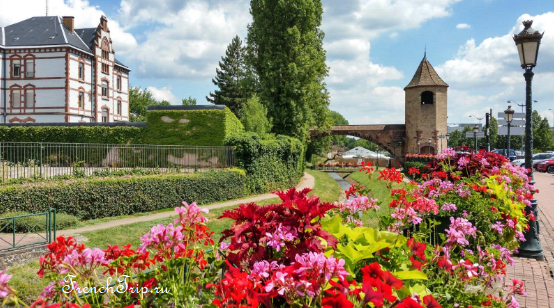
Haguenau is the gateway to northern Alsace: 35,000 people, the region’s fourth town, 30 km north of Strasbourg and surrounded by the largest state forest in France.
It is not on the wine route and it is not a village in a postcard. What it offers is the north — the pottery villages, the Maginot Line, the forest, and a town that still works — and it is the natural base for all of it.
The town
Haguenau was an imperial city, and one of the ten of the Décapole — the league of free towns of Alsace. Barbarossa built a palace here in the twelfth century and the town was, for a while, a seat of the Holy Roman Emperors. Very little of that survives: the town was burnt in 1677 on Louis XIV’s orders and shelled again in 1945.
- Musée Historique — a fine neo-Renaissance building of 1900 holding one of the best archaeological collections in Alsace, from the Bronze Age tumuli of the Haguenau forest
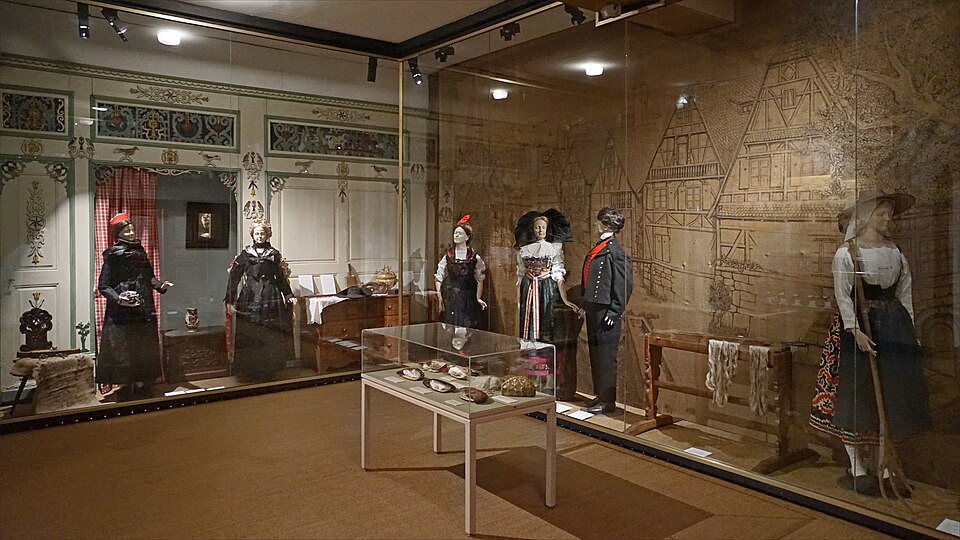
- Musée Alsacien — regional furniture, costume and craft in a fifteenth-century former chancellery
- Église Saint-Georges — twelfth–thirteenth century, Romanesque turning Gothic, with two of the oldest bells in France (1268)
- Église Saint-Nicolas — founded by Barbarossa’s son, with eighteenth-century woodwork brought from a dissolved abbey
- Tour des Chevaliers and Tour des Pêcheurs — what is left of the medieval walls
The pottery villages
Two villages beside Haguenau are known across France for their ceramics, and they make completely different things:
- Betschdorf (15 km) — salt-glazed grey stoneware with cobalt-blue decoration, fired at 1,280 °C. The technique arrived with Rhenish potters in the eighteenth century and the same families still work it.
- Soufflenheim (13 km) — glazed earthenware in yellows, browns and greens, above all the moulded terrine in which baeckeoffe is baked. Around a dozen workshops remain.
Both have workshops open to visitors, and both are the honest answer to the question of what to bring home from Alsace. See the cooking of Alsace.
The forest
The Forêt de Haguenau covers 21,000 hectares north of the town — the largest undivided state forest in France, pine and oak on old Rhine sands, with marked walking and cycling routes and Bronze Age burial mounds under the trees.
The Maginot Line
Northern Alsace has the best-preserved sections of the Maginot Line, and several are open:
- Fort de Schoenenbourg — 25 km, the largest visitable work in Alsace, with three kilometres of galleries 30 m underground, the machinery restored and running
- Casemate d’Esch and the Hatten museum — smaller works with the battle of January 1945 as their subject
See also Wissembourg, further up the same road.
Getting to Haguenau
- By train — direct from Strasbourg, about 30 minutes, on the line to Wissembourg and Neustadt in Germany. Frequent.
- By car — A4 from Strasbourg or Paris, exit 47 then the D1340; or the A35, exits 55 and 57. Strasbourg 30 minutes, Colmar 1 h 20, Baden-Baden 45 minutes, Paris 5 hours. See parking in France.
- By bus — regional services across the north of the region.
Around Haguenau
- Betschdorf and Soufflenheim — 15 and 13 km, the potteries
- Hunspach — 25 km, all-white timber-framed houses and one of the most beautiful villages in France
- Wissembourg — 35 km, on the German border
- Fort de Schoenenbourg — 25 km
- Northern Vosges regional park — west, with castles on every ridge
When to go
April to October. Haguenau has its own Houblonnade hop festival in August and a Christmas market in December, and being a real town rather than a resort it is open all year — useful in the months when the wine-route villages close.
See Alsace.
Photo credits
Some photographs on this page come from Wikimedia Commons under free licences:
- The Alsatian museum — Jean-Pierre Dalbéra, CC BY 2.0, via Wikimedia Commons
_(36197980936).jpg)
Nearby
Other places on this site within easy reach, as the crow flies:
- Obernai — 49 km
- Barr — 55 km
- Mittelbergheim — 57 km
Weather in Haguenau
| Month | Day | Night | Rainfall |
|---|---|---|---|
| January | +5° | 0° | 77 mm |
| February | +7° | 0° | 65 mm |
| March | +12° | +2° | 64 mm |
| April | +17° | +5° | 51 mm |
| May | +21° | +9° | 76 mm |
| June | +25° | +13° | 64 mm |
| July | +27° | +14° | 69 mm |
| August | +27° | +14° | 59 mm |
| September | +22° | +10° | 62 mm |
| October | +16° | +7° | 75 mm |
| November | +9° | +3° | 79 mm |
| December | +6° | +1° | 92 mm |
This page in Russian: Haguenau (Агно)
Updated: