Chamonix
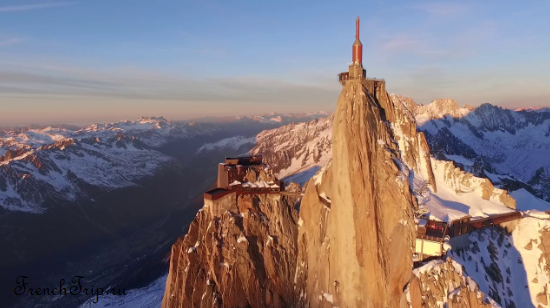
Chamonix, officially Chamonix-Mont-Blanc, is a mountain town of about 9,000 people in Haute-Savoie, in a deep valley at the foot of Mont Blanc, at 4,806 m the highest mountain in the Alps and in western Europe. It sits close to the borders of both Switzerland and Italy. Chamonix is the birthplace of mountaineering, it hosted the first Winter Olympic Games in 1924, and it is one of the great resorts of the world in winter and summer alike: a place for skiing, walking and climbing, and for some of the most spectacular cable cars and mountain railways anywhere.
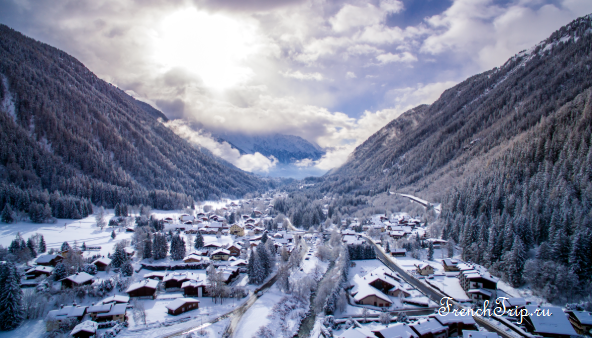
The valley is about 16 km long, with the town in the middle and a string of villages and ski areas along it: Les Houches at the lower end, then Chamonix itself, Les Praz, Argentière and Le Tour at the top, near the Swiss border.
A short history
Until the 18th century Chamonix was a poor, remote valley of farmers. In 1741 two English travellers, William Windham and Richard Pococke, came to see the glaciers, and their account made the valley famous. In 1786 two local men, the crystal hunter Jacques Balmat and the doctor Michel-Gabriel Paccard, made the first ascent of Mont Blanc, encouraged by the Genevan scientist Horace-Bénédict de Saussure, who climbed it himself the following year. A statue of Balmat pointing Saussure to the summit stands in the town centre. The first guides’ company in the world, the Compagnie des Guides de Chamonix, was founded here in 1821, and the hotels, the railway and the cable cars followed.
What to see
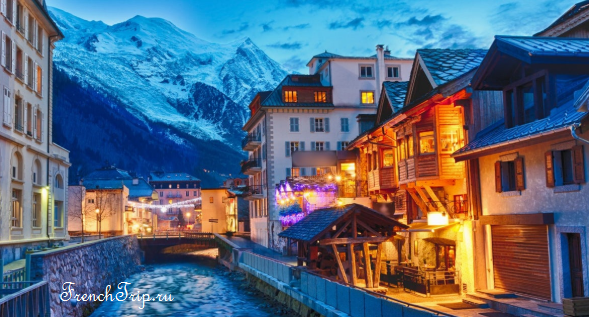
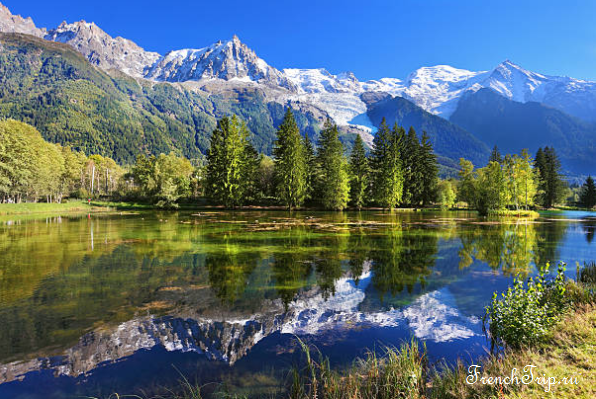
The town itself is pleasant rather than remarkable: a lively pedestrian centre along the river Arve, with Belle Époque hotels and balconies, outdoor shops, cafés and restaurants. It is the setting that makes Chamonix: wherever you stand, the glaciers and the granite needles of the Mont Blanc massif rise almost 3,800 m above the valley floor.
The Aiguille du Midi
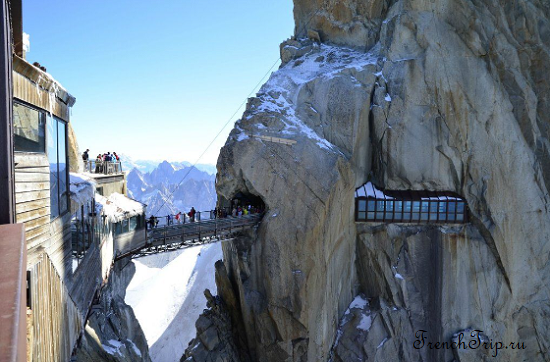
The cable car to the Aiguille du Midi is the classic excursion from Chamonix and one of the most spectacular in the Alps. It climbs in two stages from the edge of town, by the mid-station of the Plan de l’Aiguille at 2,317 m, to the summit station at 3,777 m, in about twenty minutes. When it was built in 1955 it was the highest cable car in the world. A lift inside the rock takes you up to the terrace at 3,842 m, with a view over Mont Blanc and the peaks of France, Switzerland and Italy.
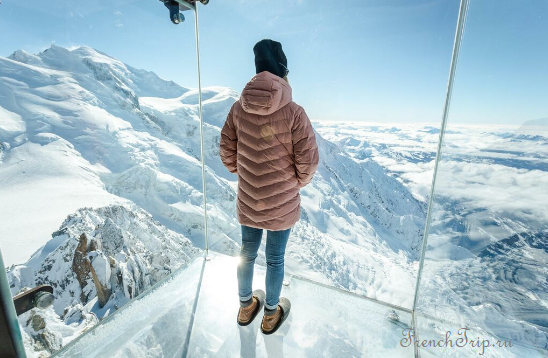
On the summit, the Step into the Void is a glass box hanging over a sheer drop of a thousand metres. In summer a small cabin, the Panoramic Mont-Blanc, crosses the glaciers to the Pointe Helbronner on the Italian border, from where another cable car runs down to Courmayeur.
Go early on a clear morning, before the clouds build up and the queues grow; in high summer thousands of people make the trip each day.
Montenvers and the Mer de Glace
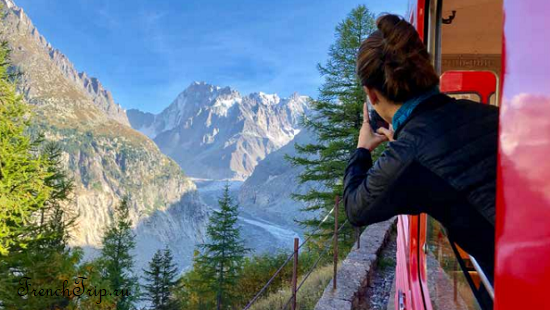
The little red rack railway of Montenvers, opened in 1908, climbs 5 km from the station in Chamonix to a viewpoint at 1,913 m in about twenty minutes. It overlooks the Mer de Glace, the “sea of ice”, the longest glacier in France, under the sharp granite spire of the Drus. Each year an ice cave is carved into the glacier, so you can walk inside it.
The glacier is shrinking fast: the station once stood just above the ice, but now a gondola and a long staircase of several hundred steps lead down to it, and the climb back up is tiring. Signs along the way show where the ice stood in past decades, a striking lesson in climate change. There is also a small museum of the glaciers and a crystal gallery at the top.
Other viewpoints
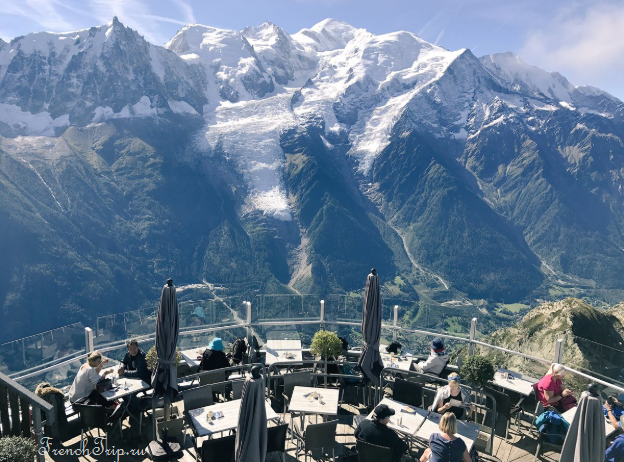
- Le Brévent and La Flégère, on the sunny side of the valley opposite Mont Blanc, reached by cable car and gondola from town: the best views of the whole massif.
- The Tramway du Mont-Blanc, the highest rack railway in France, from Saint-Gervais-Le Fayet to the Nid d’Aigle at 2,372 m, at the foot of the Bionnassay glacier.
- The Bossons glacier, which comes down almost to the valley floor just above the road at the lower end of Chamonix.
Skiing in winter
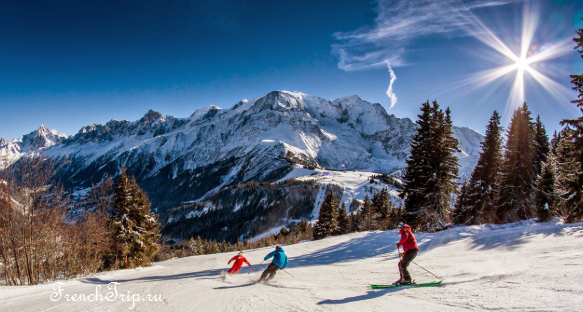
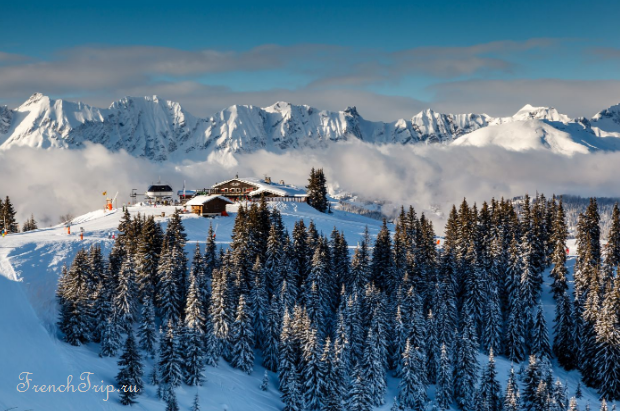
Chamonix is not one linked ski area but several separate ones along the valley, connected by bus: Les Houches, with wooded runs and good for families; Le Brévent and La Flégère, sunny and facing Mont Blanc; Les Grands Montets above Argentière, high, steep and famous among expert skiers; and Le Tour and Balme at the top of the valley, with wide, gentle slopes. There are beginners’ slopes in the villages along the valley, but Chamonix is above all a resort for good skiers and for off-piste skiing.
The Vallée Blanche, a descent of about 20 km from the Aiguille du Midi down the glaciers to the Mer de Glace, is one of the great ski runs of the world. It is unmarked and unpatrolled off-piste terrain, crossing crevasses: do it only with a qualified mountain guide.
For the other big French resorts, see ski resorts in France.
Walking in summer
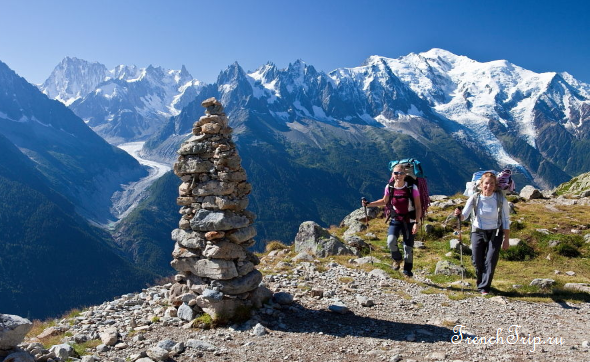
In summer the valley has hundreds of kilometres of paths, from easy walks along the valley floor to high mountain trails. Some of the most popular:
- The Lac Blanc (2,352 m), from the top of La Flégère, about two hours each way: a lake with Mont Blanc reflected in it, one of the most famous views in the Alps. The nearby Lac des Chéserys and Lac Cornu are quieter.
- The Grand Balcon Nord, from the Plan de l’Aiguille to Montenvers, two to three hours along the mountainside above the valley.
- The Bossons glacier, a walk up through the forest to the Chalet du Glacier des Bossons, with a view of the ice.
- The Aiguillette des Posettes above Le Tour, with views over France and Switzerland, and the Bérard valley, an easy walk to a waterfall.
- The Tour du Mont Blanc, a famous long-distance trail of about 170 km round the whole massif through France, Italy and Switzerland, usually walked in ten to twelve days.
Chamonix is also a centre for climbing, paragliding, mountain biking and via ferrata.
Safety in the mountains
- Altitude. At the top of the Aiguille du Midi you are at almost 3,800 m after twenty minutes. Some people feel dizzy, short of breath or get a headache; move slowly, and come down if you feel unwell. It is cold up there even in summer: bring warm clothes, sunglasses and sun cream. It is not recommended for very young children, pregnant women or people with heart or breathing problems.
- Glaciers. Never walk on a glacier without a mountain guide and equipment. Crevasses are often hidden under snow, and the ridge from the Aiguille du Midi summit station is a mountaineering route, not a walk.
- Mont Blanc. Climbing Mont Blanc is a serious high-mountain ascent that kills climbers every year, especially through rockfall in the Goûter couloir. Do not attempt it without experience, training and a guide.
- Weather. Storms build quickly on summer afternoons. Check the forecast at the guides’ office or the tourist office, start walks early and turn back if the weather changes.
- Winter. Off the marked pistes, avalanches are a real danger; go off-piste only with a guide and the proper equipment.
What to eat
Chamonix is in Savoy, and the local food is hearty mountain cooking built on cheese: fondue, raclette, tartiflette (potatoes, bacon and onions baked with Reblochon cheese), and the croûte savoyarde, bread soaked in white wine and baked with melted cheese. There are also pierrade evenings, where you grill your own meat on a hot stone at the table. The town has everything from mountain huts to Michelin-starred restaurants.
Getting there
- By air: the nearest airport is Geneva, about 90 km away, an hour and a quarter by road, with shuttle buses to Chamonix all year. Lyon airport is about two and a half hours away.
- By train: Chamonix has its own station but no direct mainline trains. Take a train to Saint-Gervais-Le Fayet, then the narrow-gauge Mont-Blanc Express up the valley; the same line continues over the border to Martigny in Switzerland. In winter some TGVs from Paris run to Saint-Gervais. See trains in France.
- By car: Chamonix is at the end of the A40 motorway from Geneva and Lyon. The Mont Blanc Tunnel, 11.6 km long and open since 1965, runs under the massif to Courmayeur in Italy. In winter, winter tyres or snow chains are compulsory on the mountain roads. See toll roads in France.
Where to park in Chamonix
| Car park | Spaces | Fee | From centre |
|---|---|---|---|
| Parking de l'Outa | — | paid | 200 m |
| Parking du Poilu | — | paid | 220 m |
| Allobroges | — | paid | 230 m |
| Parking Sous-Terrain Saint-Michel underground | — | paid | 260 m |
| Parking du Mont Blanc underground | — | paid | 300 m |
| Oustalet | 6 | — | 360 m |
| Parking du Savoy | — | — | 400 m |
| Parking Biollay | 105 | freemax 1 d | 540 m |
Buses run along the valley between the villages and the ski areas, and a guest card from your hotel usually makes them free.
Around Chamonix
- Courmayeur and the Aosta valley in Italy, through the Mont Blanc Tunnel or over the glaciers by cable car, with Roman and medieval Aosta beyond.
- Megève and Saint-Gervais, with its thermal baths; see spa towns in France.
- The Gorges de la Diosaz at Servoz, a gorge with walkways and waterfalls.
- Lake Emosson across the Swiss border, with a dam and views of Mont Blanc, and Martigny in the Rhône valley.
- Annecy and its lake, about an hour and a quarter away.
Weather in Chamonix
| Month | Day | Night | Rainfall |
|---|---|---|---|
| January | +1° | -6° | 97 mm |
| February | +5° | -5° | 77 mm |
| March | +10° | -2° | 78 mm |
| April | +14° | +2° | 87 mm |
| May | +18° | +6° | 122 mm |
| June | +22° | +9° | 122 mm |
| July | +24° | +11° | 121 mm |
| August | +23° | +11° | 126 mm |
| September | +19° | +7° | 97 mm |
| October | +14° | +4° | 101 mm |
| November | +7° | -1° | 94 mm |
| December | +1° | -5° | 111 mm |
Updated: