Avignon
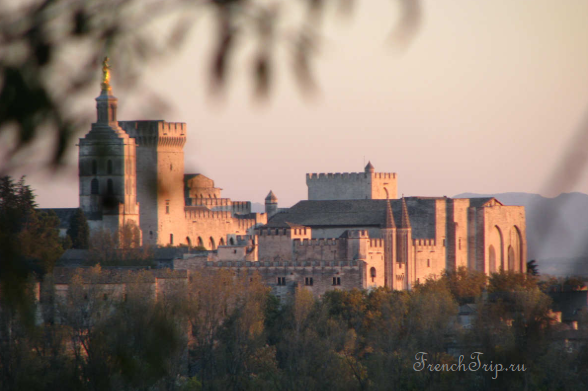
Avignon is one of the finest towns in Provence: a walled old town, a broken bridge that everyone has sung about, and the enormous Palais des Papes — the largest Gothic palace in Europe, and a UNESCO World Heritage site.
For most of the fourteenth century the popes lived here rather than in Rome. Seven of them, from 1309 to 1377, and then a further two of the rival line during the Great Schism. That is why a provincial town on the Rhône has a palace on this scale.
Avignon is also the best base in the region for the hill villages of the Luberon, many of which are on the list of Plus Beaux Villages de France and most of which can be reached by bus from the town.
Getting to Avignon
There are two stations, and the difference matters.
- Avignon TGV — high-speed trains from Paris (about 2 hours 40), Lyon and Marseille. It sits several kilometres outside the town, connected by a frequent shuttle train and by bus.
- Avignon Centre — regional TER trains, right by the walls and a few minutes’ walk from the Palais des Papes.
A local shuttle connects the two in a few minutes, so arriving at the TGV station is no disaster — but do not plan a tight connection without knowing which station you are at. See TGV trains in France and regional trains.
By car, be warned: parking inside the walls is genuinely difficult. The usual approach is one of the car parks outside the ramparts or on the Île de la Barthelasse, with a free shuttle into the centre. See parking in France.
Public transport is the easier option here, which is not true of most of Provence.
What to see
Palais des Papes
The papal palace dominates the town and takes a couple of hours to walk through. It is vast and largely bare — the furnishings went long ago — so the interest is in the scale, the frescoed chapels and the sense of a fortress built by people who expected trouble. The gardens of the Rocher des Doms behind it give the best view over the river and the bridge.
Pont Saint-Bénézet
The bridge of the song, built in the twelfth century and repeatedly washed away by the Rhône until the town gave up rebuilding it in the seventeenth. Four arches of the original twenty-two remain, ending in mid-river. The song has people dancing sur le pont; they more likely danced sous it, on the island underneath.
The ramparts
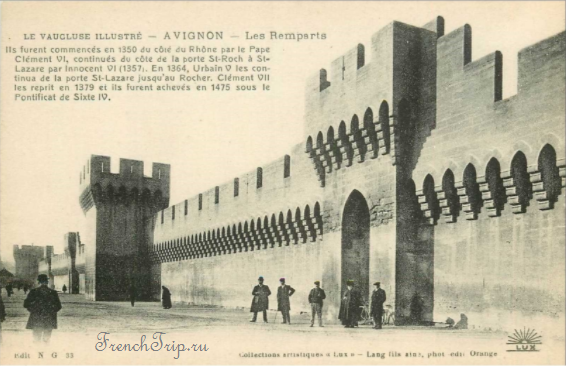
The walls run for over four kilometres around the old town and are almost complete — begun in 1355 under Innocent VI and finished in 1475. The postcard above shows them a century ago, before the moat was filled and the road built.
Villeneuve-lès-Avignon
Across the river, and worth the trip: this is where the cardinals built their residences, away from the crowded papal town. Fort Saint-André and the Tour Philippe-le-Bel give the classic view back at Avignon — the one in the photograph at the top of this page. A bus runs across.
Pont du Gard
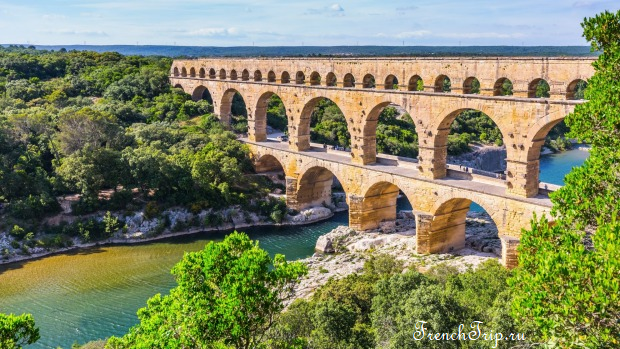
Half an hour west of Avignon stands the best-preserved Roman aqueduct bridge anywhere: three tiers, 49 metres high, built in the first century AD to carry water to Nîmes. It is a UNESCO site and an easy half-day trip from the town.
The Avignon Festival
Every July the town is taken over by the Festival d’Avignon, one of the largest performing-arts festivals in the world, with the official programme in the palace courtyard and hundreds of fringe productions — the Off — in every available room and courtyard in the old town.
It transforms the place. If you are coming for the theatre, book months ahead. If you are not, July is the month to avoid: accommodation triples in price and the streets are impassable. See the festival calendar.
What to eat
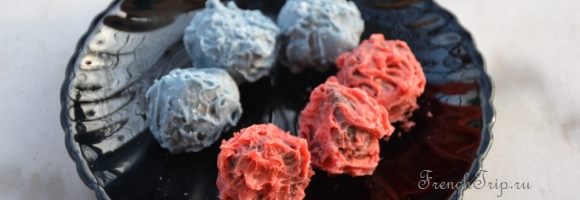
The local speciality is the papaline d’Avignon: a small pink chocolate thistle filled with a liqueur made from around sixty herbs of Mont Ventoux. Invented in 1960 by the town’s confectioners, and sold in every good pâtisserie here.
Otherwise this is Rhône cooking — daube, tapenade, goat cheeses, melon from Cavaillon just down the road — and the wines are the reason many people come at all. More in Provençal cuisine.
Wine around Avignon
Avignon sits in the middle of the southern Rhône vineyards. Châteauneuf-du-Pape is 15 km north — the name comes from the popes, who built a summer castle there and planted the first vines. Gigondas, Vacqueyras and Tavel are all within half an hour.
Around Avignon
This is what makes Avignon worth a few days rather than one:
- The Luberon — Gordes, Roussillon, Ménerbes and the rest of the hill villages; see the Luberon guide and three walking tours
- L’Isle-sur-la-Sorgue — the antiques town on the water, best on a Sunday; see the guide
- Sénanque Abbey — the Cistercian abbey with the lavender field in front of it, photographed more than any other building in Provence; see Sénanque
- Nîmes and Arles — Roman arenas, both under an hour by train
- Mont Ventoux — the bald mountain that dominates the skyline; see Mont Ventoux
When to go
May, June and September are best. July means the festival — wonderful if that is why you came, difficult otherwise. August is hot and the mistral can blow hard down the Rhône valley at any season. Winter is quiet, and the palace is far more pleasant without the queue.
See when to visit Provence and what to do in Provence.
Where to park in Avignon
| Car park | Spaces | Fee | From centre |
|---|---|---|---|
| Parking Oratoire underground | — | — | 350 m |
| Parking du Palais des Papes underground | 825 | paid | 380 m |
| Les Halles multi-storey | 520 | paid | 390 m |
| Parking de L'Oulle | 765 | paid | 480 m |
| Parking Saint Charles underground | 190 | paid | 800 m |
| Grand Delta Habitat | — | — | 940 m |
| Place Robert Blanc | — | — | 1.4 km |
| Place Jules Guesde | — | free | 1.5 km |
Weather in Avignon
| Month | Day | Night | Rainfall |
|---|---|---|---|
| January | +11° | +2° | 53 mm |
| February | +12° | +2° | 35 mm |
| March | +17° | +5° | 38 mm |
| April | +20° | +7° | 61 mm |
| May | +24° | +11° | 52 mm |
| June | +28° | +15° | 39 mm |
| July | +31° | +17° | 31 mm |
| August | +31° | +17° | 37 mm |
| September | +26° | +13° | 93 mm |
| October | +21° | +10° | 88 mm |
| November | +15° | +6° | 96 mm |
| December | +11° | +3° | 48 mm |
Updated: