Villeneuve-lès-Avignon
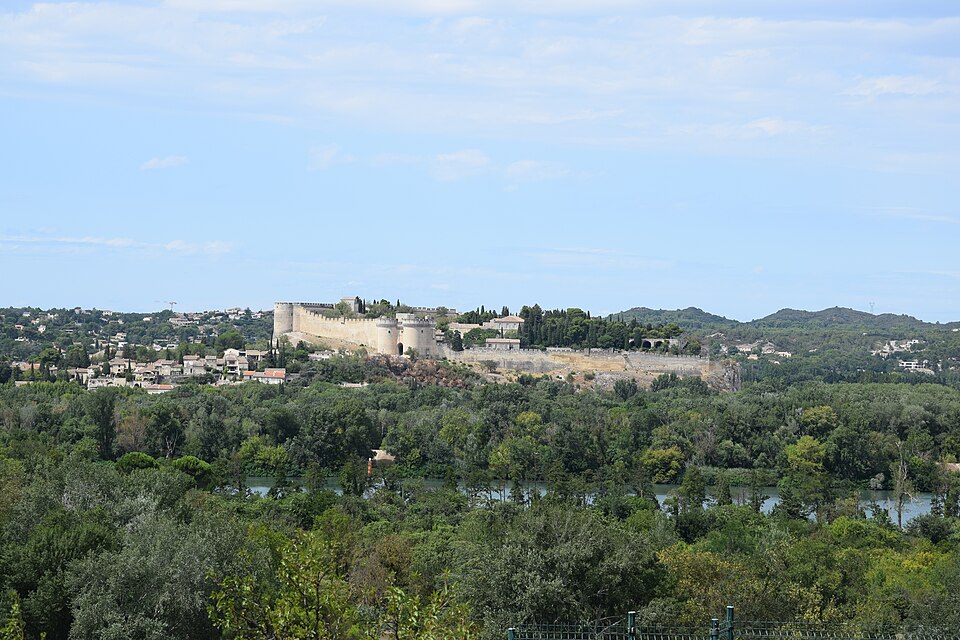
Villeneuve-lès-Avignon is directly across the Rhône from Avignon, and for most of its history that was the whole point: the river was the border, Avignon belonged to the pope and Villeneuve to the king of France.
So the French crown built a fortress here to watch the popes, and fourteen cardinals built palaces to live in the cheaper, quieter, royal side while working across the bridge. It is ten minutes from Avignon and it feels like a different country, which is exactly what it was.
Fort Saint-André
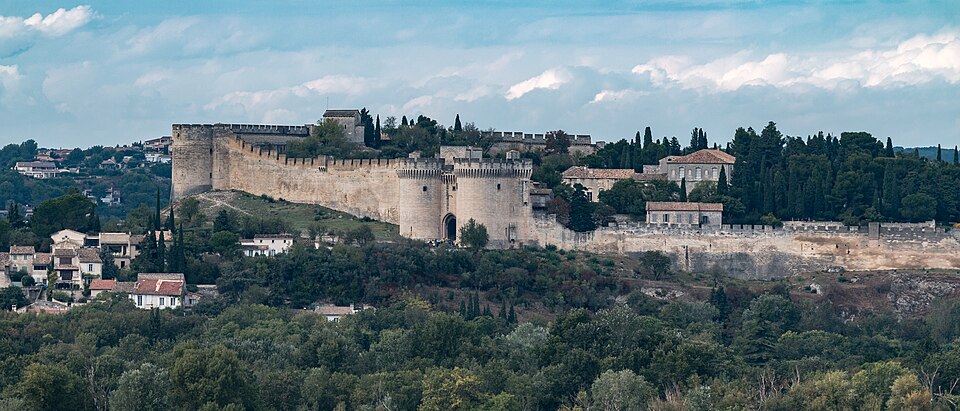
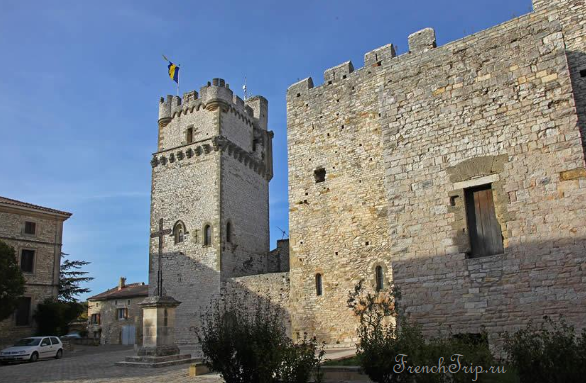
The fortress on Mont Andaon, built from 1362 by John the Good and Charles V, is one of the most impressive military works of medieval France: twin round towers over the gate, a curtain wall enclosing the whole summit, and inside it an abbey and its gardens.
The view from the ramparts takes in Avignon, the Palace of the Popes, the broken bridge, the Rhône and — on a clear day — Mont Ventoux and the Alpilles. It is the best view of Avignon there is, and it is from outside Avignon.
Chartreuse du Val de Bénédiction
Founded in 1352 by Pope Innocent VI, this was the largest Carthusian monastery in France. Three cloisters, forty individual monks’ cells each with its own garden, a church, and the pope’s own tomb.
Sold off at the Revolution and lived in as tenements for a century, it was bought back by the state and restored. It now works partly as a cultural centre and hosts part of the Avignon festival in July. It is large, empty and quiet, and an hour there is the best antidote to the queues across the river.
Tour Philippe le Bel
The tower at the western end of the Pont Saint-Bénézet, built in 1293 to guard the French end of the bridge — the bridge that Avignon still sings about, which reached only halfway across before it was abandoned. Climb it for a second view of the city.
The museum
The Musée Pierre-de-Luxembourg holds two remarkable things: the Coronation of the Virgin by Enguerrand Quarton, painted here in 1453 and one of the masterpieces of French medieval painting, and a fourteenth-century ivory Virgin carved from a single elephant tusk, which curves because the tusk did.
The village
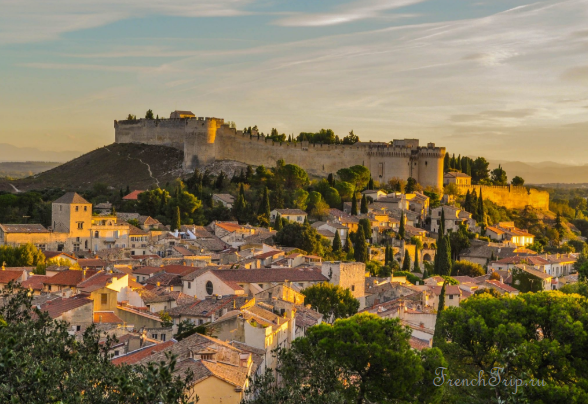
Between the monuments: streets of cardinals’ houses — livrées — with courtyards and gardens behind high walls, a Thursday market, and a good deal less noise than the other bank. Roughly 12,000 people live here.
Getting there
- From Avignon — bus 5 across the bridge, about 15 minutes, or 40 minutes on foot over the Île de la Barthelasse. In summer a free ferry crosses to the island from beneath the Avignon walls.
- By car — 10 minutes, and parking is far easier than in Avignon. See parking in France.
- By train — Avignon Centre is the nearest station.
Around
- Tarascon and Beaucaire — facing each other across the Rhône 20 km south, with a castle each; Tarascon’s is one of the best-preserved river fortresses in France
- Saint-Laurent-des-Arbres — a fortified village 15 km north, with a keep and a Romanesque church
- Barbentane — with its seventeenth-century château across the river
- Châteauneuf-du-Pape — 20 km north
- Avignon — 10 minutes, and the reason most people are here
When to go
April to June and September to October. In July, when Avignon’s festival makes the other bank impossible, Villeneuve is where to stay — it is ten minutes away, it costs less, and its own festival programme is part of the same event.
See Occitanie.
Photo credits
Some photographs on this page come from Wikimedia Commons under free licences:
- Fort Saint-André from the river — Chatsam, CC BY-SA 4.0, via Wikimedia Commons
- The fort walls — Martin Kraft, CC BY-SA 3.0, via Wikimedia Commons
.jpg)
.jpg)
Weather in Villeneuve-lès-Avignon
| Month | Day | Night | Rainfall |
|---|---|---|---|
| January | +11° | +2° | 53 mm |
| February | +12° | +2° | 35 mm |
| March | +17° | +5° | 38 mm |
| April | +20° | +7° | 61 mm |
| May | +24° | +11° | 52 mm |
| June | +28° | +15° | 39 mm |
| July | +31° | +17° | 31 mm |
| August | +31° | +17° | 37 mm |
| September | +26° | +13° | 93 mm |
| October | +21° | +10° | 88 mm |
| November | +15° | +6° | 96 mm |
| December | +11° | +3° | 48 mm |
Updated: