Château du Haut-Koenigsbourg
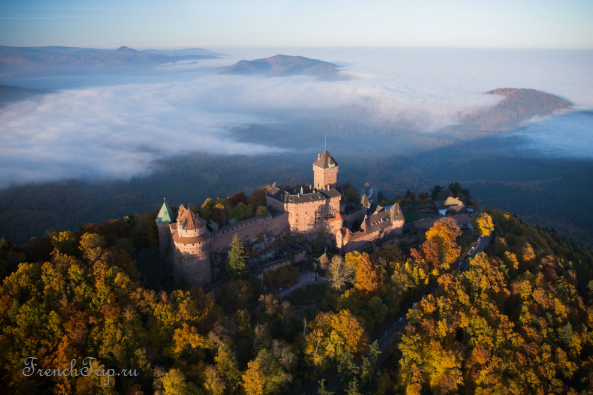
Château du Haut-Kœnigsbourg stands at 757 m on a spur of the Vosges above Sélestat, looking out over the whole Rhine plain. It is the most visited monument in Alsace — around half a million people a year — and it is not quite what it appears.
The castle is medieval. What you walk through is a reconstruction of 1900–1908, and that is the interesting part.
Ruin, then emperor
A castle existed here from the twelfth century, controlling the road between Lorraine and Alsace and the wine and wheat routes below. It was rebuilt as an artillery fortress in the sixteenth century, besieged and burned by the Swedes in 1633 during the Thirty Years’ War, and left a ruin for 250 years.
Before the ruin
The first stronghold here is not precisely dated: a castle called Burg Staufen is recorded in 1147, and by the end of that century it was known as Königsburg, the royal castle. It passed to the Dukes of Lorraine, then to the lords of Hohenstein, who let robber barons use it as a base; a coalition from Colmar, Strasbourg and Basel burned it in 1462. In 1479 the Habsburg emperor Frederick III granted the ruin to the counts of Thierstein, who rebuilt it to withstand artillery; it reverted to the Habsburgs in 1517 and, still an imperial castle, was besieged for 52 days by the Swedes in 1633, then burned and looted — the start of its two and a half centuries as a ruin.
In 1899 the town of Sélestat gave the ruin to Kaiser Wilhelm II — Alsace was German then — and he had it rebuilt. The architect Bodo Ebhardt spent eight years on it, excavating, measuring and reconstructing what he believed the castle looked like around 1500.
Wilhelm wanted Haut-Kœnigsbourg, at the western edge of German Alsace, to answer the similarly restored Marienburg in the east, and hoped the project would bind Alsatians to the new German Empire. It opened on 13 May 1908, the Kaiser present, with a costumed historical procession filing in through pouring rain.
It was a political building as much as a historical one: a German emperor restoring a German castle on newly German soil, and the imperial eagle over the gate said so. Alsace returned to France in 1919 and the castle with it.
What the reconstruction means
Ebhardt worked carefully by the standards of his day, and much of what stands is faithful. But the interiors — panelled halls, painted walls, furniture, the great Kaiser’s hall — are an interpretation, and modern scholarship disagrees with parts of it.
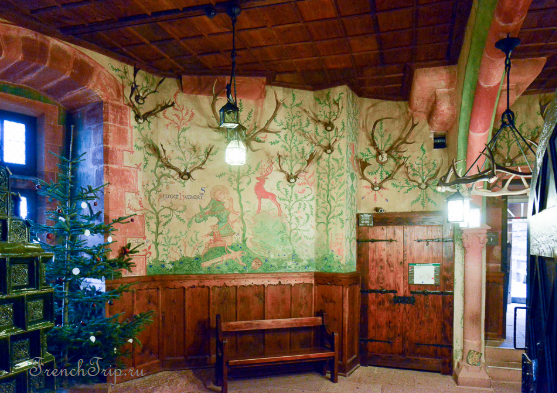
This is worth knowing on the way round, because it changes what you are looking at: not a medieval castle preserved, but a very good 1900s idea of one, itself now over a century old and listed as a historic monument in its own right.
Ebhardt had to guess in places — the keep’s height, now about 14 metres, was essentially his estimate — and Wilhelm pushed for romantic touches such as a taller dining-hall roof than the original and decoration linking the Hohenzollern family to the Habsburg rulers of the Holy Roman Empire. The castle was mocked in France for decades afterwards as a fairy-tale folly in the manner of Neuschwanstein; more recent historians take it seriously instead, as evidence of how Wilhelm II imagined the German past, since Ebhardt worked from surviving walls, archives and comparable fortified castles of the period.
Going round
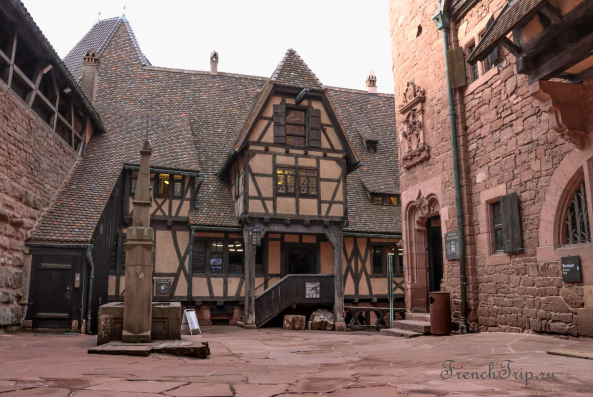
Allow an hour and a half. The route runs through the lower courtyard, the inn, the forge and the mill, then up through the living quarters to the keep and out along the artillery bastion at the western tip.
- The furnished rooms — Ebhardt’s interiors, with the painted Kaiser’s hall as the set piece
- The armoury — weapons and armour collected for the reconstruction
- The great bastion — the sixteenth-century gun platform, with the view over the plain to the Black Forest and, on a clear day, the Alps
- The gardens — a small medieval-style garden on the terrace
Inside
The enclosure follows the rock it stands on, about 270 m long and 40 m wide. From the lower courtyard — with its inn, fountain and forge — a stair climbs past a drawbridge to the inner courtyard, where a hexagonal staircase rebuilt in the early twentieth century leads up to the living quarters. The north wing is lined in wood panelling used since the fifteenth century for insulation; the south wing, the Thierstein family’s own fifteenth-century quarters, now holds a trophy room of late-medieval edged weapons and armour.
The garden below the ramparts is a modern addition, planted in 2001 on the assumption that the castle would have had one in the Middle Ages: square beds fenced with woven wattle, holding roses, vegetables and medicinal herbs.
Practical
- Book online. Timed entry operates in high season and the queue at the door can be long.
- It is exposed and 757 m up. Windy and cold on the bastion even in summer; bring a layer.
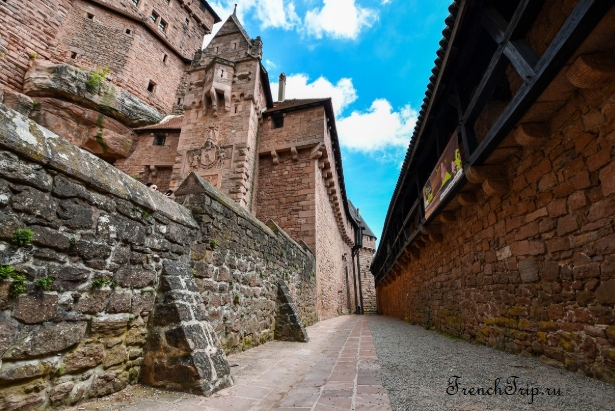
- Stone stairs and cobbles throughout, with limited accessibility.
- Arrive early or late. Coaches fill the middle of the day, particularly in July, August and December.
Getting there
- By car — 15 km from Sélestat by a winding road, with paid parking below the castle. See parking in France.
- From further out — Colmar is about 26 km south and Strasbourg about 55 km north, via the A35.
- By shuttle — a seasonal bus runs from Sélestat station, which makes the castle reachable without a car; check the dates, it does not run all year.
- On foot — marked paths climb from Kintzheim and Orschwiller, about an hour and a half and a serious ascent.
Around
- Montagne des Singes and Volerie des Aigles — a Barbary macaque park and a birds-of-prey centre, both a few minutes away and both good with children
- Sélestat — 15 km, with the Humanist Library
- Riquewihr, Hunawihr and Ribeauvillé — the wine villages 20 minutes south
- The wine route — the castle is visible from most of it
When to go
May, June, September and October. The castle in autumn, with the forest turning below it, is the picture everyone takes. Winter can be spectacular — snow and mist below the walls — but the road up is occasionally closed. Avoid the middle of a summer day.
See Alsace.
Weather in Haut-Koenigsbourg
| Month | Day | Night | Rainfall |
|---|---|---|---|
| January | +3° | -3° | 89 mm |
| February | +5° | -2° | 77 mm |
| March | +9° | 0° | 76 mm |
| April | +14° | +4° | 66 mm |
| May | +17° | +7° | 91 mm |
| June | +21° | +11° | 83 mm |
| July | +23° | +13° | 83 mm |
| August | +23° | +12° | 82 mm |
| September | +19° | +9° | 72 mm |
| October | +14° | +6° | 92 mm |
| November | +8° | +1° | 86 mm |
| December | +5° | -2° | 98 mm |
Updated: