Vichy
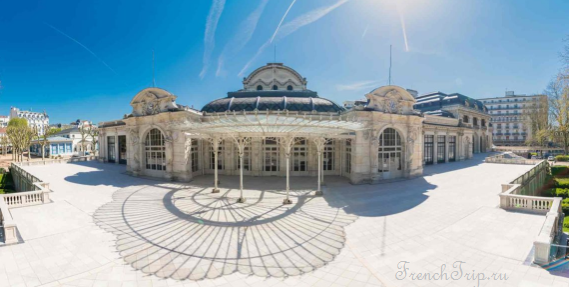
Vichy is a spa town in the Auvergne, in the middle of France, and it carries two entirely separate reputations: the most fashionable thermal resort in Europe for a century, and the seat of the collaborationist government of 1940–44. Both are here, and the second is not hidden.
Since 2021 it has been UNESCO-listed as one of the Great Spa Towns of Europe, alongside Baden-Baden, Bath and Karlovy Vary.
Vichy stands on the right bank of the Allier, some 40 km from Clermont-Ferrand. The springs’ therapeutic reputation goes back to the Gallo-Roman period, and long before Napoleon III they had already drawn visitors such as Madame de Sévigné.
The spa
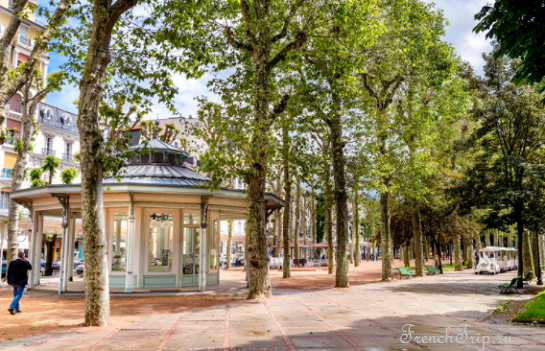
The springs were known to the Romans, but the town as you see it was made by Napoleon III, who took the waters here between 1861 and 1866. His stays triggered a building boom: the parks along the Allier, the chalets he had built for himself, the covered galleries, and the railway station that brought everyone else.
Vichy’s building stock falls into four broad periods: an older core that predates 1861, the Second Empire redevelopment from 1861 to 1870, the Belle Époque expansion that followed up to about 1930, and building from the interwar and postwar 20th century.
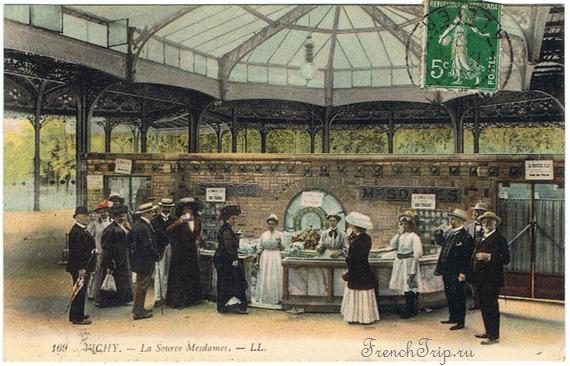
The peak came in the 1930s, when Vichy was one of the grand resorts of Europe. What survives from that world:
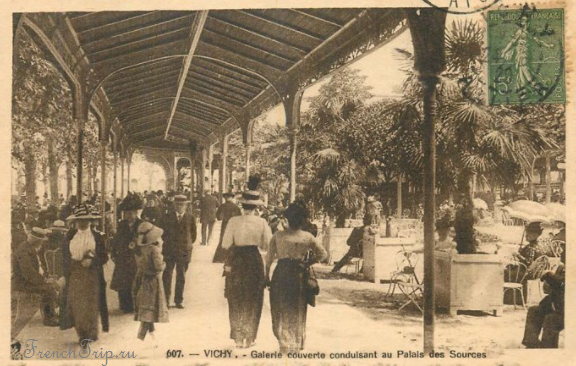
- Parc des Sources — the central park with its cast-iron covered gallery running the length of it, built for taking the waters in the rain
- Hall des Sources — where the springs are still drawn. They come out at very different temperatures, taste strongly of minerals, and are drunk rather than bathed in.
- Six springs — the Hall des Sources draws on six different thermal waters
- Pavillon des Célestins — the pavilion over the Célestins spring, Vichy’s best-known thermal water
- Thermes des Dômes — the Neo-Moorish spa building, historically used to treat digestive disorders
- Vichy Spa — a large thermal spa complex with a pool, Turkish bath, saunas and cosmetic treatments, said to be among the largest of its kind in Europe
- Opéra de Vichy — a 1901 Art Nouveau auditorium in gold and cream inside the Palais des Congrès, and one of the finest of its date in France
- The chalets of Napoleon III along the Boulevard des États-Unis
- Église Saint-Blaise — with a startling Art Deco interior of 1931 and a Black Madonna
- The old Church of Saint-Blaise — adjoining the new one, it holds a venerated statue known as Our Lady of the Sick, a Black Madonna dated to the 14th century
- Centre culturel Valery Larbaud — an Art Deco cultural centre
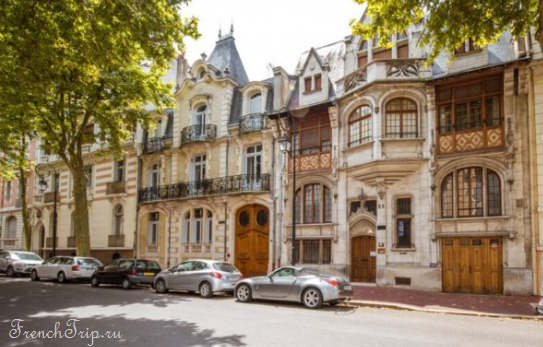
- The Belle Époque villas, scattered through the streets in every style anyone could think of — Moorish, Gothic, Swiss chalet, Art Nouveau
1940–1944
After the armistice of 22 June 1940 France was divided into occupied and unoccupied zones, and the French state moved its government to Vichy — chosen because a small spa town had more hotel rooms than anywhere else of its size. From 11 July 1940 it was the seat of government for four years, and the word “Vichy” entered the language.
The buildings are still standing and still in use — the Hôtel du Parc, where Pétain had his office, is now flats. The town spent decades saying nothing about it and now marks it: a signed historical trail runs past the sites with explanatory panels, and it is the honest way to visit. The town’s museum covers the period.
The town today
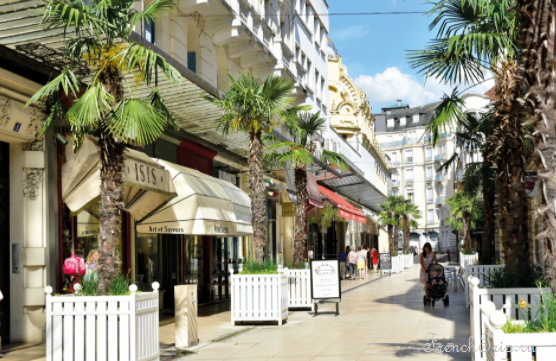
About 25,000 people, thermal establishments still operating, a great deal of sport — Vichy has a national training centre and hosts a long-course triathlon — and the parks along the Allier, which is dammed to form a lake used for rowing and sailing right beside the centre.
The lake covers some 100 hectares and is also used for canoeing, water-skiing and fishing, with pedalos, minigolf and children’s play areas along the banks. The resort’s calendar includes horse racing too.
Two other things carry the name. Vichy Cosmetics, founded in 1931, is built on the thermal water and sold in pharmacies worldwide. And the checked cotton vichy print — gingham — became a phenomenon after Brigitte Bardot married in a pink checked dress in 1959 rather than white, setting off a decade of it.
The other export is pastilles de Vichy, octagonal mint sweets pressed from the spring salts, sold everywhere in tins.
As a resort and tourist town, many shops in Vichy open on Sundays, unusual in France.
Getting to Vichy
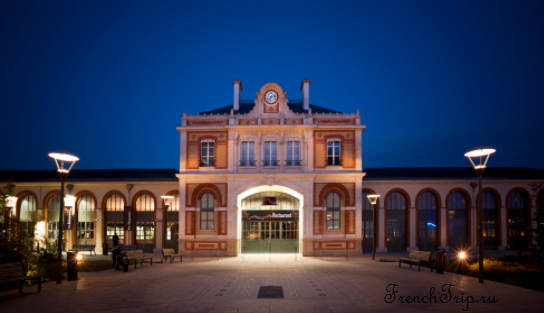
- By train — direct services from Paris Bercy in about 3 hours, and from Clermont-Ferrand in 30 minutes. The station of 1862 is itself part of the Napoleon III building programme and a short walk from the parks.
- By car — the A71, about 3 h 30 from Paris and an hour from Lyon. See parking in France.
- By air — Clermont-Ferrand, or Lyon for a wider choice of flights.
The town is flat and compact; everything above is within twenty minutes’ walk.
What to eat
Auvergnat cooking, which is mountain food: aligot — potato beaten with fresh tomme until it ropes — truffade, potée auvergnate, and green lentils from Le Puy. The region has five AOC cheeses: Cantal, Saint-Nectaire, Bleu d’Auvergne, Fourme d’Ambert and Salers. Saint-Pourçain, one of the oldest vineyards in France, is 30 km north.
See French cheeses.
Vichy specialities
A handful of dishes and products carry the town’s name:
- Carottes Vichy — a local recipe in which carrots are cooked in Vichy water, said to make them more digestible and to improve their colour, flavour and aroma without added salt
- Vichyssoise — a cold potato-and-leek velouté, traditionally made with Vichy Célestins water
- Comtesse de Vichy — a soft, rinded cheese made from raw whole cow’s milk, similar in taste to Coulommiers
Around Vichy
- Clermont-Ferrand — 30 minutes, with its black lava cathedral
- Cusset — immediately next to Vichy, across the boulevard that marks the town boundary, with medieval remains in its old centre
- Chaîne des Puys — the chain of extinct volcanoes west of Clermont, UNESCO-listed, with a rack railway up the Puy de Dôme
- Saint-Pourçain — the vineyards north
- Saint-Yorre — a small town of some 2,600 people, known for its mineral water rich in bicarbonates
- Charroux — one of the most beautiful villages in France, half an hour west
- Montagne bourbonnaise — hills behind Cusset with a panoramic view back over the town
- Lapalisse — over 20 km northeast, on the old route of the N7, with a château
- Lyon — an hour and a half east
Clermont-Ferrand, the historic capital of the Auvergne, also has a Romanesque basilica, Notre-Dame-du-Port, separately UNESCO-listed and on the pilgrim route to Santiago de Compostela, along with the medieval quarter of Montferrand and a Michelin museum.
When to go
May to September. The parks and the lake are the point in summer, and the opera season runs through it. The spa establishments work most of the year. Winter in the Auvergne is cold and the town is quiet.
See Auvergne-Rhône-Alpes and UNESCO sites in France.
Weather in Vichy
| Month | Day | Night | Rainfall |
|---|---|---|---|
| January | +8° | +2° | 53 mm |
| February | +9° | +1° | 43 mm |
| March | +14° | +4° | 45 mm |
| April | +17° | +6° | 68 mm |
| May | +21° | +10° | 84 mm |
| June | +25° | +14° | 76 mm |
| July | +28° | +15° | 73 mm |
| August | +28° | +15° | 84 mm |
| September | +23° | +12° | 70 mm |
| October | +18° | +9° | 76 mm |
| November | +12° | +5° | 74 mm |
| December | +8° | +2° | 55 mm |
Updated: