Cuisine of Bretagne
Brittany has 1,700 kilometres of coastline on one side and farmland on the other, and its cooking comes straight out of that geography: buckwheat galettes, cider, oysters, salted butter and caramel. Almost everything on the list is cheap, everyday food that the region happens to do better than anywhere else.
Galettes and crepes
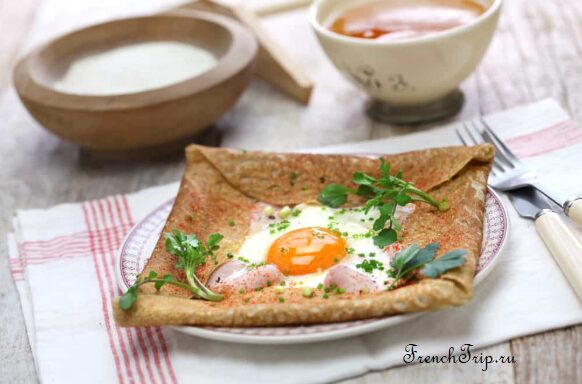
Galettes de sarrasin are thin pancakes of buckwheat flour — blé noir, black wheat, in the local name — and they are always savoury. The classic is the galette complète: cheese, ham and an egg, 5.5 to 6.5€ in most crperies. Another Breton favourite is the one filled with andouille, the smoked tripe sausage. You can usually build your own from ham, bacon, cheese, egg, mushrooms and fried onion, or take one of the house combinations — sheep cheese, roquefort, Hawaiian, Provençal. The galette saucisse is a pork sausage rolled into a galette and eaten in the hand.
Sweet crepes are made with wheat flour and come with sugar, butter, chocolate spread, jam or the local salted caramel. Most creperies offer a set menu of one savoury galette, one sweet crepe and a cup of cider: 9.5–15€ depending on how touristy the place is, and around 10€ as a rule. Supermarkets sell packs of ready-made galettes and crepes for about 2.5€ for five — fry them in butter at home, but carry them carefully, because buckwheat galettes break easily.
The dough itself is nothing more than 330 g of buckwheat flour, 10 g of salt and 750 ml of cold water for five people. More on the difference between the two in French pancakes: crepes and galettes.
Salted butter, and what follows from it
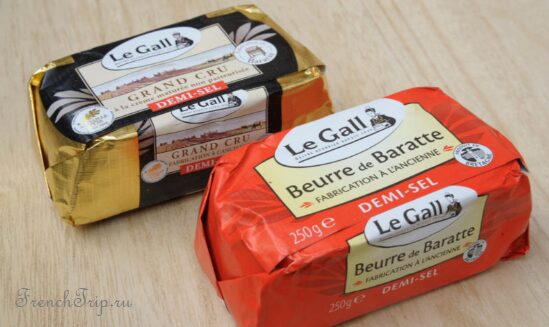
Brittany salts its butter, which is unusual in France and explains a good deal of the local repertoire. Beurre de baratte, churned butter with visible salt crystals, goes on bread, into galettes, into caramel and into the cakes below. Salt comes from the marshes of the south coast, Guérande above all.
What comes out of the sea
Brittany is the main supplier of seafood in France, and the ports specialise. Brest, Audierne and Concarneau land large fish — monkfish, sea bass, cod. Loctudy is the centre for mackerel and langoustines, Audierne for lobster, Erquy and Loguivy-de-la-Mer for scallops, and the bay of Saint-Brieuc is scallop country too. Quiberon, Douarnenez and Concarneau keep the sardine and tuna canneries going.
Mussels. Moules de bouchot, grown on posts driven into the seabed, come from the Vilaine delta near Dinard and the bay of Cancale. In summer every restaurant has them — marinière, with bacon, or as a creamy mouclade. See French mussels.
Oysters. Brittany distinguishes twelve grands crus of oyster, each with its own shade of taste. The flat belon is farmed at Riec-sur-Belon in the south and at Cancale in the north; the more common cupped oyster comes from Cancale, the bay of Quiberon and the Gulf of Morbihan. The oysters of Cancale were recognised in 2019 as part of France’s intangible cultural heritage. Here you can eat them all year round, including the months without an R in the name, when they are milkier. More in French oysters.
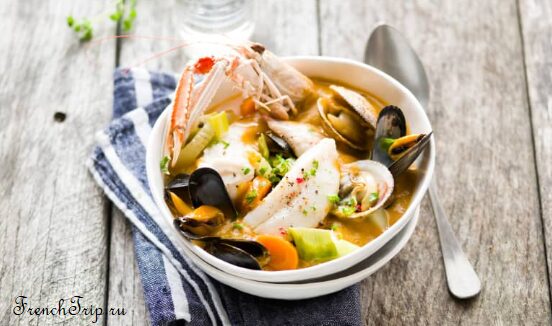
Fish soup. Whether it is called cotriade or godaille, it has nothing to envy bouillabaisse: the catch of the day cooked in a seasoned wine broth. There are as many versions as there are families. See also French soups.
The rest of the catch. A fish auction in Brittany is worth attending for the crabs alone — tourteaux, spider crabs, slipper lobsters — along with prawns and lobster. If you find ormeau, the abalone, at a market, take it: fishing for it is banned from 15 June to 31 August, which is what saved the species, and the price shows it. Lobster à l’armoricaine in a spiced tomato and onion sauce, lobster bisque, stuffed clams and stuffed crab are all standard.
Meat, inland
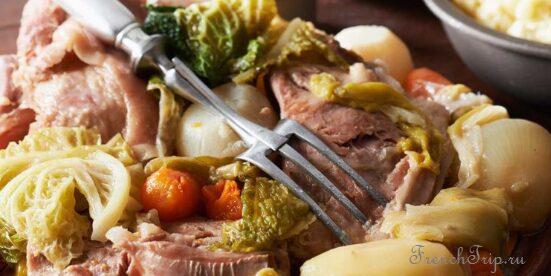
Away from the coast this is farming country — every third chicken in France and 58 per cent of its pigs are raised in Brittany — and pork dominates the table. Andouille de Guémené-sur-Scorff is the famous one: smoked, soft, not too fat. The andouille de Baye in southern Finistère is just as good and is served with bacon. Village butchers everywhere sell their own de campagne version, close to the andouille de Vire in Normandy, traditionally eaten at breakfast on toast with salted butter. Prefer the artisan ones: this is not a sausage that survives industrial production.
Then there is pâté breton, coarse and porky; boudin noir, the blood sausage; kig ha farz, a pork and vegetable stew with buckwheat dumplings; and gigot à la bretonne, leg of lamb with white beans, tomato and garlic.
Vegetables and cheese
The coastal belt grows cauliflower, artichokes, shallots and broccoli in quantity, and the petit gris de Rennes melon is a local speciality worth looking for in summer. Brittany is not a great cheese region by French standards, but it makes the fresh curé nantais and a handful of farm cheeses; the rest of the country’s output is covered in French cheeses.
Sweets
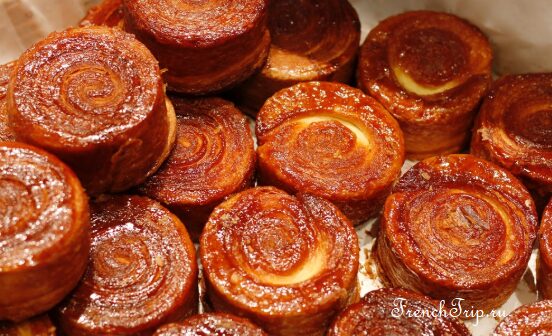
Kouign-amann is the one to try: a heavy, buttery cake of folded dough with a caramelised crust, not very sweet and extremely filling. Bakeries sell it as a 20 cm cake for 7–8€; in a souvenir shop expect up to 13€. Small single-portion versions exist too.
Far aux pruneaux is a dense, rubbery prune pudding, somewhere between a flan and a baked cheesecake.
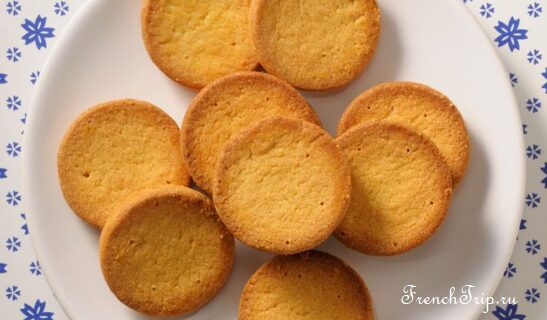
Sablé breton, the salted-butter shortbread, comes in decorated tins that make the obvious souvenir. Prices vary more than you would think: around 5.95€ a tin in a Quimper supermarket, 6.95€ in a Tréguier gift shop (with a fourth tin free), 7.5€ in most places, 7.95€ in airport duty free.
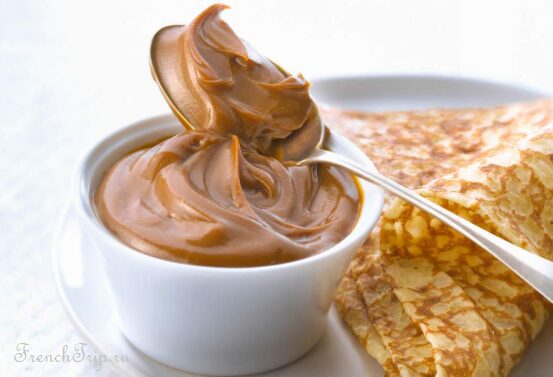
Caramel au beurre salé is arguably the regional dessert: caramel made with the local salted butter, eaten with crepes and biscuits or as toffees. Recipes differ from maker to maker, and some shops let you taste two or three pastes side by side before choosing.
What to drink
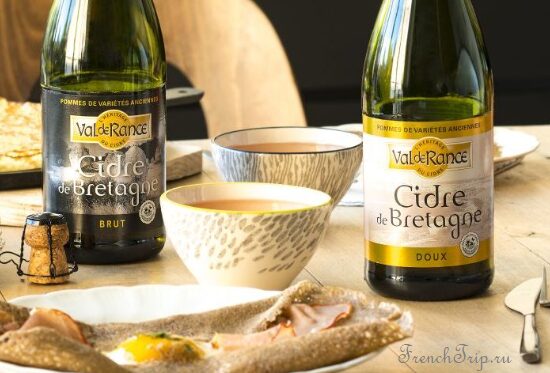
Cider is the everyday drink, about 4.5% alcohol, and it is what you order with galettes. Every area has its blend; the best-known appellations are the cidre de Cornouaille (AOC since 1996) and the pays de Fouesnant, with the valley of the Rance close behind. It comes doux (slightly sweet), brut, rosé and blanc: the rosé is the most delicate, the doux the most farmyard. Apple varieties are local too — Guillevic around Vannes, Rouget at Dol, Petit Jaune at Châteaubriant, Kermerrien in Cornouaille. A 0.75 l bottle costs 2–6€ in a shop and 8–16€ in a restaurant; a cup in a creperie is about 2.5€.
Beyond cider: chouchen, the Breton mead; local beers, which have multiplied in the last twenty years; a very small amount of wine around Nantes; Breizh Cola, the regional cola that outsells the global brands in some shops; and lait ribot, the buttermilk traditionally drunk with galettes.
For the region itself, see Bretagne; for the rest of the country’s regional cooking, French cuisine.
Updated: