Dijon
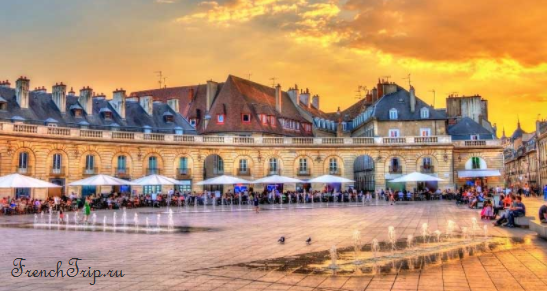
Dijon was the capital of the Dukes of Burgundy, who in the fourteenth and fifteenth centuries were richer than the kings of France and ruled from here to Flanders. The city they built came through the Revolution and both wars nearly intact, which is why the centre is a continuous run of half-timbered houses, ducal palaces and merchants’ mansions with almost nothing modern in it.
It is also the head of the Burgundy wine road, and the mustard is a side issue that got famous.
What to see
Palais des Ducs
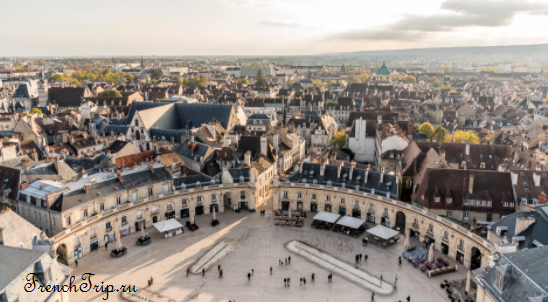
The ducal palace on the great curved Place de la Libération, itself laid out by Hardouin-Mansart in the 1680s. The palace holds the town hall and the Musée des Beaux-Arts — one of the oldest museums in France, free, and holding the extraordinary carved and gilded tombs of the dukes, which alone justify the visit.
Climb the Tour Philippe le Bon for the view: on a clear day you can see the Mont Blanc massif.
The old streets
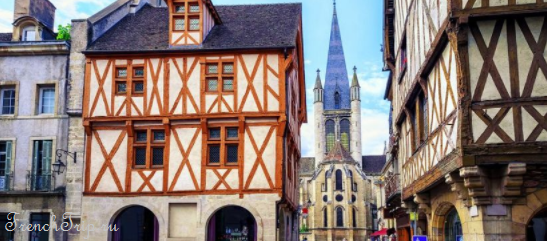
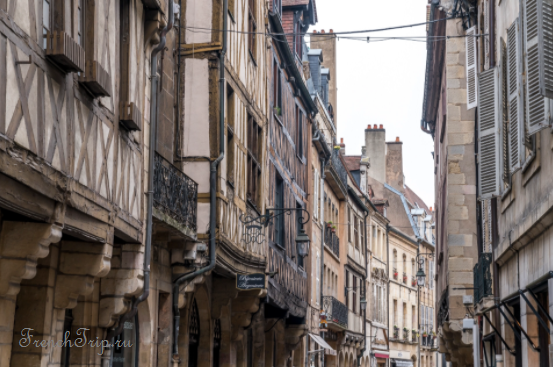
- Rue des Forges — the grandest street, with the Hôtel Chambellan and its spiral staircase
- Rue de la Verrerie — the leaning timber-framed row, and the antique-dealers’ street
- Église Notre-Dame — thirteenth-century, with a facade of false gargoyles and the Jacquemart, a mechanical clock family that has been striking the hours since 1383. On the outside wall is the chouette, a small worn stone owl; the tradition is to stroke it with your left hand and make a wish, and several centuries of hands have nearly rubbed it away.
- Cathédrale Saint-Bénigne — with an unusual circular Romanesque crypt
- Les Halles — the covered market, in an iron structure associated with Eiffel, working Tuesday, Thursday, Friday and Saturday mornings
The owl trail
A line of bronze owl plaques set into the pavement marks a 22-stop walking route through the historic centre. Follow it and you will not miss anything; the tourist office sells the booklet. It is the most painless way to see the city.
Mustard
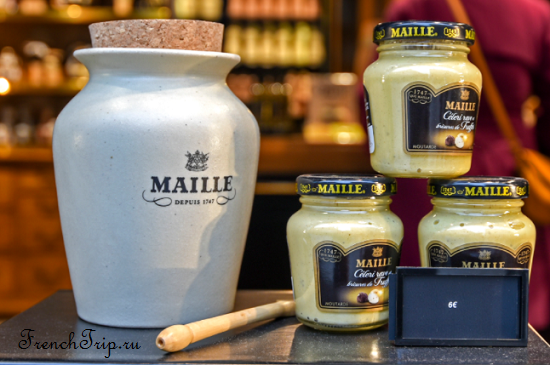
Worth knowing before you shop: “Dijon mustard” is a recipe, not a protected origin. It can legally be made anywhere, and most of it is — for decades most of the seed came from Canada rather than Burgundy. What is protected is Moutarde de Bourgogne IGP, made with Burgundian seed and white wine, and there has been a real revival of local seed growing.
The historic shops in the centre sell it loose from stoneware jars, in variants with blackcurrant, tarragon, honey or gingerbread. It is the best souvenir the city has.
What to eat
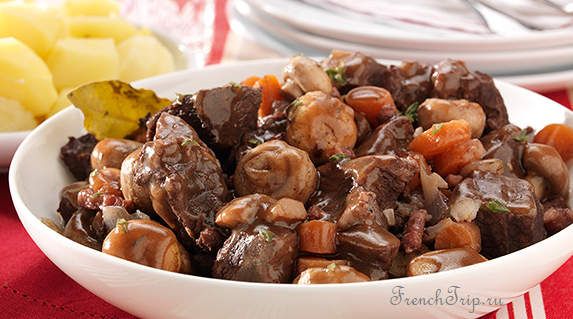
Burgundy is one of the two or three serious eating regions of France:
- Bœuf bourguignon — beef stewed for hours in red wine with bacon, onions and mushrooms
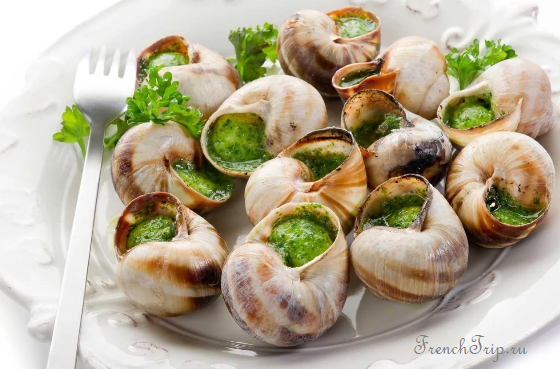
- Escargots de Bourgogne — snails with garlic and parsley butter
- Coq au vin, œufs en meurette — eggs poached in red wine sauce — and jambon persillé
- Gougères — cheese choux puffs, served with a glass before dinner
- Pain d’épices — spiced honey bread, a Dijon speciality since the Middle Ages
- Crème de cassis — blackcurrant liqueur, invented here in 1841; with white wine it makes a kir, named after a mayor of Dijon
- Époisses — the local cheese, washed in marc, and pungent enough that its reputation precedes it onto any train
The Cité Internationale de la Gastronomie et du Vin, opened in 2022 in the old hospital, gathers the whole subject in one place — and the French gastronomic meal, of which Dijon considers itself a capital, is on the UNESCO intangible heritage list.
See French cheeses and French wines.
The wine road
The Route des Grands Crus starts at the southern edge of Dijon and runs 60 km to Santenay through the most valuable agricultural land in the world: Gevrey-Chambertin, Vougeot, Vosne-Romanée, Nuits-Saint-Georges, Beaune, Pommard, Meursault. The climats — the individually named parcels, some of them a few rows of vines — are UNESCO-listed.
Beaune, 40 minutes south, is the wine capital proper, with the Hospices and their glazed tile roof. Do this by bicycle or with a driver; the villages are 2 km apart and the tastings add up.
See wine routes in France and the 50 most renowned French wines.
Getting to Dijon
- By train — TGV from Paris in about 1 h 35, and direct services from Lyon, Strasbourg and Marseille. The station is a ten-minute walk from the centre.
- By car — the A6 and A31. The centre is largely pedestrian; use the underground car parks. See parking in France.
- By air — Lyon or Geneva; Dijon’s own airport has almost no scheduled traffic.
The historic centre is compact and flat, with two tram lines. A day covers the city; a second gets you into the vineyards.
Around Dijon
- Beaune — 40 minutes, the Hospices and the wine auction in November
- The Route des Grands Crus — starting at the city limit
- Fontenay Abbey — a Cistercian abbey of 1118, UNESCO-listed, an hour north-west
- Vézelay — the Romanesque basilica on its hill, one of the great churches of France
- Besançon — Vauban’s citadel, an hour and a half east
When to go
May to October. September and early October are the harvest, and the whole region is working. Early November brings the Hospices de Beaune wine auction and the Trois Glorieuses; late November has the international gastronomy fair. Winter is cold and continental, and the Christmas market is a good one.
See Burgundy and UNESCO sites in France.
Where to park in Dijon
| Car park | Spaces | Fee | From centre |
|---|---|---|---|
| DiviaPark Dauphine underground | 308 | paid | 270 m |
| Petit Potet | 33 | paid | 310 m |
| DiviaPark Grangier underground | 354 | paid | 360 m |
| DiviaPark Sainte-Anne underground | 468 | paid | 420 m |
| DiviaPark Trémouille-Marché underground | 448 | paid | 470 m |
| Parvis Saint-Philibert | — | paid | 540 m |
| DiviaPark Darcy-Liberté underground | 505 | paid | 580 m |
| DiviaPark Condorcet multi-storey | 383 | paid | 710 m |
Weather in Dijon
| Month | Day | Night | Rainfall |
|---|---|---|---|
| January | +6° | 0° | 60 mm |
| February | +8° | 0° | 50 mm |
| March | +13° | +3° | 55 mm |
| April | +17° | +5° | 60 mm |
| May | +21° | +9° | 73 mm |
| June | +25° | +13° | 64 mm |
| July | +27° | +15° | 68 mm |
| August | +27° | +14° | 58 mm |
| September | +22° | +11° | 57 mm |
| October | +17° | +8° | 81 mm |
| November | +10° | +3° | 77 mm |
| December | +6° | +1° | 69 mm |
This page in Russian: Dijon (Дижон)
Updated: